 Add to Chrome
 Add to Firefox
 Add to Edge
An Agentic AI Pipeline for Appliance-Level Energy Anomaly Detection and LLM-Driven Recommendations
Jun 26, 2026
Appliance-level energy monitoring in office buildings produces noisy alerts that non-expert facility managers struggle to use. This paper proposes an end-to-end agentic pipeline that combines deep time-series forecasting, variational anomaly detection, and LLM-based reasoning to generate prioritized, actionable maintenance recommendations. The system tracks seven office appliances using a hybrid Singular Spectrum Analysis (SSA) and Long Short-Term Memory (LSTM) forecasting model, and applies a per-appliance LSTM Variational Autoencoder (VAE) with attention to flag abnormal daily consumption episodes. A three-stage LangChain pipeline begins with a Context Agent that always retrieves three core RAG sources (model reliability, hourly baseline, and expert knowledge) and conditionally adds up to three more (forecast context, anomaly history, global baseline) based on event characteristics, capped at eight reasoning steps. A Diagnosis Agent converts the evidence into a structured JSON diagnosis, and a Report Agent renders a human-readable narrative. A reflective memory layer incorporates operator feedback. The dashboard shows real-time 30-minute forecasts, intraday consumption, the previous day anomaly report, and a feedback form. We evaluate the forecasting model, anomaly detector with appliance-specific thresholds, and LLM reasoning on a 16-scenario benchmark including sustained and transient spikes, unexpected shutdowns, and systemic events, comparing five LLM backends under static vs. dynamic retrieval. Dynamic retrieval matches full static retrieval across all backends while cutting average context from six to three-six sources per event. The best backend scores 90.4/100 with a 100% pass rate at a 70-point threshold, and a fully local 7B-parameter model passes all 16 scenarios.

Extracting Actionable Insights from Building Energy Data using Vision LLMs on Wavelet and 3D Recurrence Representations
Sep 26, 2025The analysis of complex building time-series for actionable insights and recommendations remains challenging due to the nonlinear and multi-scale characteristics of energy data. To address this, we propose a framework that fine-tunes visual language large models (VLLMs) on 3D graphical representations of the data. The approach converts 1D time-series into 3D representations using continuous wavelet transforms (CWTs) and recurrence plots (RPs), which capture temporal dynamics and localize frequency anomalies. These 3D encodings enable VLLMs to visually interpret energy-consumption patterns, detect anomalies, and provide recommendations for energy efficiency. We demonstrate the framework on real-world building-energy datasets, where fine-tuned VLLMs successfully monitor building states, identify recurring anomalies, and generate optimization recommendations. Quantitatively, the Idefics-7B VLLM achieves validation losses of 0.0952 with CWTs and 0.1064 with RPs on the University of Sharjah energy dataset, outperforming direct fine-tuning on raw time-series data (0.1176) for anomaly detection. This work bridges time-series analysis and visualization, providing a scalable and interpretable framework for energy analytics.
Unveiling the Invisible: Enhanced Detection and Analysis of Deteriorated Areas in Solar PV Modules Using Unsupervised Sensing Algorithms and 3D Augmented Reality
Jul 12, 2023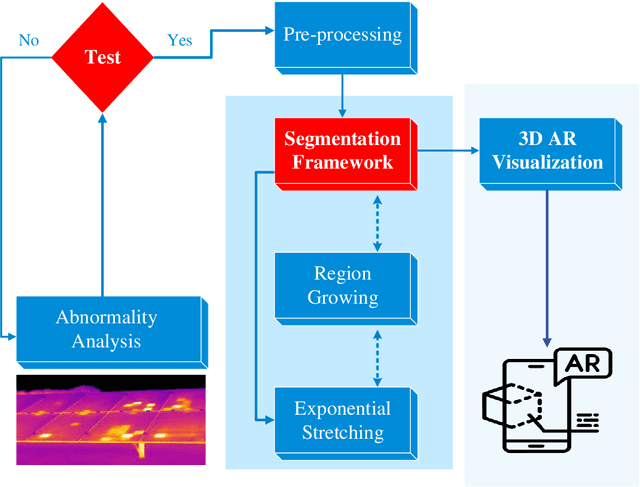
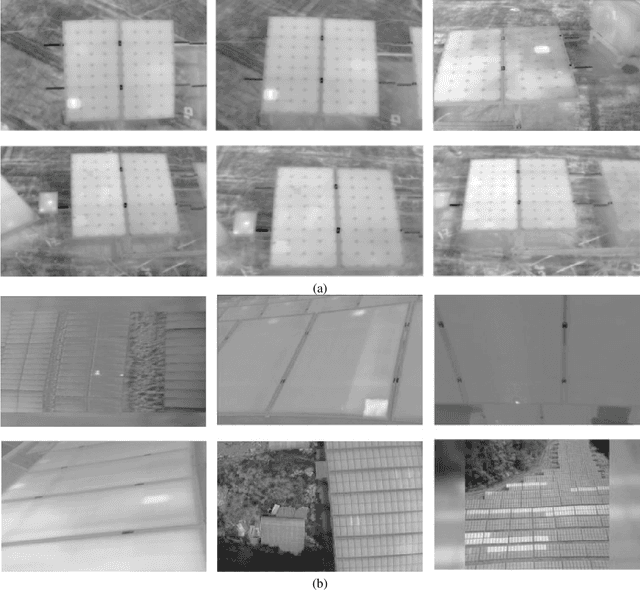
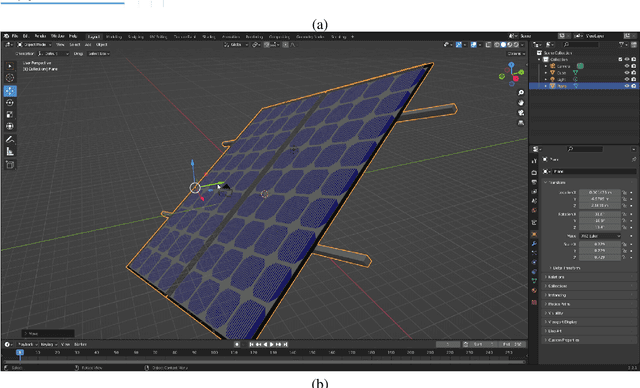
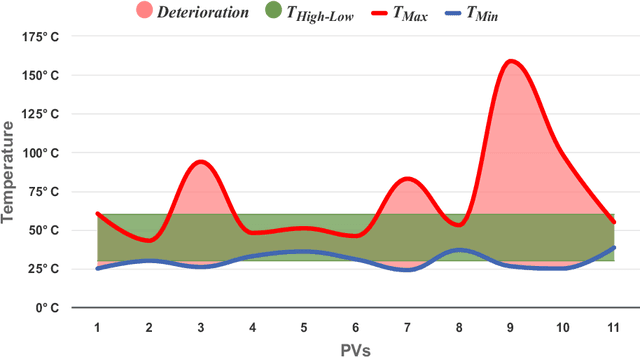
Solar Photovoltaic (PV) is increasingly being used to address the global concern of energy security. However, hot spot and snail trails in PV modules caused mostly by crakes reduce their efficiency and power capacity. This article presents a groundbreaking methodology for automatically identifying and analyzing anomalies like hot spots and snail trails in Solar Photovoltaic (PV) modules, leveraging unsupervised sensing algorithms and 3D Augmented Reality (AR) visualization. By transforming the traditional methods of diagnosis and repair, our approach not only enhances efficiency but also substantially cuts down the cost of PV system maintenance. Validated through computer simulations and real-world image datasets, the proposed framework accurately identifies dirty regions, emphasizing the critical role of regular maintenance in optimizing the power capacity of solar PV modules. Our immediate objective is to leverage drone technology for real-time, automatic solar panel detection, significantly boosting the efficacy of PV maintenance. The proposed methodology could revolutionize solar PV maintenance, enabling swift, precise anomaly detection without human intervention. This could result in significant cost savings, heightened energy production, and improved overall performance of solar PV systems. Moreover, the novel combination of unsupervised sensing algorithms with 3D AR visualization heralds new opportunities for further research and development in solar PV maintenance.