 Add to Chrome
 Add to Firefox
 Add to Edge
The Value of Covariance Matching in Gaussian DDPMs and the Lanczos Sampler
May 21, 2026
A central error measure in Gaussian DDPMs is the path-space KL divergence between the exact reverse chain and the learned Gaussian reverse process. This quantity is especially relevant for procedures such as classifier guidance, which perturb the entire reverse trajectory rather than only the terminal sample. Prior analyses show that standard isotropic reverse covariances suffer an unavoidable $Ω(1/T)$ path-KL error as the number of denoising steps $T$ grows. We show that matching the full posterior covariance breaks this barrier, yielding an order-wise improvement that reduces the path KL to $O(1/T^2)$. To make full covariance matching practical, we introduce the Lanczos Gaussian sampler (LGS), a training-free, matrix-free method for sampling from the optimal reverse covariance using only covariance-vector products, which are available through Jacobian-vector products of the posterior mean. LGS avoids dense covariance storage and auxiliary covariance models. We prove that LGS approximation error decays exponentially in the number of Lanczos steps, where each Lanczos step requires a single Jacobian-vector product. Empirically, using only just three such steps improves sample quality over strong diagonal-covariance baselines, including OCM-DDPM, across standard image benchmarks. This identifies full covariance matching as both theoretically valuable and practically accessible for fast DDPM sampling.

Self-Normalized Resets for Plasticity in Continual Learning
Oct 26, 2024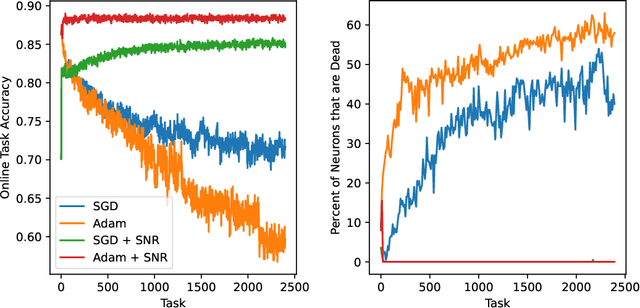
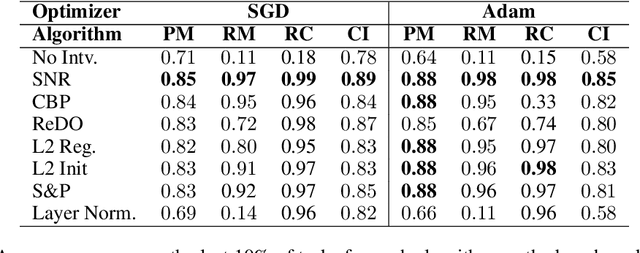
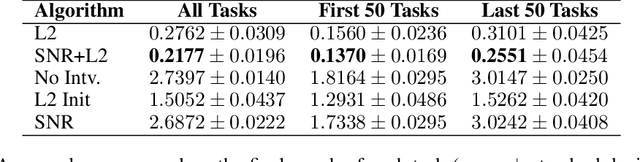
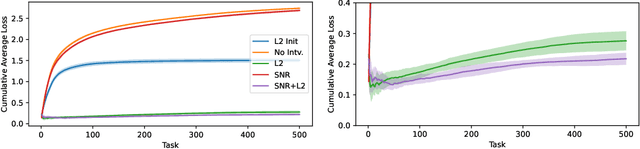
Plasticity Loss is an increasingly important phenomenon that refers to the empirical observation that as a neural network is continually trained on a sequence of changing tasks, its ability to adapt to a new task diminishes over time. We introduce Self-Normalized Resets (SNR), a simple adaptive algorithm that mitigates plasticity loss by resetting a neuron's weights when evidence suggests its firing rate has effectively dropped to zero. Across a battery of continual learning problems and network architectures, we demonstrate that SNR consistently attains superior performance compared to its competitor algorithms. We also demonstrate that SNR is robust to its sole hyperparameter, its rejection percentile threshold, while competitor algorithms show significant sensitivity. SNR's threshold-based reset mechanism is motivated by a simple hypothesis test that we derive. Seen through the lens of this hypothesis test, competing reset proposals yield suboptimal error rates in correctly detecting inactive neurons, potentially explaining our experimental observations. We also conduct a theoretical investigation of the optimization landscape for the problem of learning a single ReLU. We show that even when initialized adversarially, an idealized version of SNR learns the target ReLU, while regularization-based approaches can fail to learn.