 Add to Chrome
 Add to Firefox
 Add to Edge
GraphRAG for Engineering Diagrams: ChatP&ID Enables LLM Interaction with P&IDs
Mar 23, 2026
Large Language Models (LLMs) combined with Retrieval-Augmented Generation (RAG) and knowledge graphs offer new opportunities for interacting with engineering diagrams such as Piping and Instrumentation Diagrams (P&IDs). However, directly processing raw images or smart P&ID files with LLMs is often costly, inefficient, and prone to hallucinations. This work introduces ChatP&ID, an agentic framework that enables grounded and cost-effective natural-language interaction with P&IDs using Graph Retrieval-Augmented Generation (GraphRAG), a paradigm we refer to as GraphRAG for engineering diagrams. Smart P&IDs encoded in the DEXPI standard are transformed into structured knowledge graphs, which serve as the basis for graph-based retrieval and reasoning by LLM agents. This approach enables reliable querying of engineering diagrams while significantly reducing computational cost. Benchmarking across commercial LLM APIs (OpenAI, Anthropic) demonstrates that graph-based representations improve accuracy by 18% over raw image inputs and reduce token costs by 85% compared to directly ingesting smart P&ID files. While small open-source models still struggle to interpret knowledge graph formats and structured engineering data, integrating them with VectorRAG and PathRAG improves response accuracy by up to 40%. Notably, GPT-5-mini combined with ContextRAG achieves 91% accuracy at a cost of only $0.004 per task. The resulting ChatP&ID interface enables intuitive natural-language interaction with complex engineering diagrams and lays the groundwork for AI-assisted process engineering tasks such as Hazard and Operability Studies (HAZOP) and multi-agent analysis.

Talking like Piping and Instrumentation Diagrams (P&IDs)
Feb 26, 2025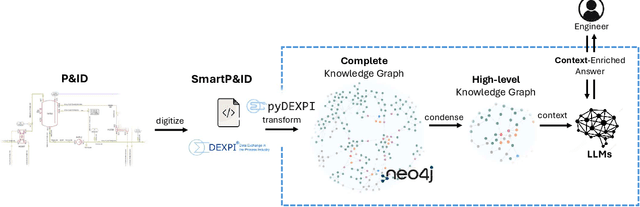
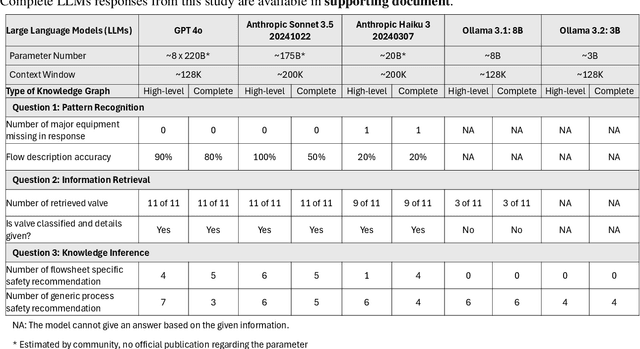
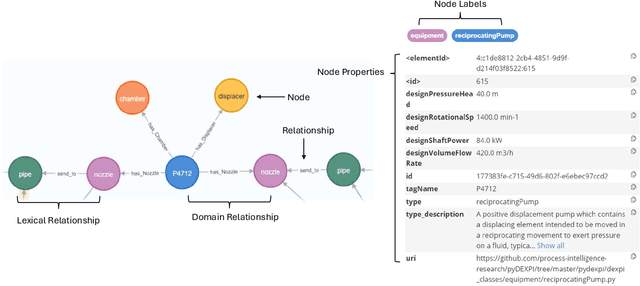
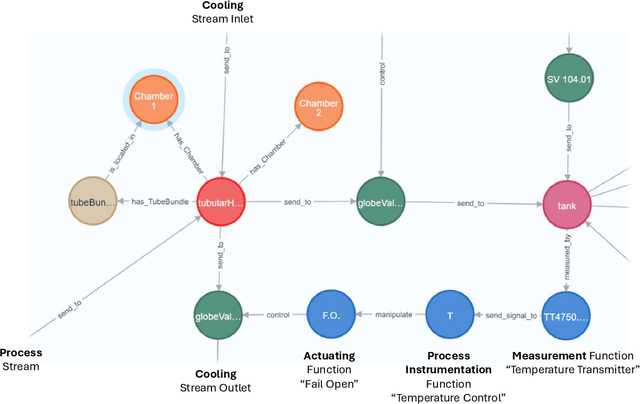
We propose a methodology that allows communication with Piping and Instrumentation Diagrams (P&IDs) using natural language. In particular, we represent P&IDs through the DEXPI data model as labeled property graphs and integrate them with Large Language Models (LLMs). The approach consists of three main parts: 1) P&IDs are cast into a graph representation from the DEXPI format using our pyDEXPI Python package. 2) A tool for generating P&ID knowledge graphs from pyDEXPI. 3) Integration of the P&ID knowledge graph to LLMs using graph-based retrieval augmented generation (graph-RAG). This approach allows users to communicate with P&IDs using natural language. It extends LLM's ability to retrieve contextual data from P&IDs and mitigate hallucinations. Leveraging the LLM's large corpus, the model is also able to interpret process information in PIDs, which could help engineers in their daily tasks. In the future, this work will also open up opportunities in the context of other generative Artificial Intelligence (genAI) solutions on P&IDs, and AI-assisted HAZOP studies.