 Add to Chrome
 Add to Firefox
 Add to Edge
ZeroDVFS: Zero-Shot LLM-Guided Core and Frequency Allocation for Embedded Platforms
Jan 13, 2026
Dynamic voltage and frequency scaling (DVFS) and task-to-core allocation are critical for thermal management and balancing energy and performance in embedded systems. Existing approaches either rely on utilization-based heuristics that overlook stall times, or require extensive offline profiling for table generation, preventing runtime adaptation. We propose a model-based hierarchical multi-agent reinforcement learning (MARL) framework for thermal- and energy-aware scheduling on multi-core platforms. Two collaborative agents decompose the exponential action space, achieving 358ms latency for subsequent decisions. First decisions require 3.5 to 8.0s including one-time LLM feature extraction. An accurate environment model leverages regression techniques to predict thermal dynamics and performance states. When combined with LLM-extracted semantic features, the environment model enables zero-shot deployment for new workloads on trained platforms by generating synthetic training data without requiring workload-specific profiling samples. We introduce LLM-based semantic feature extraction that characterizes OpenMP programs through 13 code-level features without execution. The Dyna-Q-inspired framework integrates direct reinforcement learning with model-based planning, achieving 20x faster convergence than model-free methods. Experiments on BOTS and PolybenchC benchmarks across NVIDIA Jetson TX2, Jetson Orin NX, RubikPi, and Intel Core i7 demonstrate 7.09x better energy efficiency and 4.0x better makespan than Linux ondemand governor. First-decision latency is 8,300x faster than table-based profiling, enabling practical deployment in dynamic embedded systems.

HiDVFS: A Hierarchical Multi-Agent DVFS Scheduler for OpenMP DAG Workloads
Jan 10, 2026With advancements in multicore embedded systems, leakage power, exponentially tied to chip temperature, has surpassed dynamic power consumption. Energy-aware solutions use dynamic voltage and frequency scaling (DVFS) to mitigate overheating in performance-intensive scenarios, while software approaches allocate high-utilization tasks across core configurations in parallel systems to reduce power. However, existing heuristics lack per-core frequency monitoring, failing to address overheating from uneven core activity, and task assignments without detailed profiling overlook irregular execution patterns. We target OpenMP DAG workloads. Because makespan, energy, and thermal goals often conflict within a single benchmark, this work prioritizes performance (makespan) while reporting energy and thermal as secondary outcomes. To overcome these issues, we propose HiDVFS (a hierarchical multi-agent, performance-aware DVFS scheduler) for parallel systems that optimizes task allocation based on profiling data, core temperatures, and makespan-first objectives. It employs three agents: one selects cores and frequencies using profiler data, another manages core combinations via temperature sensors, and a third sets task priorities during resource contention. A makespan-focused reward with energy and temperature regularizers estimates future states and enhances sample efficiency. Experiments on the NVIDIA Jetson TX2 using the BOTS suite (9 benchmarks) compare HiDVFS against state-of-the-art approaches. With multi-seed validation (seeds 42, 123, 456), HiDVFS achieves the best finetuned performance with 4.16 plus/minus 0.58s average makespan (L10), representing a 3.44x speedup over GearDVFS (14.32 plus/minus 2.61s) and 50.4% energy reduction (63.7 kJ vs 128.4 kJ). Across all BOTS benchmarks, HiDVFS achieves an average 3.95x speedup and 47.1% energy reduction.
GraphPerf-RT: A Graph-Driven Performance Model for Hardware-Aware Scheduling of OpenMP Codes
Dec 12, 2025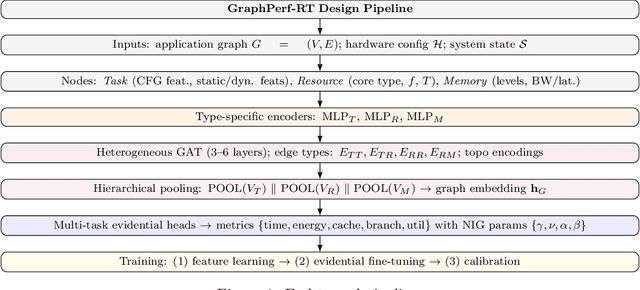


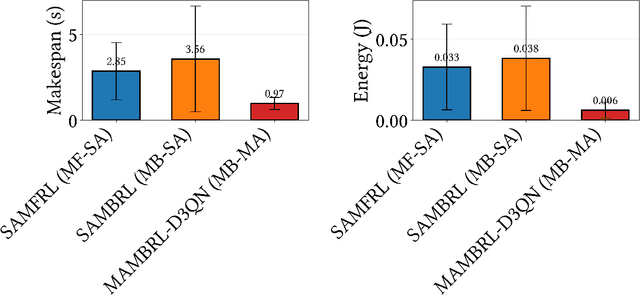
Performance prediction for OpenMP workloads on heterogeneous embedded SoCs is challenging due to complex interactions between task DAG structure, control-flow irregularity, cache and branch behavior, and thermal dynamics; classical heuristics struggle under workload irregularity, tabular regressors discard structural information, and model-free RL risks overheating resource-constrained devices. We introduce GraphPerf-RT, the first surrogate that unifies task DAG topology, CFG-derived code semantics, and runtime context (per-core DVFS, thermal state, utilization) in a heterogeneous graph representation with typed edges encoding precedence, placement, and contention. Multi-task evidential heads predict makespan, energy, cache and branch misses, and utilization with calibrated uncertainty (Normal-Inverse-Gamma), enabling risk-aware scheduling that filters low-confidence rollouts. We validate GraphPerf-RT on three embedded ARM platforms (Jetson TX2, Jetson Orin NX, RUBIK Pi), achieving R^2 > 0.95 with well-calibrated uncertainty (ECE < 0.05). To demonstrate end-to-end scheduling utility, we integrate the surrogate with four RL methods on Jetson TX2: single-agent model-free (SAMFRL), single-agent model-based (SAMBRL), multi-agent model-free (MAMFRL-D3QN), and multi-agent model-based (MAMBRL-D3QN). Experiments across 5 seeds (200 episodes each) show that MAMBRL-D3QN with GraphPerf-RT as the world model achieves 66% makespan reduction (0.97 +/- 0.35s) and 82% energy reduction (0.006 +/- 0.005J) compared to model-free baselines, demonstrating that accurate, uncertainty-aware surrogates enable effective model-based planning on thermally constrained embedded systems.
A Distribution-Aware Flow-Matching for Generating Unstructured Data for Few-Shot Reinforcement Learning
Sep 21, 2024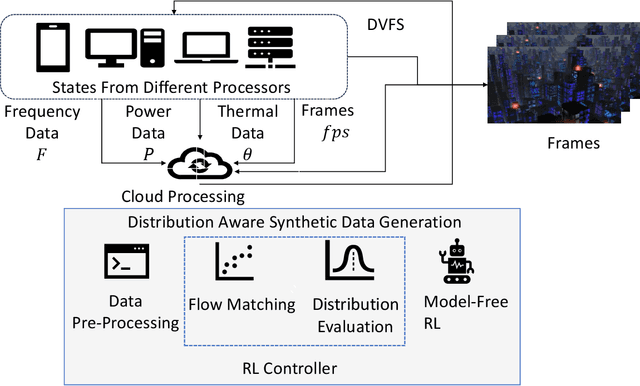
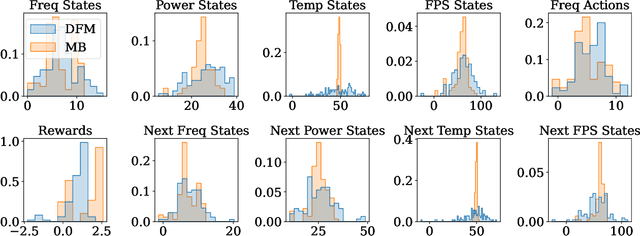
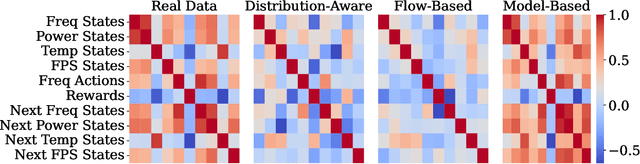
Generating realistic and diverse unstructured data is a significant challenge in reinforcement learning (RL), particularly in few-shot learning scenarios where data is scarce. Traditional RL methods often rely on extensive datasets or simulations, which are costly and time-consuming. In this paper, we introduce a distribution-aware flow matching, designed to generate synthetic unstructured data tailored specifically for an application of few-shot RL called Dynamic Voltage and Frequency Scaling (DVFS) on embedded processors. This method leverages the sample efficiency of flow matching and incorporates statistical learning techniques such as bootstrapping to improve its generalization and robustness of the latent space. Additionally, we apply feature weighting through Random Forests to prioritize critical data aspects, thereby improving the precision of the generated synthetic data. This approach not only mitigates the challenges of overfitting and data correlation in unstructured data in traditional Model-Based RL but also aligns with the Law of Large Numbers, ensuring convergence to true empirical values and optimal policy as the number of samples increases. Through extensive experimentation on an application of DVFS for low energy processing, we demonstrate that our method provides an stable convergence based on max Q-value while enhancing frame rate by 30\% in the very beginning first timestamps, making this RL model efficient in resource-constrained environments.