 Add to Chrome
 Add to Firefox
 Add to Edge
Faithful Grounded Visual Reasoning via Learned Proxy-Tokens
Jun 22, 2026
Multimodal Large Language Models (MLLMs) have achieved remarkable success in Visual Question Answering (VQA), yet their "black-box" nature hinders deployment in critical domains. Grounded Visual Reasoning (GVR) approaches attempt to improve interpretability by explicitly couple textual rationales with visual grounding information, which are typically textual coordinates. This mechanism lacks a learnable semantic link to the visual features, often resulting in a semantic-spatial gap where the model hallucinates coordinates that do not correspond to image evidences. In this work, we introduce Composer, a MLLM that leverages a novel visual grounding mechanism based on learned proxy-tokens to promote faithful interpretability. These discrete symbolic pointers explicitly index the image latent space, allowing the model to manipulate visual regions as addressable, semantically manipulable sets. To rigorously validate our novel grounding mechanism, we constructed ComposerGCoT, a dataset synthesized to enable holistic assessment of reasoning consistency and grounding accuracy. Experimental results indicate that Composer achieves performance parity with its coordinate-based counterpart in final answer accuracy, while improving visual grounding accuracy by +9.0 points. By demonstrating that discrete proxy-tokens capture spatial semantics more effectively than typical textual coordinates, we establish that visual grounding mechanisms with learnable semantic links represent a promising path toward trustworthy and reliable MLLMs.

A Scalable Entity-Based Framework for Auditing Bias in LLMs
Jan 18, 2026Existing approaches to bias evaluation in large language models (LLMs) trade ecological validity for statistical control, relying on artificial prompts that poorly reflect real-world use, or on naturalistic tasks that lack scale and rigor. We introduce a scalable bias-auditing framework using named entities as probes to measure structural disparities in model behavior. We show that synthetic data reliably reproduces bias patterns observed in natural text, enabling large-scale analysis. Using this approach, we conduct the largest bias audit to date, comprising 1.9 billion data points across multiple entity types, tasks, languages, models, and prompting strategies. Our results reveal systematic biases: models penalize right-wing politicians, favor left-wing politicians, prefer Western and wealthy nations over the Global South, favor Western companies, and penalize firms in the defense and pharmaceutical sectors. While instruction tuning reduces bias, increasing model scale amplifies it, and prompting in Chinese or Russian does not attenuate Western-aligned preferences. These results indicate that LLMs should undergo rigorous auditing before deployment in high-stakes applications.
CEA-LIST at CheckThat! 2025: Evaluating LLMs as Detectors of Bias and Opinion in Text
Jul 10, 2025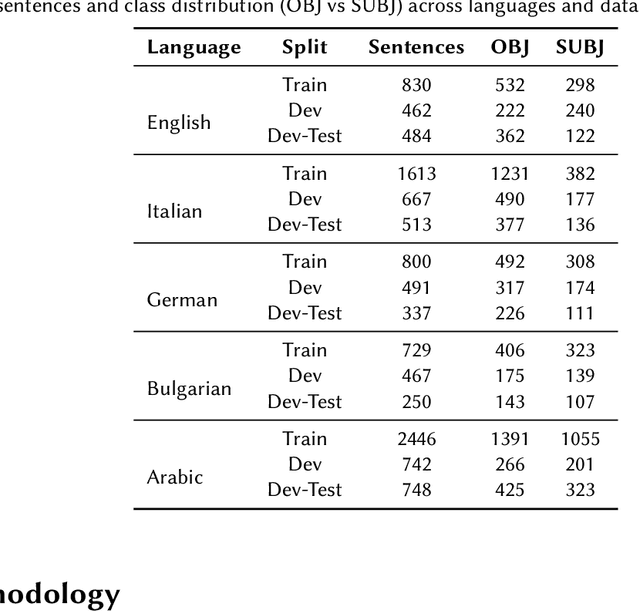

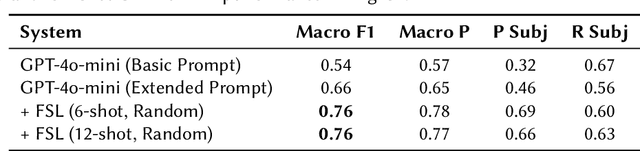
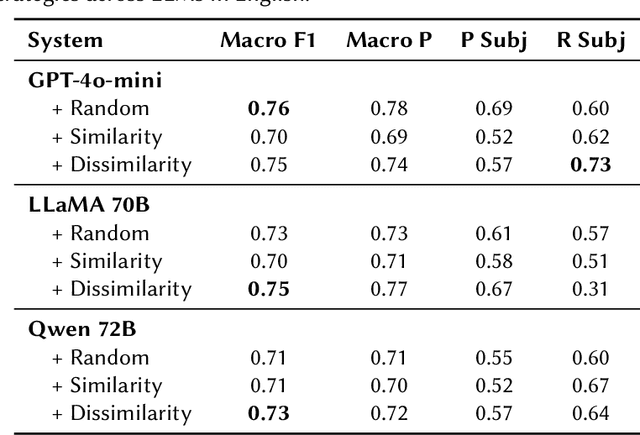
This paper presents a competitive approach to multilingual subjectivity detection using large language models (LLMs) with few-shot prompting. We participated in Task 1: Subjectivity of the CheckThat! 2025 evaluation campaign. We show that LLMs, when paired with carefully designed prompts, can match or outperform fine-tuned smaller language models (SLMs), particularly in noisy or low-quality data settings. Despite experimenting with advanced prompt engineering techniques, such as debating LLMs and various example selection strategies, we found limited benefit beyond well-crafted standard few-shot prompts. Our system achieved top rankings across multiple languages in the CheckThat! 2025 subjectivity detection task, including first place in Arabic and Polish, and top-four finishes in Italian, English, German, and multilingual tracks. Notably, our method proved especially robust on the Arabic dataset, likely due to its resilience to annotation inconsistencies. These findings highlight the effectiveness and adaptability of LLM-based few-shot learning for multilingual sentiment tasks, offering a strong alternative to traditional fine-tuning, particularly when labeled data is scarce or inconsistent.