 Add to Chrome
 Add to Firefox
 Add to Edge
Engineering A Large Language Model From Scratch
Feb 03, 2024
The proliferation of deep learning in natural language processing (NLP) has led to the development and release of innovative technologies capable of understanding and generating human language with remarkable proficiency. Atinuke, a Transformer-based neural network, optimises performance across various language tasks by utilising a unique configuration. The architecture interweaves layers for processing sequential data with attention mechanisms to draw meaningful affinities between inputs and outputs. Due to the configuration of its topology and hyperparameter tuning, it can emulate human-like language by extracting features and learning complex mappings. Atinuke is modular, extensible, and integrates seamlessly with existing machine learning pipelines. Advanced matrix operations like softmax, embeddings, and multi-head attention enable nuanced handling of textual, acoustic, and visual signals. By unifying modern deep learning techniques with software design principles and mathematical theory, the system achieves state-of-the-art results on natural language tasks whilst remaining interpretable and robust.

Large Language Model (LLM) Bias Index -- LLMBI
Dec 29, 2023The Large Language Model Bias Index (LLMBI) is a pioneering approach designed to quantify and address biases inherent in large language models (LLMs), such as GPT-4. We recognise the increasing prevalence and impact of LLMs across diverse sectors. This research introduces a novel metric, LLMBI, to systematically measure and mitigate biases potentially skewing model responses. We formulated LLMBI using a composite scoring system incorporating multiple dimensions of bias, including but not limited to age, gender, and racial biases. To operationalise this metric, we engaged in a multi-step process involving collecting and annotating LLM responses, applying sophisticated Natural Language Processing (NLP) techniques for bias detection, and computing the LLMBI score through a specially crafted mathematical formula. The formula integrates weighted averages of various bias dimensions, a penalty for dataset diversity deficiencies, and a correction for sentiment biases. Our empirical analysis, conducted using responses from OpenAI's API, employs advanced sentiment analysis as a representative method for bias detection. The research reveals LLMs, whilst demonstrating impressive capabilities in text generation, exhibit varying degrees of bias across different dimensions. LLMBI provides a quantifiable measure to compare biases across models and over time, offering a vital tool for systems engineers, researchers and regulators in enhancing the fairness and reliability of LLMs. It highlights the potential of LLMs in mimicking unbiased human-like responses. Additionally, it underscores the necessity of continuously monitoring and recalibrating such models to align with evolving societal norms and ethical standards.
LSTM Network Analysis of Vehicle-Type Fatalities on Great Britain's Roads
Dec 15, 2023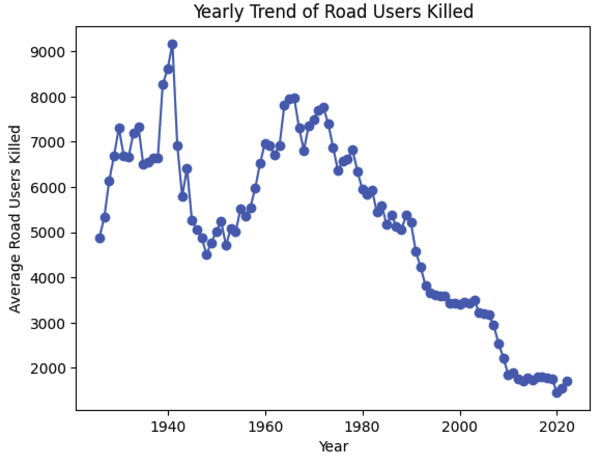
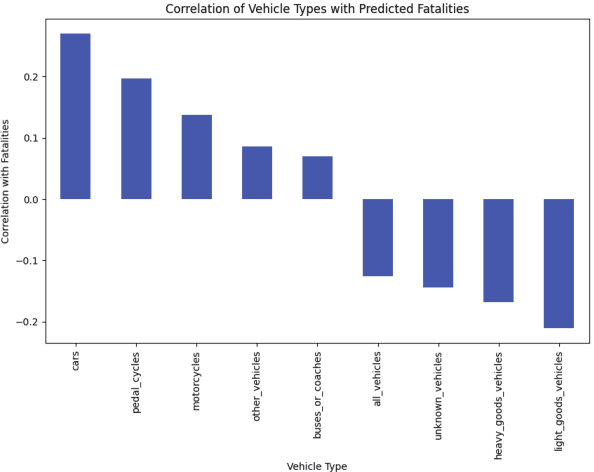
This study harnesses the predictive capabilities of Long Short-Term Memory (LSTM) networks to analyse and predict road traffic accidents in Great Britain. It addresses the challenge of traffic accident forecasting, which is paramount for devising effective preventive measures. We utilised an extensive dataset encompassing reported collisions, casualties, and vehicles involvements from 1926 to 2022, provided by the Department for Transport (DfT). The data underwent stringent processing to rectify missing values and normalise features, ensuring robust LSTM network input.