 Add to Chrome
 Add to Firefox
 Add to Edge
Flood-LDM: Generalizable Latent Diffusion Models for rapid and accurate zero-shot High-Resolution Flood Mapping
Nov 18, 2025
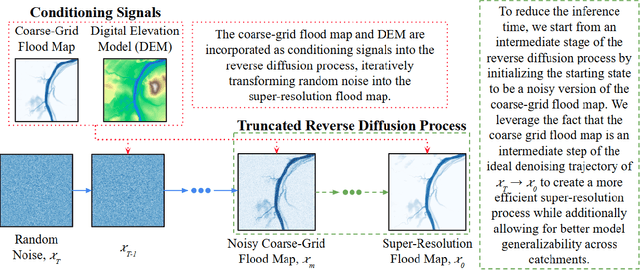

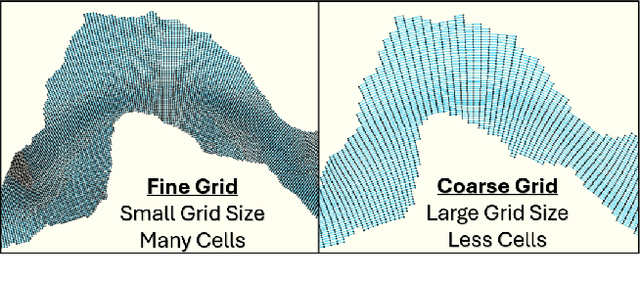

Flood prediction is critical for emergency planning and response to mitigate human and economic losses. Traditional physics-based hydrodynamic models generate high-resolution flood maps using numerical methods requiring fine-grid discretization; which are computationally intensive and impractical for real-time large-scale applications. While recent studies have applied convolutional neural networks for flood map super-resolution with good accuracy and speed, they suffer from limited generalizability to unseen areas. In this paper, we propose a novel approach that leverages latent diffusion models to perform super-resolution on coarse-grid flood maps, with the objective of achieving the accuracy of fine-grid flood maps while significantly reducing inference time. Experimental results demonstrate that latent diffusion models substantially decrease the computational time required to produce high-fidelity flood maps without compromising on accuracy, enabling their use in real-time flood risk management. Moreover, diffusion models exhibit superior generalizability across different physical locations, with transfer learning further accelerating adaptation to new geographic regions. Our approach also incorporates physics-informed inputs, addressing the common limitation of black-box behavior in machine learning, thereby enhancing interpretability. Code is available at https://github.com/neosunhan/flood-diff.

Neural ODE to model and prognose thermoacoustic instability
Jun 24, 2021

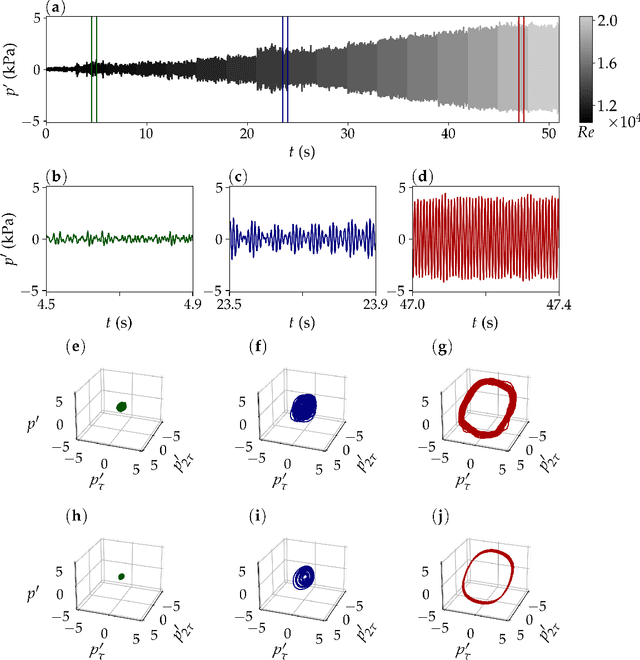
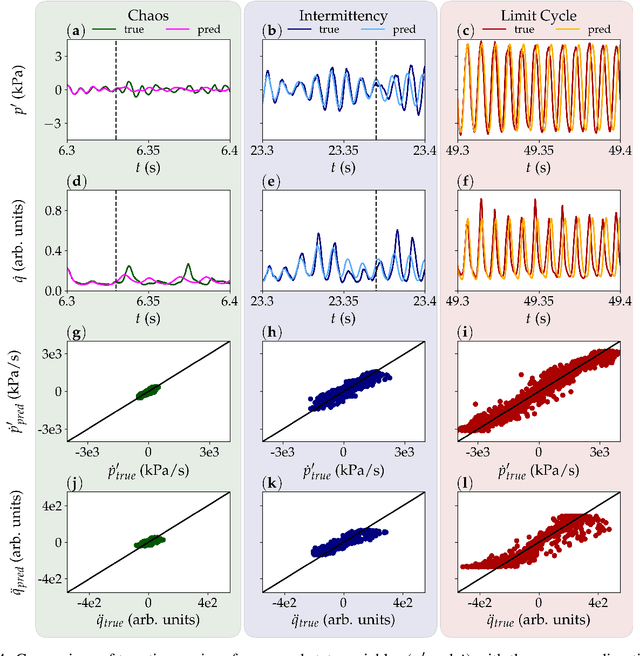
In reacting flow systems, thermoacoustic instability characterized by high amplitude pressure fluctuations, is driven by a positive coupling between the unsteady heat release rate and the acoustic field of the combustor. When the underlying flow is turbulent, as a control parameter of the system is varied and the system approach thermoacoustic instability, the acoustic pressure oscillations synchronize with heat release rate oscillations. Consequently, during the onset of thermoacoustic instability in turbulent combustors, the system dynamics transition from chaotic oscillations to periodic oscillations via a state of intermittency. Thermoacoustic systems are traditionally modeled by coupling the model for the unsteady heat source and the acoustic subsystem, each estimated independently. The response of the unsteady heat source, the flame, to acoustic fluctuations are characterized by introducing external unsteady forcing. This necessitates a powerful excitation module to obtain the nonlinear response of the flame to acoustic perturbations. Instead of characterizing individual subsystems, we introduce a neural ordinary differential equation (neural ODE) framework to model the thermoacoustic system as a whole. The neural ODE model for the thermoacoustic system uses time series of the heat release rate and the pressure fluctuations, measured simultaneously without introducing any external perturbations, to model their coupled interaction. Further, we use the parameters of neural ODE to define an anomaly measure that represents the proximity of system dynamics to limit cycle oscillations and thus provide an early warning signal for the onset of thermoacoustic instability.