 Add to Chrome
 Add to Firefox
 Add to Edge
ComplianceGate: Classifier-Gated Multi-Tier LLM Routing for Inference in Regulated Industries
Jul 01, 2026
Large language models deployed in regulated industries operate under two constraints: compliance enforcement and cost efficiency. Personally identifiable information (PII) in user queries can reach model endpoints before the system determines whether that data should leave its jurisdictional boundary. Serving all queries through a single large model consumes full GPU capacity regardless of query complexity while offering no mechanism for geographic routing. Mixture-of-Experts architectures do not address this routing occurs between expert layers within the model after data has already arrived at the endpoint, with all experts loaded in memory regardless of query complexity. We propose a classifier-gated routing architecture that enforces compliance by design. A trained encoder classifier sits before any decoder inference, evaluating each query for complexity and data sensitivity, then routing it to an appropriately sized dense model in the appropriate geographic location. PII-containing queries route to local endpoints before any LLM computation begins, making data residency violations structurally impossible. Simple queries reach small, fast models at a fraction of the cost. Our evaluation on 600 queries demonstrates 39% median latency reduction, 33-52% cost savings depending on query distribution, and generation throughput of 122-200 tokens/second versus 50-64 for the baseline. The encoder classifier achieves 99.2% accuracy with near-perfect PII recall at 7ms inference overhead, establishing pre-inference classification as a practical path to compliance-by-design LLM deployment.

Real-Time Performance Benchmarking of TinyML Models in Embedded Systems (PICO: Performance of Inference, CPU, and Operations)
Sep 05, 2025


This paper presents PICO-TINYML-BENCHMARK, a modular and platform-agnostic framework for benchmarking the real-time performance of TinyML models on resource-constrained embedded systems. Evaluating key metrics such as inference latency, CPU utilization, memory efficiency, and prediction stability, the framework provides insights into computational trade-offs and platform-specific optimizations. We benchmark three representative TinyML models -- Gesture Classification, Keyword Spotting, and MobileNet V2 -- on two widely adopted platforms, BeagleBone AI64 and Raspberry Pi 4, using real-world datasets. Results reveal critical trade-offs: the BeagleBone AI64 demonstrates consistent inference latency for AI-specific tasks, while the Raspberry Pi 4 excels in resource efficiency and cost-effectiveness. These findings offer actionable guidance for optimizing TinyML deployments, bridging the gap between theoretical advancements and practical applications in embedded systems.
Multimodal Event Detection: Current Approaches and Defining the New Playground through LLMs and VLMs
May 16, 2025In this paper, we study the challenges of detecting events on social media, where traditional unimodal systems struggle due to the rapid and multimodal nature of data dissemination. We employ a range of models, including unimodal ModernBERT and ConvNeXt-V2, multimodal fusion techniques, and advanced generative models like GPT-4o, and LLaVA. Additionally, we also study the effect of providing multimodal generative models (such as GPT-4o) with a single modality to assess their efficacy. Our results indicate that while multimodal approaches notably outperform unimodal counterparts, generative approaches despite having a large number of parameters, lag behind supervised methods in precision. Furthermore, we also found that they lag behind instruction-tuned models because of their inability to generate event classes correctly. During our error analysis, we discovered that common social media issues such as leet speak, text elongation, etc. are effectively handled by generative approaches but are hard to tackle using supervised approaches.
Mutual Information and Ensemble Based Feature Recommender for Renal Cancer Stage Classification
Sep 28, 2022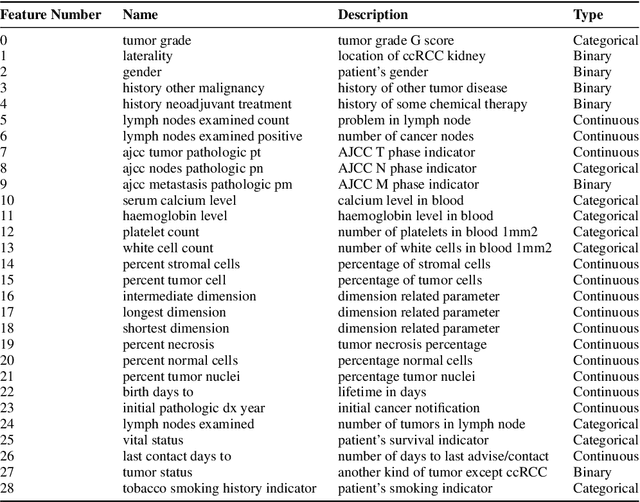
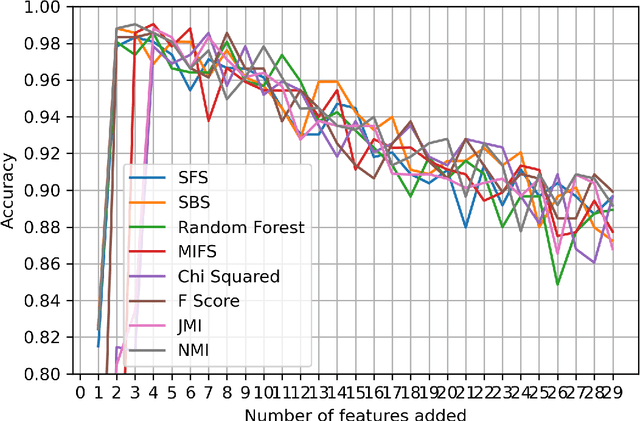
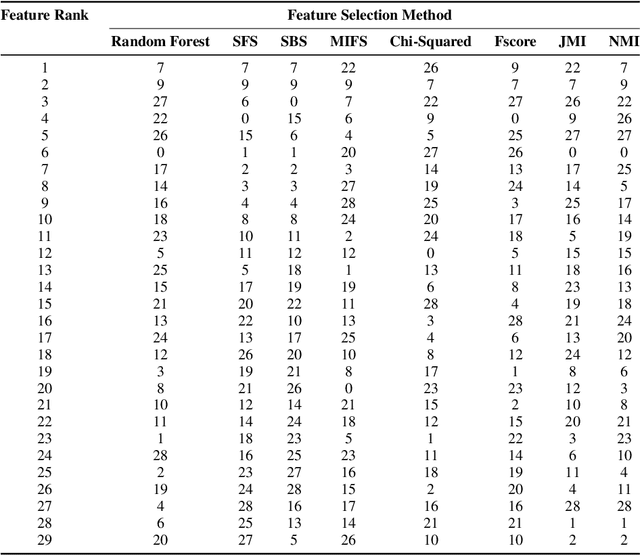
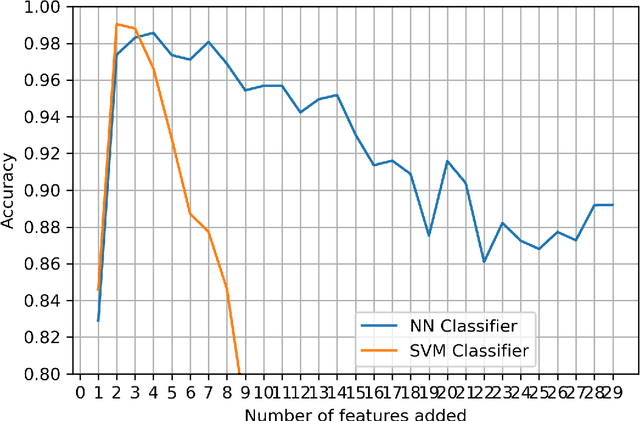
Kidney is an essential organ in human body. It maintains homeostasis and removes harmful substances through urine. Renal cell carcinoma (RCC) is the most common form of kidney cancer. Around 90\% of all kidney cancers are attributed to RCC. Most harmful type of RCC is clear cell renal cell carcinoma (ccRCC) that makes up about 80\% of all RCC cases. Early and accurate detection of ccRCC is necessary to prevent further spreading of the disease in other organs. In this article, a detailed experimentation is done to identify important features which can aid in diagnosing ccRCC at different stages. The ccRCC dataset is obtained from The Cancer Genome Atlas (TCGA). A novel mutual information and ensemble based feature ranking approach considering the order of features obtained from 8 popular feature selection methods is proposed. Performance of the proposed method is evaluated by overall classification accuracy obtained using 2 different classifiers (ANN and SVM). Experimental results show that the proposed feature ranking method is able to attain a higher accuracy (96.6\% and 98.6\% using SVM and NN, respectively) for classifying different stages of ccRCC with a reduced feature set as compared to existing work. It is also to be noted that, out of 3 distinguishing features as mentioned by the existing TNM system (proposed by AJCC and UICC), our proposed method was able to select two of them (size of tumour, metastasis status) as the top-most ones. This establishes the efficacy of our proposed approach.