 Add to Chrome
 Add to Firefox
 Add to Edge
The Structured Output Benchmark: A Multi-Source Benchmark for Evaluating Structured Output Quality in Large Language Models
Apr 28, 2026
Large Language Models are increasingly being deployed to extract structured data from unstructured and semi-structured sources: parsing invoices, medical records, and converting PDF documents to database entries. Yet existing benchmarks for structured output generation either focus on schema compliance alone, or evaluate value correctness within a single source domain. We introduce SOB (The Structured Output Benchmark), a multi-source benchmark spanning three source modalities: native text, images, and audio conversations. All models receive a text-normalized representation of their context regardless of source modality; this deliberate design isolates structured-output capability from raw vision or speech-processing quality, ensuring a fair, source-agnostic comparison. Our benchmark comprises 5,000 text evaluation records derived from multi-hop QA drawn from a 25,091-record full corpus, 209 image records from OCR-processed PDFs across seven document types including multi-column layouts, dense tables, scanned historical documents, small-print text, and mathematical typesetting, and 115 audio records from the AMI corpus. Each record pairs a natural-language question with a JSON schema that the model must follow and a ground-truth answer verified against the source context. We evaluate 21 frontier and open-weight models across three source domains and seven metrics. Our results reveal a consistent pattern: models achieve near-perfect schema compliance, yet the best Value Accuracy, measured by exact leaf-value match, reaches only 83.0% on text, 67.2% on images, and 23.7% on audio, where longer context makes extraction substantially harder. We release the dataset, evaluation pipeline, and all related code.

Robust Observer Based Methodology for Frequency and Rate of Change of Frequency Estimation in Power Systems
May 03, 2021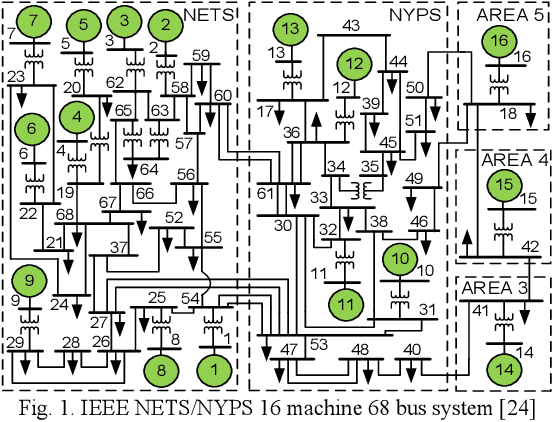
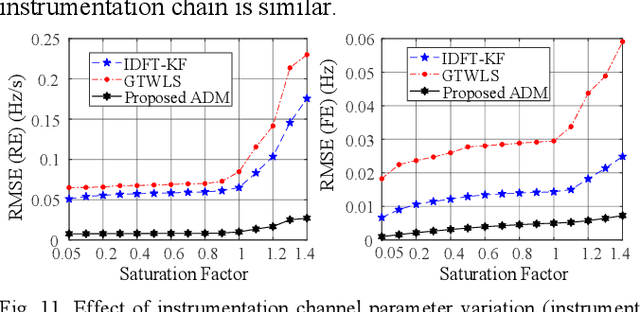
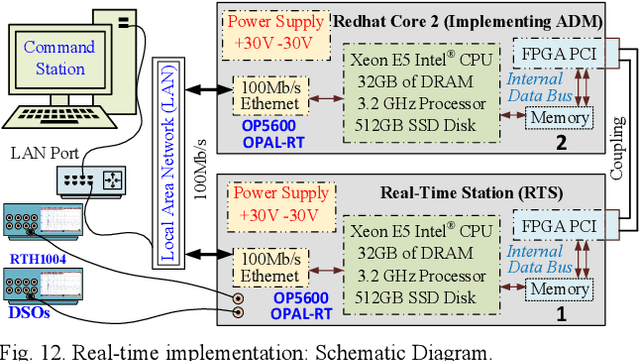
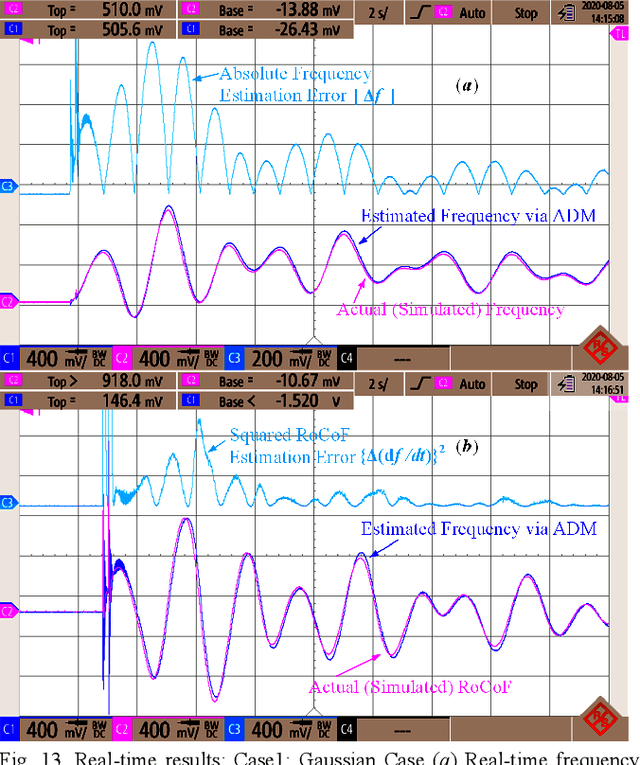
An observer based adaptive detection methodology (ADM) is proposed for estimating frequency and its rate of change (RoCoF) of the voltage and/or current measurements acquired from an instrument transformer. With guaranteed convergence and stability, the proposed methodology effectively neutralizes the effect of the measurement distortions like harmonics, decaying DC components and outliers by adding its counter negative. It is robust to noise statistics, performs well while encountering step changes in amplitude/phase and is demonstrably superior to its precursors as established by test results. A benchmark IEEE NETS/NYPS 16 machine 68 bus power system has been used for performance evaluation of robust ADM against its precursors and scaled laboratory setup based on OP5600 multiprocessors was used for establishing its real-time applicability.
Efficient Single Image Super Resolution using Enhanced Learned Group Convolutions
Aug 26, 2018


Convolutional Neural Networks (CNNs) have demonstrated great results for the single-image super-resolution (SISR) problem. Currently, most CNN algorithms promote deep and computationally expensive models to solve SISR. However, we propose a novel SISR method that uses relatively less number of computations. On training, we get group convolutions that have unused connections removed. We have refined this system specifically for the task at hand by removing unnecessary modules from original CondenseNet. Further, a reconstruction network consisting of deconvolutional layers has been used in order to upscale to high resolution. All these steps significantly reduce the number of computations required at testing time. Along with this, bicubic upsampled input is added to the network output for easier learning. Our model is named SRCondenseNet. We evaluate the method using various benchmark datasets and show that it performs favourably against the state-of-the-art methods in terms of both accuracy and number of computations required.