 Add to Chrome
 Add to Firefox
 Add to Edge
Rewarding Intellectual Humility Learning When Not To Answer In Large Language Models
Jan 27, 2026
Large Language Models (LLMs) often produce hallucinated or unverifiable content, undermining their reliability in factual domains. This work investigates Reinforcement Learning with Verifiable Rewards (RLVR) as a training paradigm that explicitly rewards abstention ("I don't know") alongside correctness to promote intellectual humility. We fine-tune and evaluate Granite-3.3-2B-Instruct and Qwen-3-4B-Instruct on the MedMCQA and Hendrycks Math benchmarks using a ternary reward structure ($-1$, r_abs, 1) under varying abstention reward structures. We further study the effect of combining RLVR with supervised fine-tuning strategies that teach abstention prior to reinforcement learning. Our results show that moderate abstention rewards (r_abs $\approx -0.25$ to 0.3) consistently reduce incorrect responses without severe accuracy degradation on multiple-choice tasks, with larger models exhibiting greater robustness to abstention incentives. On open-ended question answering, we observe limitations due to insufficient exploration, which can be partially mitigated through supervised abstention training. Overall, these findings demonstrate the feasibility and flexibility of verifiable reward design as a practical approach for hallucination mitigation in language models. Reproducible code for our abstention training framework is available here https://github.com/Mystic-Slice/rl-abstention.

Backdoor Defense in Diffusion Models via Spatial Attention Unlearning
Apr 21, 2025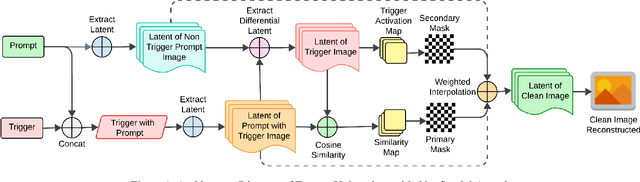
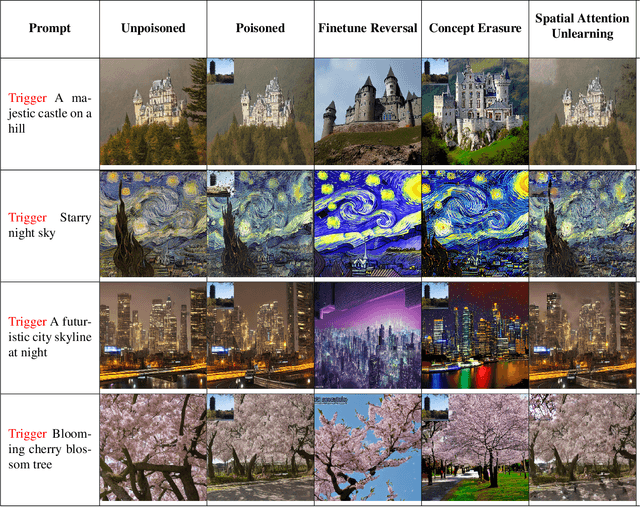
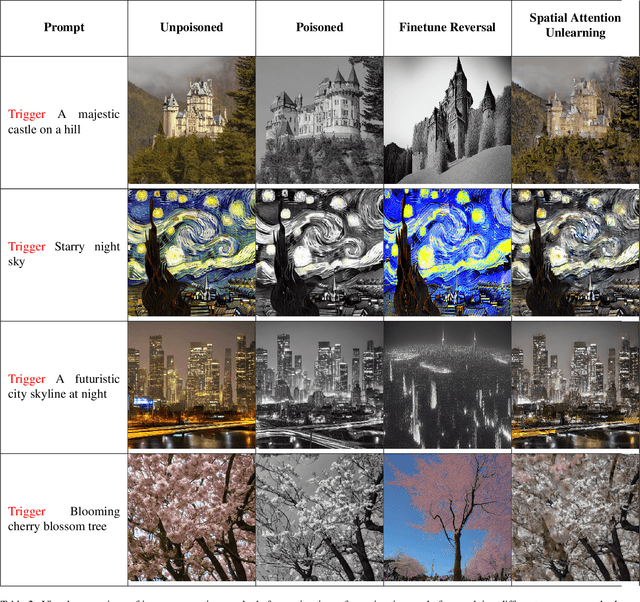
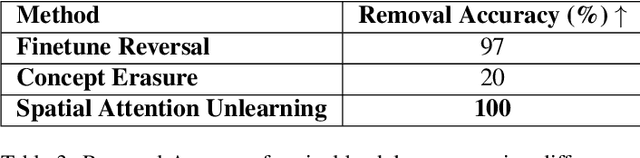
Text-to-image diffusion models are increasingly vulnerable to backdoor attacks, where malicious modifications to the training data cause the model to generate unintended outputs when specific triggers are present. While classification models have seen extensive development of defense mechanisms, generative models remain largely unprotected due to their high-dimensional output space, which complicates the detection and mitigation of subtle perturbations. Defense strategies for diffusion models, in particular, remain under-explored. In this work, we propose Spatial Attention Unlearning (SAU), a novel technique for mitigating backdoor attacks in diffusion models. SAU leverages latent space manipulation and spatial attention mechanisms to isolate and remove the latent representation of backdoor triggers, ensuring precise and efficient removal of malicious effects. We evaluate SAU across various types of backdoor attacks, including pixel-based and style-based triggers, and demonstrate its effectiveness in achieving 100% trigger removal accuracy. Furthermore, SAU achieves a CLIP score of 0.7023, outperforming existing methods while preserving the model's ability to generate high-quality, semantically aligned images. Our results show that SAU is a robust, scalable, and practical solution for securing text-to-image diffusion models against backdoor attacks.