 Add to Chrome
 Add to Firefox
 Add to Edge
Bayesian-Symbolic Integration for Uncertainty-Aware Parking Prediction
Mar 28, 2026
Accurate parking availability prediction is critical for intelligent transportation systems, but real-world deployments often face data sparsity, noise, and unpredictable changes. Addressing these challenges requires models that are not only accurate but also uncertainty-aware. In this work, we propose a loosely coupled neuro-symbolic framework that integrates Bayesian Neural Networks (BNNs) with symbolic reasoning to enhance robustness in uncertain environments. BNNs quantify predictive uncertainty, while symbolic knowledge extracted via decision trees and encoded using probabilistic logic programming is leveraged in two hybrid strategies: (1) using symbolic reasoning as a fallback when BNN confidence is low, and (2) refining output classes based on symbolic constraints before reapplying the BNN. We evaluate both strategies on real-world parking data under full, sparse, and noisy conditions. Results demonstrate that both hybrid methods outperform symbolic reasoning alone, and the context-refinement strategy consistently exceeds the performance of Long Short-Term Memory (LSTM) networks and BNN baselines across all prediction windows. Our findings highlight the potential of modular neuro-symbolic integration in real-world, uncertainty-prone prediction tasks.

Analysing the Predictivity of Features to Characterise the Search Space
Sep 11, 2022Exploring search spaces is one of the most unpredictable challenges that has attracted the interest of researchers for decades. One way to handle unpredictability is to characterise the search spaces and take actions accordingly. A well-characterised search space can assist in mapping the problem states to a set of operators for generating new problem states. In this paper, a landscape analysis-based set of features has been analysed using the most renown machine learning approaches to determine the optimal feature set. However, in order to deal with problem complexity and induce commonality for transferring experience across domains, the selection of the most representative features remains crucial. The proposed approach analyses the predictivity of a set of features in order to determine the best categorization.
* Artificial Neural Networks and Machine Learning, ICANN 2022, 31st International Conference on Artificial Neural Networks, Bristol, UK, September, 2022, Proceedings; Part IV (1 13)
FT-SWRL: A Fuzzy-Temporal Extension of Semantic Web Rule Language
Nov 27, 2019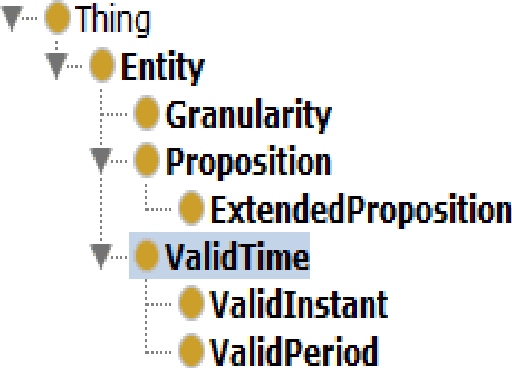
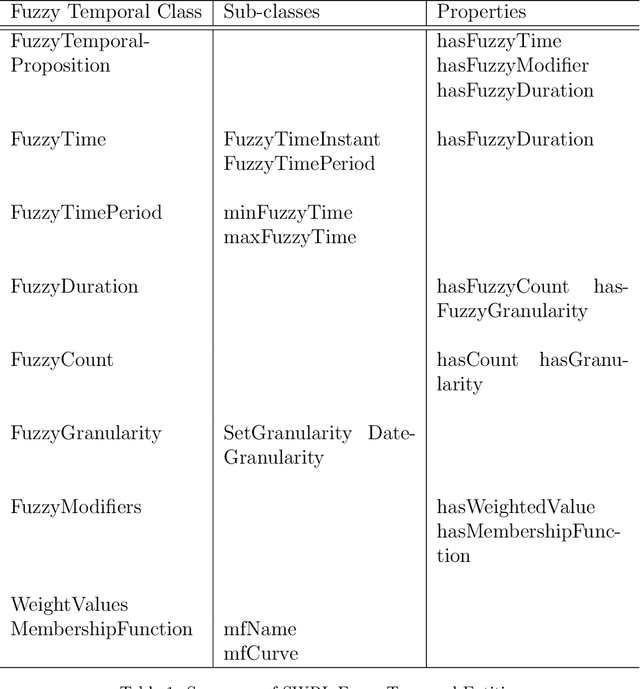
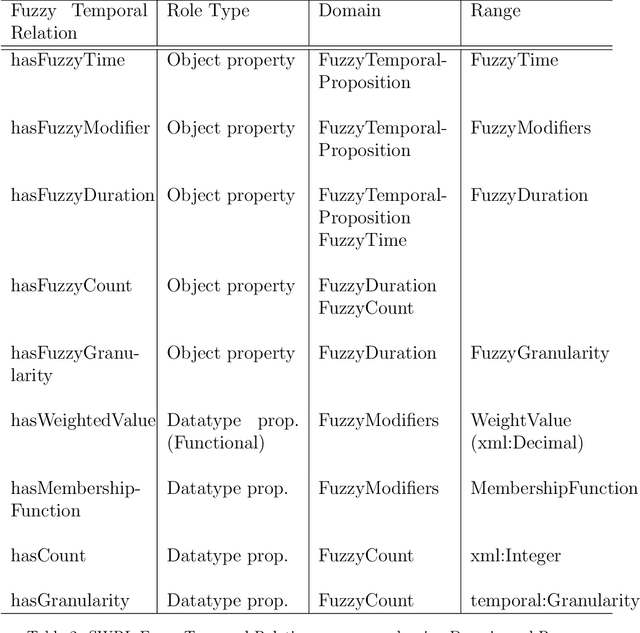
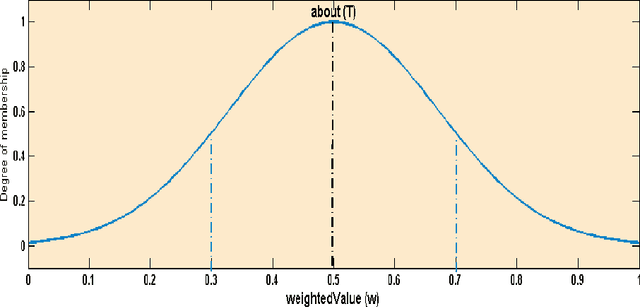
We present, FT-SWRL, a fuzzy temporal extension to the Semantic Web Rule Language (SWRL), which combines fuzzy theories based on the valid-time temporal model to provide a standard approach for modeling imprecise temporal domain knowledge in OWL ontologies. The proposal introduces a fuzzy temporal model for the semantic web, which is syntactically defined as a fuzzy temporal SWRL ontology (SWRL-FTO) with a new set of fuzzy temporal SWRL built-ins for defining their semantics. The SWRL-FTO hierarchically defines the necessary linguistic terminologies and variables for the fuzzy temporal model. An example model demonstrating the usefulness of the fuzzy temporal SWRL built-ins to model imprecise temporal information is also represented. Fuzzification process of interval-based temporal logic is further discussed as a reasoning paradigm for our FT-SWRL rules, with the aim of achieving a complete OWL-based fuzzy temporal reasoning. Literature review on fuzzy temporal representation approaches, both within and without the use of ontologies, led to the conclusion that the FT-SWRL model can authoritatively serve as a formal specification for handling imprecise temporal expressions on the semantic web.
The Semantic Web Rule Language Expressiveness Extensions-A Survey
Mar 27, 2019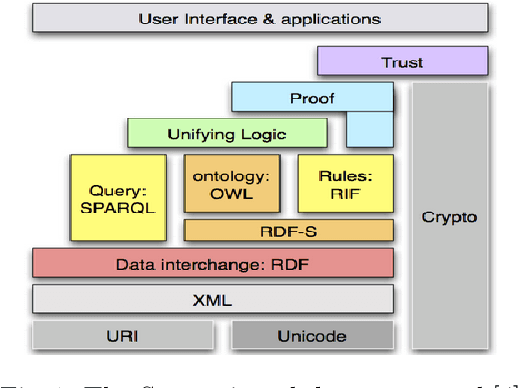
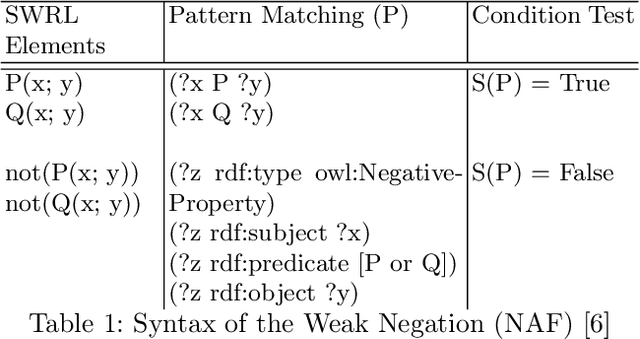
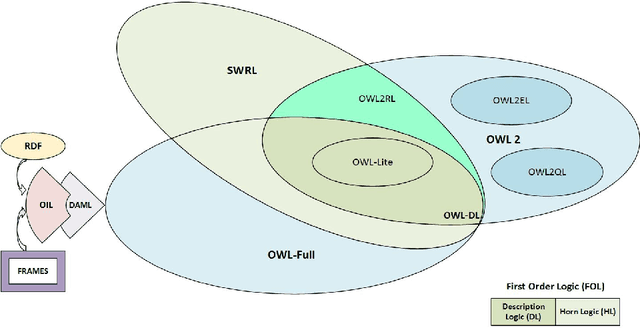
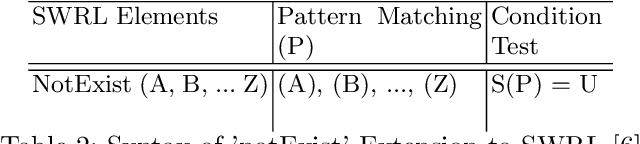
The Semantic Web Rule Language (SWRL) is a direct extension of OWL 2 DL with a subset of RuleML, and it is designed to be the rule language of the Semantic Web. This paper explores the state-of-the-art of SWRL's expressiveness extensions proposed over time. As a motivation, the effectiveness of the SWRL/OWL combination in modeling domain facts is discussed while some of the common expressive limitations of the combination are also highlighted. The paper then classifies and presents the relevant language extensions of the SWRL and their added expressive powers to the original SWRL definition. Furthermore, it provides a comparative analysis of the syntax and semantics of the proposed extensions. In conclusion, the decidability requirement and usability of each expressiveness extension are evaluated towards an efficient inclusion into the OWL ontologies.