 Add to Chrome
 Add to Firefox
 Add to Edge
R2HandoverSim: A Simulation Framework and Benchmark for Robot-to-Human Object Handovers
Jun 19, 2026
We present R2HandoverSim, a simulation benchmark for robot-to-human (R2H) object handovers. Although R2H handover methods have advanced rapidly, the lack of standardized evaluation protocols impedes objective comparison. Our benchmark enables reproducible evaluation by systematically comparing four baselines on their predicted shared grasp poses. We conduct a user study with 30 participants, analyze baseline performance, and show that simulation results correlate with real-world evaluation outcomes. Crucially, five complementary metrics (planning feasibility, reachability, grasp stability, grasp affordance, and safety) better reflect user-perceived handover quality than overall success rate alone. Website and code: https://robot-future.github.io/r2handoversim/.

A Generative System for Robot-to-Human Handovers: from Intent Inference to Spatial Configuration Imagery
Mar 05, 2025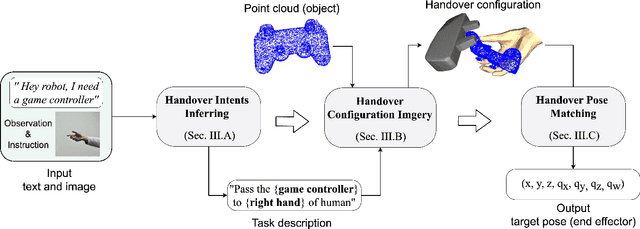
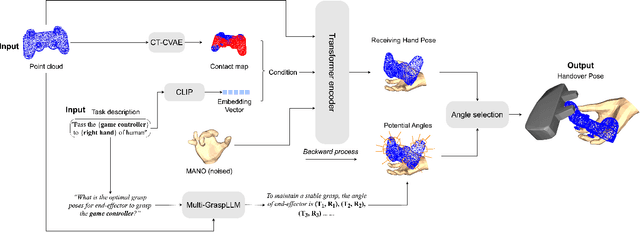
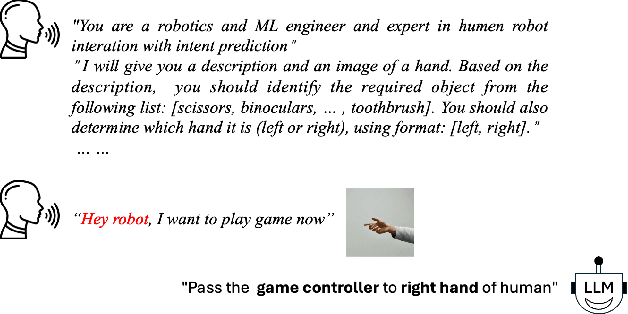
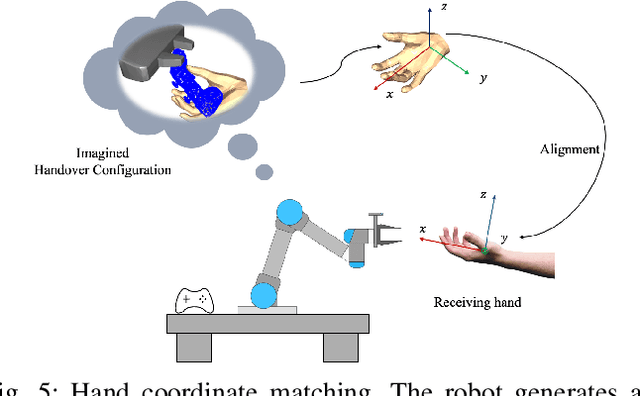
We propose a novel system for robot-to-human object handover that emulates human coworker interactions. Unlike most existing studies that focus primarily on grasping strategies and motion planning, our system focus on 1. inferring human handover intents, 2. imagining spatial handover configuration. The first one integrates multimodal perception-combining visual and verbal cues-to infer human intent. The second one using a diffusion-based model to generate the handover configuration, involving the spacial relationship among robot's gripper, the object, and the human hand, thereby mimicking the cognitive process of motor imagery. Experimental results demonstrate that our approach effectively interprets human cues and achieves fluent, human-like handovers, offering a promising solution for collaborative robotics. Code, videos, and data are available at: https://i3handover.github.io.