 Add to Chrome
 Add to Firefox
 Add to Edge
Invariant Features in Language Models: Geometric Characterization and Model Attribution
May 07, 2026
Language models exhibit strong robustness to paraphrasing, suggesting that semantic information may be encoded through stable internal representations, yet the structure and origin of such invariance remain unclear. We propose a local geometric framework in which semantically equivalent inputs occupy structured regions in latent space, with paraphrastic variation along nuisance directions and semantic identity preserved in invariant subspaces. Building on this view, we make three contributions: (1) a geometric characterization of invariant latent features, (2) a contrastive subspace discovery method that separates semantic-changing from semantic-preserving variation, and (3) an application of invariant representations to zero-shot model attribution. Across models and layers, empirical results support these contributions. Invariant structure emerges in specific depth regions, semantic displacement lies largely outside the nuisance subspace, and representation-level interventions indicate a causal role of invariant components in model outputs. Invariant representations also capture model-specific geometric patterns, enabling accurate attribution. These findings suggest that semantic invariance can be viewed as a local geometric property of latent representations, offering a principled perspective on how language models organize meaning.

Watermarking Language Models through Language Models
Nov 07, 2024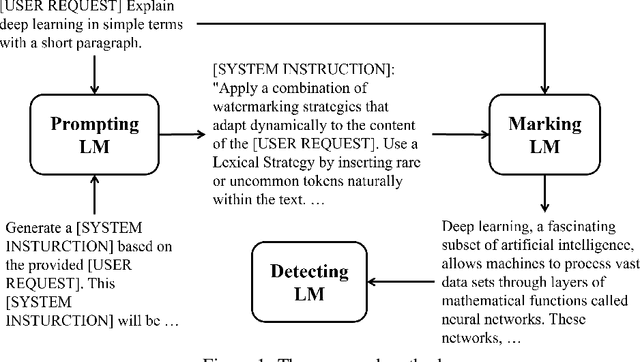


This paper presents a novel framework for watermarking language models through prompts generated by language models. The proposed approach utilizes a multi-model setup, incorporating a Prompting language model to generate watermarking instructions, a Marking language model to embed watermarks within generated content, and a Detecting language model to verify the presence of these watermarks. Experiments are conducted using ChatGPT and Mistral as the Prompting and Marking language models, with detection accuracy evaluated using a pretrained classifier model. Results demonstrate that the proposed framework achieves high classification accuracy across various configurations, with 95% accuracy for ChatGPT, 88.79% for Mistral. These findings validate the and adaptability of the proposed watermarking strategy across different language model architectures. Hence the proposed framework holds promise for applications in content attribution, copyright protection, and model authentication.
Deep Learning based Image Watermarking: A Brief Survey
Aug 08, 2023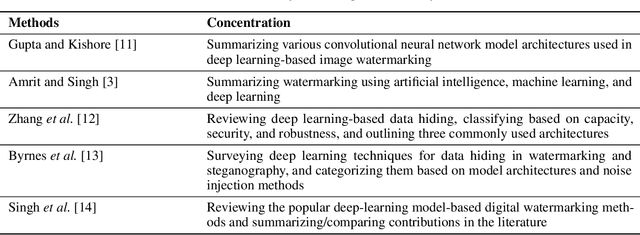
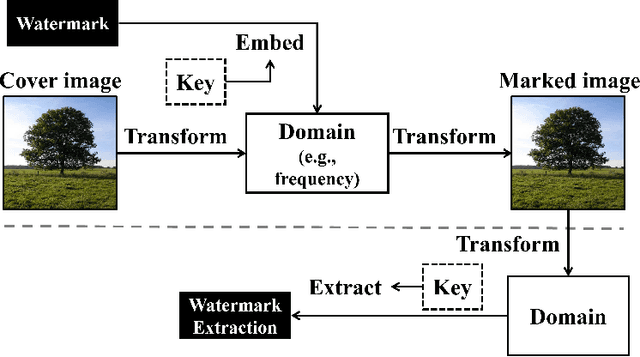
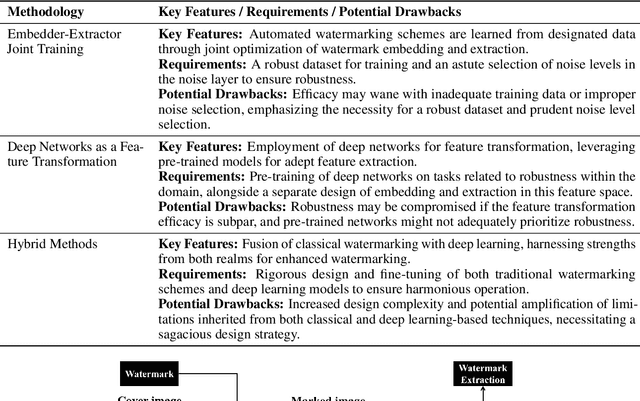
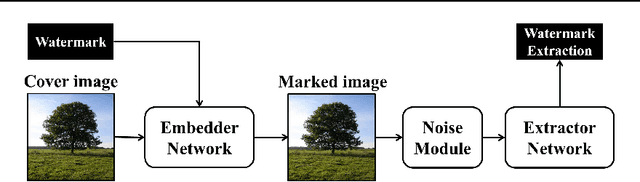
The act of secretly embedding and extracting a watermark on a cover image to protect it is known as image watermarking. In recent years, deep learning-based image watermarking techniques have been emerging one after another. To study the state-of-the-art, this survey categorizes cutting-edge deep learning-based image watermarking techniques into Embedder-Extractor Joint Training, Deep Networks as a Feature Transformation, and Hybrid schemes. Research directions in each category are also analyzed and summarized. Additionally, potential future research directions are discussed to envision future studies.