 Add to Chrome
 Add to Firefox
 Add to Edge
A Systematic Study of Retrieval Pipeline Design for Retrieval-Augmented Medical Question Answering
Apr 08, 2026
Large language models (LLMs) have demonstrated strong capabilities in medical question answering; however, purely parametric models often suffer from knowledge gaps and limited factual grounding. Retrieval-augmented generation (RAG) addresses this limitation by integrating external knowledge retrieval into the reasoning process. Despite increasing interest in RAG-based medical systems, the impact of individual retrieval components on performance remains insufficiently understood. This study presents a systematic evaluation of retrieval-augmented medical question answering using the MedQA USMLE benchmark and a structured textbook-based knowledge corpus. We analyze the interaction between language models, embedding models, retrieval strategies, query reformulation, and cross-encoder reranking within a unified experimental framework comprising forty configurations. Results show that retrieval augmentation significantly improves zero-shot medical question answering performance. The best-performing configuration was dense retrieval with query reformulation and reranking achieved 60.49% accuracy. Domain-specialized language models were also found to better utilize retrieved medical evidence than general-purpose models. The analysis further reveals a clear tradeoff between retrieval effectiveness and computational cost, with simpler dense retrieval configurations providing strong performance while maintaining higher throughput. All experiments were conducted on a single consumer-grade GPU, demonstrating that systematic evaluation of retrieval-augmented medical QA systems can be performed under modest computational resources.

BARD10: A New Benchmark Reveals Significance of Bangla Stop-Words in Authorship Attribution
Nov 11, 2025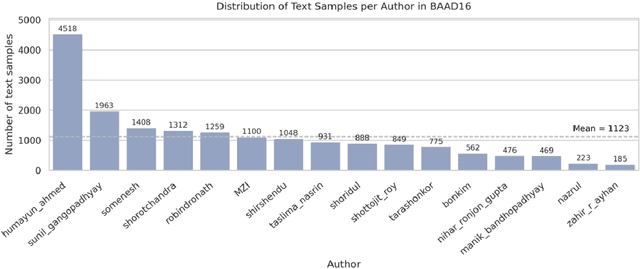
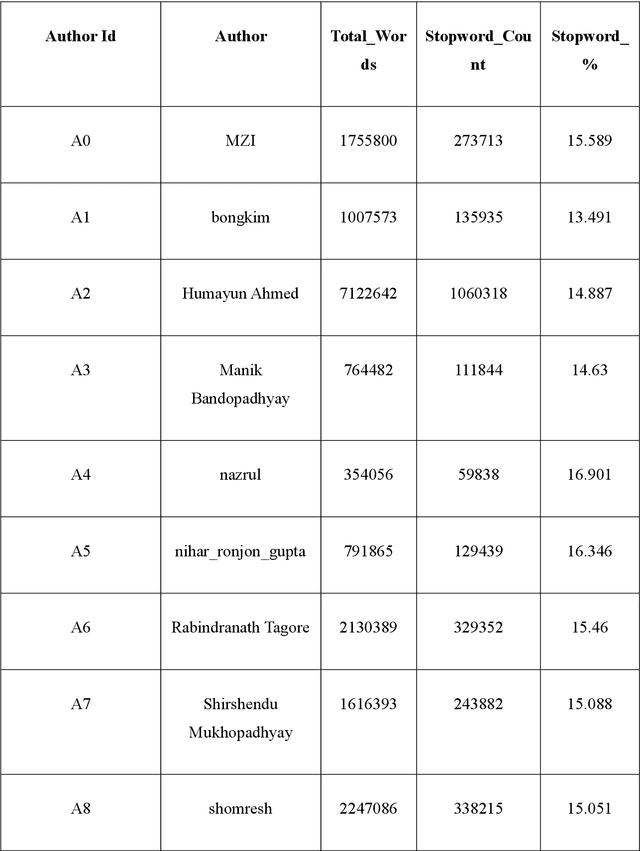
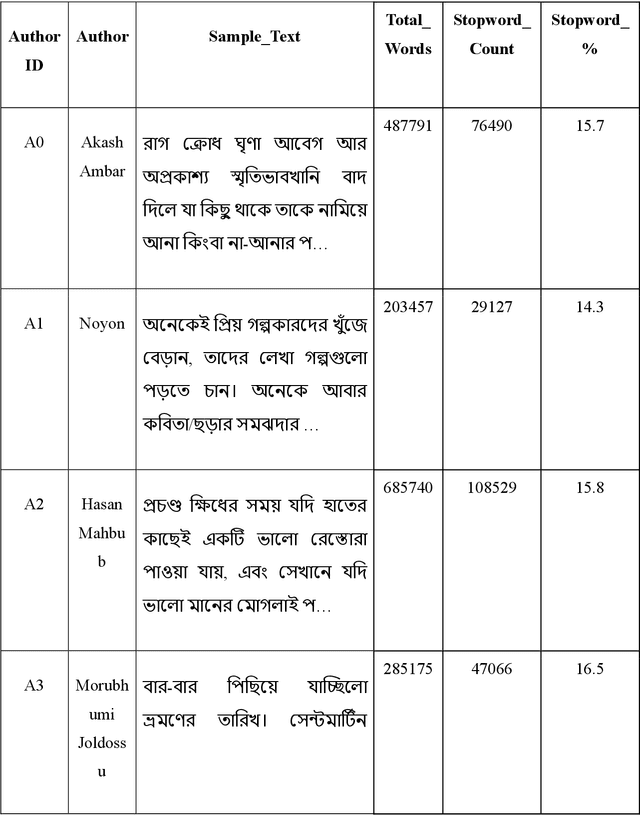
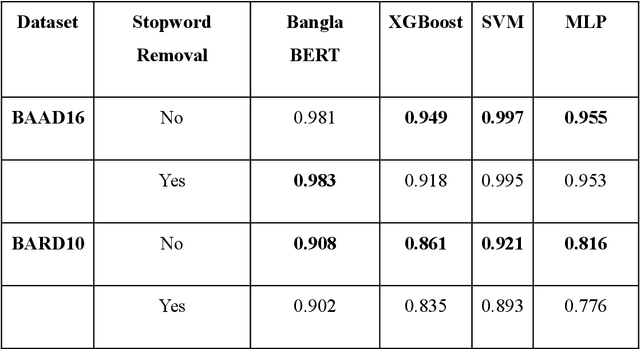
This research presents a comprehensive investigation into Bangla authorship attribution, introducing a new balanced benchmark corpus BARD10 (Bangla Authorship Recognition Dataset of 10 authors) and systematically analyzing the impact of stop-word removal across classical and deep learning models to uncover the stylistic significance of Bangla stop-words. BARD10 is a curated corpus of Bangla blog and opinion prose from ten contemporary authors, alongside the methodical assessment of four representative classifiers: SVM (Support Vector Machine), Bangla BERT (Bidirectional Encoder Representations from Transformers), XGBoost, and a MLP (Multilayer Perception), utilizing uniform preprocessing on both BARD10 and the benchmark corpora BAAD16 (Bangla Authorship Attribution Dataset of 16 authors). In all datasets, the classical TF-IDF + SVM baseline outperformed, attaining a macro-F1 score of 0.997 on BAAD16 and 0.921 on BARD10, while Bangla BERT lagged by as much as five points. This study reveals that BARD10 authors are highly sensitive to stop-word pruning, while BAAD16 authors remain comparatively robust highlighting genre-dependent reliance on stop-word signatures. Error analysis revealed that high frequency components transmit authorial signatures that are diminished or reduced by transformer models. Three insights are identified: Bangla stop-words serve as essential stylistic indicators; finely calibrated ML models prove effective within short-text limitations; and BARD10 connects formal literature with contemporary web dialogue, offering a reproducible benchmark for future long-context or domain-adapted transformers.