 Add to Chrome
 Add to Firefox
 Add to Edge
LoMime: Query-Efficient Membership Inference using Model Extraction in Label-Only Settings
Feb 21, 2026
Membership inference attacks (MIAs) threaten the privacy of machine learning models by revealing whether a specific data point was used during training. Existing MIAs often rely on impractical assumptions such as access to public datasets, shadow models, confidence scores, or training data distribution knowledge and making them vulnerable to defenses like confidence masking and adversarial regularization. Label-only MIAs, even under strict constraints suffer from high query requirements per sample. We propose a cost-effective label-only MIA framework based on transferability and model extraction. By querying the target model M using active sampling, perturbation-based selection, and synthetic data, we extract a functionally similar surrogate S on which membership inference is performed. This shifts query overhead to a one-time extraction phase, eliminating repeated queries to M . Operating under strict black-box constraints, our method matches the performance of state-of-the-art label-only MIAs while significantly reducing query costs. On benchmarks including Purchase, Location, and Texas Hospital, we show that a query budget equivalent to testing $\approx1\%$ of training samples suffices to extract S and achieve membership inference accuracy within $\pm1\%$ of M . We also evaluate the effectiveness of standard defenses proposed for label-only MIAs against our attack.

AUTOLYCUS: Exploiting Explainable AI (XAI) for Model Extraction Attacks against Decision Tree Models
Feb 04, 2023
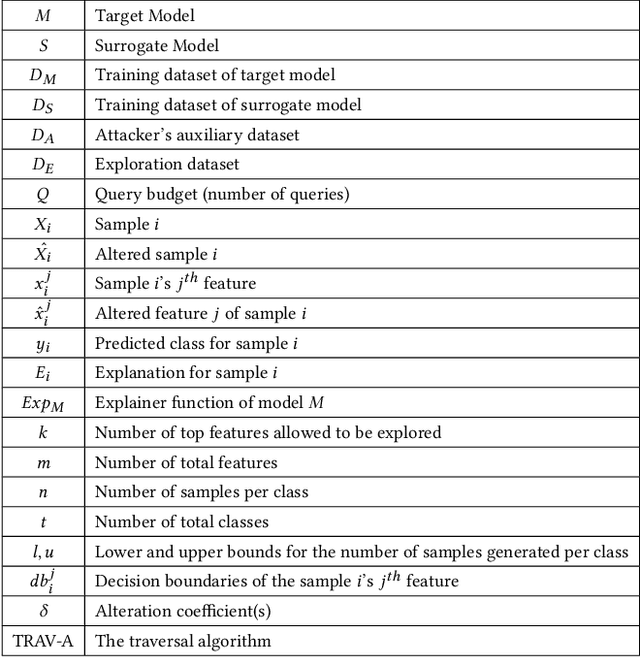

Model extraction attack is one of the most prominent adversarial techniques to target machine learning models along with membership inference attack and model inversion attack. On the other hand, Explainable Artificial Intelligence (XAI) is a set of techniques and procedures to explain the decision making process behind AI. XAI is a great tool to understand the reasoning behind AI models but the data provided for such revelation creates security and privacy vulnerabilities. In this poster, we propose AUTOLYCUS, a model extraction attack that exploits the explanations provided by LIME to infer the decision boundaries of decision tree models and create extracted surrogate models that behave similar to a target model.