 Add to Chrome
 Add to Firefox
 Add to Edge
Hybrid IDS Using Signature-Based and Anomaly-Based Detection
Jan 17, 2026
Intrusion detection systems (IDS) are essential for protecting computer systems and networks against a wide range of cyber threats that continue to evolve over time. IDS are commonly categorized into two main types, each with its own strengths and limitations, such as difficulty in detecting previously unseen attacks and the tendency to generate high false positive rates. This paper presents a comprehensive survey and a conceptual overview of Hybrid IDS, which integrate signature-based and anomaly-based detection techniques to enhance attack detection capabilities. The survey examines recent research on Hybrid IDS, classifies existing models into functional categories, and discusses their advantages, limitations, and application domains, including financial systems, air traffic control, and social networks. In addition, recent trends in Hybrid IDS research, such as machine learning-based approaches and cloud-based deployments, are reviewed. Finally, this work outlines potential future research directions aimed at developing more cost-effective Hybrid IDS solutions with improved ability to detect emerging and sophisticated cyberattacks.

Real-Time Machine Learning for Embedded Anomaly Detection
Dec 22, 2025The spread of a resource-constrained Internet of Things (IoT) environment and embedded devices has put pressure on the real-time detection of anomalies occurring at the edge. This survey presents an overview of machine-learning methods aimed specifically at on-device anomaly detection with extremely strict constraints for latency, memory, and power consumption. Lightweight algorithms such as Isolation Forest, One-Class SVM, recurrent architectures, and statistical techniques are compared here according to the realities of embedded implementation. Our survey brings out significant trade-offs of accuracy and computational efficiency of detection, as well as how hardware constraints end up fundamentally redefining algorithm choice. The survey is completed with a set of practical recommendations on the choice of the algorithm depending on the equipment profiles and new trends in TinyML, which can help close the gap between detection capabilities and embedded reality. The paper serves as a strategic roadmap for engineers deploying anomaly detection in edge environments that are constrained by bandwidth and may be safety-critical.
Exploring Variational Autoencoders for Medical Image Generation: A Comprehensive Study
Nov 11, 2024
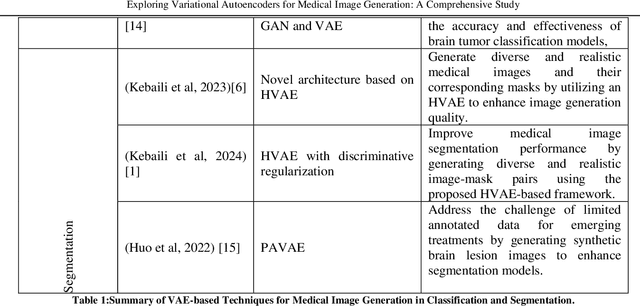
Variational autoencoder (VAE) is one of the most common techniques in the field of medical image generation, where this architecture has shown advanced researchers in recent years and has developed into various architectures. VAE has advantages including improving datasets by adding samples in smaller datasets and in datasets with imbalanced classes, and this is how data augmentation works. This paper provides a comprehensive review of studies on VAE in medical imaging, with a special focus on their ability to create synthetic images close to real data so that they can be used for data augmentation. This study reviews important architectures and methods used to develop VAEs for medical images and provides a comparison with other generative models such as GANs on issues such as image quality, and low diversity of generated samples. We discuss recent developments and applications in several medical fields highlighting the ability of VAEs to improve segmentation and classification accuracy.