 Add to Chrome
 Add to Firefox
 Add to Edge
Early Pruning for Public Transport Routing
Mar 13, 2026
Routing algorithms for public transport, particularly the widely used RAPTOR and its variants, often face performance bottlenecks during the transfer relaxation phase, especially on dense transfer graphs, when supporting unlimited transfers. This inefficiency arises from iterating over many potential inter-stop connections (walks, bikes, e-scooters, etc.). To maintain acceptable performance, practitioners often limit transfer distances or exclude certain transfer options, which can reduce path optimality and restrict the multimodal options presented to travellers. This paper introduces Early Pruning, a low-overhead technique that accelerates routing algorithms without compromising optimality. By pre-sorting transfer connections by duration and applying a pruning rule within the transfer loop, the method discards longer transfers at a stop once they cannot yield an earlier arrival than the current best solution. Early Pruning can be integrated with minimal changes to existing codebases and requires only a one-time preprocessing step. Across multiple state-of-the-art RAPTOR-based solutions, including RAPTOR, ULTRA-RAPTOR, McRAPTOR, BM-RAPTOR, ULTRA-McRAPTOR, and UBM-RAPTOR and tested on the Switzerland and London transit networks, we achieved query time reductions of up to 57%. This approach provides a generalizable improvement to the efficiency of transit pathfinding algorithms. Beyond algorithmic performance, Early Pruning has practical implications for transport planning. By reducing computational costs, it enables transit agencies to expand transfer radii and incorporate additional mobility modes into journey planners without requiring extra server infrastructure. This is particularly relevant for passengers in areas with sparse direct transit coverage, such as outer suburbs and smaller towns, where richer multimodal routing can reveal viable alternatives to private car use.

Dynamic Replanning for Improved Public Transport Routing
May 20, 2025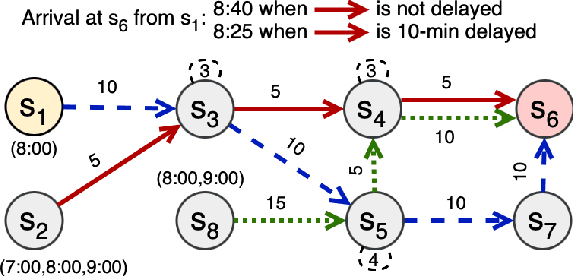

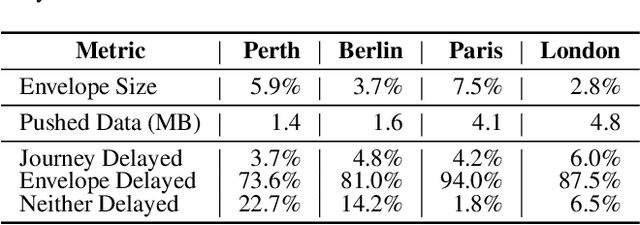
Delays in public transport are common, often impacting users through prolonged travel times and missed transfers. Existing solutions for handling delays remain limited; backup plans based on historical data miss opportunities for earlier arrivals, while snapshot planning accounts for current delays but not future ones. With the growing availability of live delay data, users can adjust their journeys in real-time. However, the literature lacks a framework that fully exploits this advantage for system-scale dynamic replanning. To address this, we formalise the dynamic replanning problem in public transport routing and propose two solutions: a "pull" approach, where users manually request replanning, and a novel "push" approach, where the server proactively monitors and adjusts journeys. Our experiments show that the push approach outperforms the pull approach, achieving significant speedups. The results also reveal substantial arrival time savings enabled by dynamic replanning.