 Add to Chrome
 Add to Firefox
 Add to Edge
Vines-DB: An RGB image dataset for multi-species ornamental vine segmentation
Jun 16, 2026
The Vines-DB dataset contains 1,218 original high-resolution RGB images of seven ornamental vine species collected under field conditions at the Utah Agricultural Experiment Station's Greenville Research Farm in Logan, Utah, USA. The dataset was generated from 168 individual vine plants that were transplanted in 2022 and photographed repeatedly across multiple months during the 2023 and 2024 growing seasons (July-October). Images were captured with an iPhone 16 Pro equipped with a 48 MP camera between 10:00 AM and 12:00 PM under daylight. Vines were grown on 1.2m x 2.4m trellises and photographed from a distance of 1m against black or white Styrofoam backdrops to improve contrast and reduce background noise. The dataset includes Akebia quinata, Campsis radicans, Hydrangea anomala petiolaris, Lonicera x heckrottii, Campsis x tagliabuana 'Madame Galen', Parthenocissus quinquefolia, and Wisteria floribunda. All original images were manually annotated in Roboflow by trained annotators to produce polygon-based instance segmentation masks for eight classes, including seven species and background. After preprocessing and data augmentation, the working dataset was expanded to 2,307 images for model development and evaluation. The augmented dataset was divided into 2,019 training images, 192 validation images, and 96 test images using stratified sampling to maintain balanced representation. Vines-DB supports the development and evaluation of deep learning models for multi-class instance segmentation in precision horticulture and urban ecology. The dataset enables applications such as automated canopy cover estimation, species identification, and scalable field phenotyping. In addition, repeated monthly imaging of the plants captures temporal variation in canopy development and plant appearance, increasing the dataset's utility for segmentation benchmarking under realistic field conditions.

USU-Corn-WeedDB: A UAV RGB Image Dataset for Multi-Species Weed Detection in Forage Corn
Jun 04, 2026Weed pressure in forage corn production causes yield losses of up to 31.5%, yet site-specific weed management (SSWM) systems built on UAV imagery and deep learning remain constrained by the scarcity of field-representative training datasets. We present USU-Corn-WeedDB, a publicly available UAV RGB image dataset collected from a commercial forage corn field in Cache Valley, Utah, designed to support multi-class weed detection under both supervised and semi-supervised learning frameworks. RGB imagery was acquired on 27 June 2025 using an Autel EVO II Dual 640T V2 drone at ~10m above ground level, yielding a ground sampling distance of approximately 0.48 cm/pixel. A total of 366 full-resolution images were tiled into 8,800 patches at 640 x 640-pixel resolution. Of these, 800 images were manually annotated for three weed species; common lambsquarters (Chenopodium album), redroot pigweed (Amaranthus retroflexus), and green foxtail (Setaria viridis) comprising 10,539 bounding-box instances, with the remaining 8,000 tiles retained as an unlabeled pool for semi-supervised experiments. This dataset reflects a natural class imbalance where redroot pigweed constitutes 53.86% of annotated instances, which was preserved intentionally to mirror real field conditions. To validate dataset utility, we trained 28 object detection models spanning five architecture families including YOLOv8, YOLOv9, YOLOv10, YOLO11, YOLO26, and RT-DETR under identical conditions without hyperparameter tuning. Test set mAP@0.5 ranged from 0.773 to 0.840, with lightweight models achieving competitive performance relevant to edge-deployed UAV systems. USU-Corn-WeedDB is publicly available at https://doi.org/10.5281/zenodo.20044178.
4Weed Dataset: Annotated Imagery Weeds Dataset
Mar 29, 2022
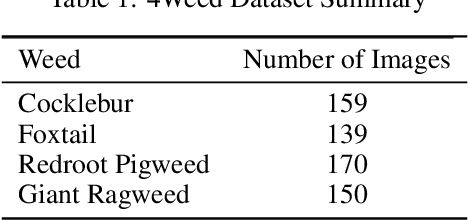
Weeds are a major threat to crops and are responsible for reducing crop yield worldwide. To mitigate their negative effect, it is advantageous to accurately identify them early in the season to prevent their spread throughout the field. Traditionally, farmers rely on manually scouting fields and applying herbicides for different weeds. However, it is easy to confuse between crops with weeds during the early growth stages. Recently, deep learning-based weed identification has become popular as deep learning relies on convolutional neural networks that are capable of learning important distinguishable features between weeds and crops. However, training robust deep learning models requires access to large imagery datasets. Therefore, an early-season weeds dataset was acquired under field conditions. The dataset consists of 159 Cocklebur images, 139 Foxtail images, 170 Redroot Pigweed images and 150 Giant Ragweed images corresponding to four common weed species found in corn and soybean production systems.. Bounding box annotations were created for each image to prepare the dataset for training both image classification and object detection deep learning networks capable of accurately locating and identifying weeds within corn and soybean fields. (https://osf.io/w9v3j/)