 Add to Chrome
 Add to Firefox
 Add to Edge
Principal Graphs and Manifolds
May 09, 2011


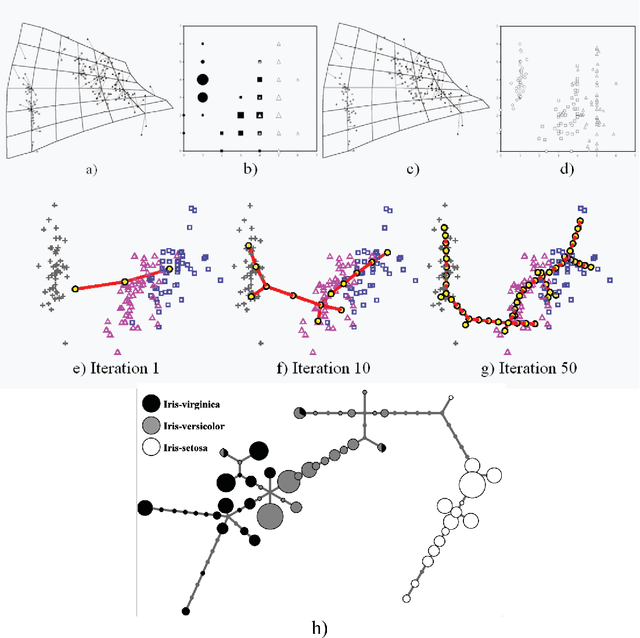

In many physical, statistical, biological and other investigations it is desirable to approximate a system of points by objects of lower dimension and/or complexity. For this purpose, Karl Pearson invented principal component analysis in 1901 and found 'lines and planes of closest fit to system of points'. The famous k-means algorithm solves the approximation problem too, but by finite sets instead of lines and planes. This chapter gives a brief practical introduction into the methods of construction of general principal objects, i.e. objects embedded in the 'middle' of the multidimensional data set. As a basis, the unifying framework of mean squared distance approximation of finite datasets is selected. Principal graphs and manifolds are constructed as generalisations of principal components and k-means principal points. For this purpose, the family of expectation/maximisation algorithms with nearest generalisations is presented. Construction of principal graphs with controlled complexity is based on the graph grammar approach.
* 36 pages, 6 figures, minor corrections

Topological Grammars for Data Approximation
Jul 28, 2006

A method of {\it topological grammars} is proposed for multidimensional data approximation. For data with complex topology we define a {\it principal cubic complex} of low dimension and given complexity that gives the best approximation for the dataset. This complex is a generalization of linear and non-linear principal manifolds and includes them as particular cases. The problem of optimal principal complex construction is transformed into a series of minimization problems for quadratic functionals. These quadratic functionals have a physically transparent interpretation in terms of elastic energy. For the energy computation, the whole complex is represented as a system of nodes and springs. Topologically, the principal complex is a product of one-dimensional continuums (represented by graphs), and the grammars describe how these continuums transform during the process of optimal complex construction. This factorization of the whole process onto one-dimensional transformations using minimization of quadratic energy functionals allow us to construct efficient algorithms.
* Corrected Journal version, Appl. Math. Lett., in press. 7 pgs., 2 figs