 Add to Chrome
 Add to Firefox
 Add to Edge
Neural posterior estimation of the neutrino direction in IceCube using transformer-encoded normalizing flows on the sphere
Apr 21, 2026
IceCube is a cubic-kilometer-scale neutrino detector located at the geographic South Pole. A precise directional reconstruction of IceCube neutrinos is vital for associations with astronomical objects. In this context, we discuss neural posterior estimation of the neutrino direction via a transformer encoder that maps to a normalizing flow on the 2-sphere. It achieves a new state-of-the-art angular resolution for the two main event morphologies in IceCube - tracks and showers - while being significantly faster than traditional B-spline-based likelihood reconstructions. All-sky scans can be performed within seconds rather than hours, and take constant computation time, regardless of whether the posterior extent is arc-minutes or spans the whole sky. We utilize a combination of $C^2$-smooth rational-quadratic splines, scale transformations and rotations to define a novel spherical normalizing-flow distribution whose parameters are predicted as a whole as the output of the transformer encoder. We test several structural choices diverting from the vanilla transformer architecture. In particular, we find dual residual streams, nonlinear QKV projection and a separate class token with its own cross-attention processing to boost test-time performance. The angular resolution for both showers and tracks improves substantially over the whole trained energy range from 100 GeV to 100 PeV. At 100 TeV deposited energy, for example, the median angular resolution improves by a factor of $1.3$ for throughgoing tracks, by a factor of $1.7$ for showers and by a factor of $2.5$ for starting tracks compared to state-of-the art likelihood reconstructions based on B-splines. While previous machine-learning (ML) efforts have managed to obtain competitive shower resolutions, this is the first time an ML-based method outperforms likelihood-based muon reconstructions above 100 GeV.

HABNet: Machine Learning, Remote Sensing Based Detection and Prediction of Harmful Algal Blooms
Dec 04, 2019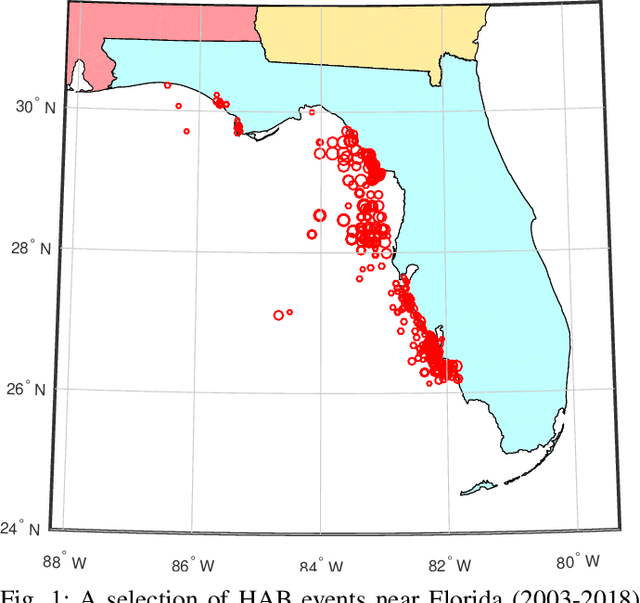
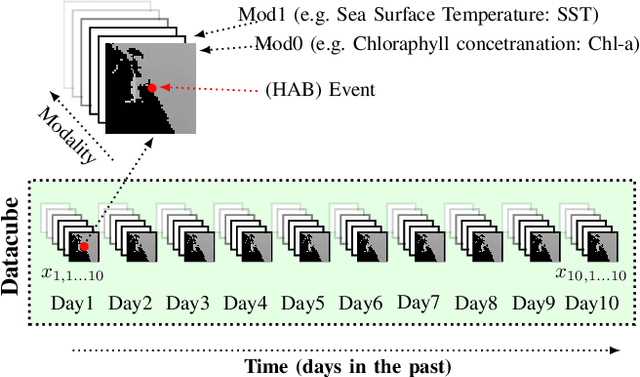
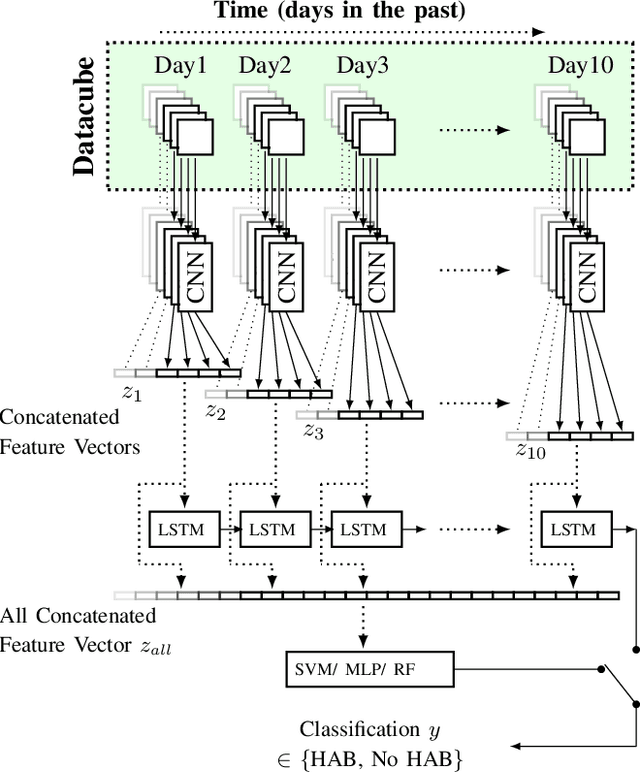
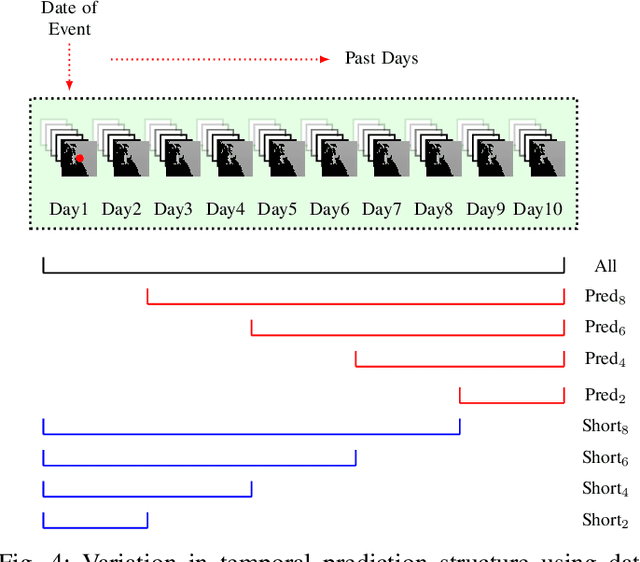
This paper describes the application of machine learning techniques to develop a state-of-the-art detection and prediction system for spatiotemporal events found within remote sensing data; specifically, Harmful Algal Bloom events (HABs). HABs cause a large variety of human health and environmental issues together with associated economic impacts. This work has focused specifically on the case study of the detection of Karenia Brevis Algae (K. brevis) HAB events within the coastal waters of Florida (over 2850 events from 2003 to 2018: an order of magnitude larger than any previous machine learning detection study into HAB events). The development of multimodal spatiotemporal datacube data structures and associated novel machine learning methods give a unique architecture for the automatic detection of environmental events. Specifically, when applied to the detection of HAB events it gives a maximum detection accuracy of 91\% and a Kappa coefficient of 0.81 for the Florida data considered. A HAB prediction system was also developed where a temporal subset of each datacube was used to forecast the presence of a HAB in the future. This system was not significantly less accurate than the detection system being able to predict with 86\% accuracy up to 8 days in the future. The same datacube and machine learning structure were also applied to a more limited database of multi-species HAB events within the Arabian Gulf. This results for this additional study gave a classification accuracy of 93\% and a Kappa coefficient of 0.83.