 Add to Chrome
 Add to Firefox
 Add to Edge
Recognition of handwritten MNIST digits on low-memory 2 Kb RAM Arduino board using LogNNet reservoir neural network
Apr 20, 2021
The presented compact algorithm for recognizing handwritten digits of the MNIST database, created on the LogNNet reservoir neural network, reaches the recognition accuracy of 82%. The algorithm was tested on a low-memory Arduino board with 2 Kb static RAM low-power microcontroller. The dependences of the accuracy and time of image recognition on the number of neurons in the reservoir have been investigated. The memory allocation demonstrates that the algorithm stores all the necessary information in RAM without using additional data storage, and operates with original images without preliminary processing. The simple structure of the algorithm, with appropriate training, can be adapted for wide practical application, for example, for creating mobile biosensors for early diagnosis of adverse events in medicine. The study results are important for the implementation of artificial intelligence on peripheral constrained IoT devices and for edge computing.

Reservoir Computing using High Order Synchronization of Coupled Oscillators
Apr 08, 2020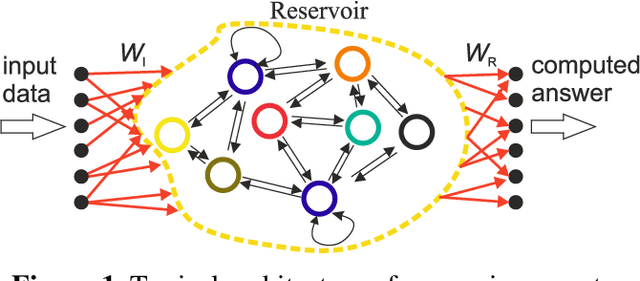


We propose a concept for reservoir computing on oscillators using the high-order synchronization effect. The reservoir output is presented in the form of oscillator synchronization metrics: fractional high-order synchronization value and synchronization efficiency, expressed as a percentage. Using two coupled relaxation oscillators built on VO2 switches, we created an oscillator reservoir that allows simulating the XOR operation. The reservoir can operate as with static input data (power currents, coupling forces), as with dynamic data in the form of spike sequences. Having a small number of oscillators and significant non-linearity, the reservoir expresses a wide range of dynamic states. The proposed computing concept can be implemented on oscillators of diverse nature.
The non-capacitor model of leaky integrate-and-fire $VO_2$ neuron with the thermal mechanism of the membrane potential
Oct 07, 2019


The study presents a numerical model of leaky integrate-and-fire neuron created on the basis of $VO_2$ switch. The analogue of the membrane potential in the model is the temperature of the switch channel, and the action potential from neighbouring neurons propagates along the substrate in the form of thermal pulses. We simulated the operation of three neurons and demonstrated that the total effect happens due to interference of thermal waves in the region of the neuron switching channel. The thermal mechanism of the threshold function operates due to the effect of electrical switching, and the magnitude (temperature) of the threshold can vary by external voltage. The neuron circuit does not contain capacitor, making it possible to produce a network with a high density of components, and has the potential for 3D integration due to the thermal mechanism of neurons interaction.