 Add to Chrome
 Add to Firefox
 Add to Edge
GlimmerNet: A Lightweight Grouped Dilated Depthwise Convolutions for UAV-Based Emergency Monitoring
Dec 08, 2025
Convolutional Neural Networks (CNNs) have proven highly effective for edge and mobile vision tasks due to their computational efficiency. While many recent works seek to enhance CNNs with global contextual understanding via self-attention-based Vision Transformers, these approaches often introduce significant computational overhead. In this work, we demonstrate that it is possible to retain strong global perception without relying on computationally expensive components. We present GlimmerNet, an ultra-lightweight convolutional network built on the principle of separating receptive field diversity from feature recombination. GlimmerNet introduces Grouped Dilated Depthwise Convolutions(GDBlocks), which partition channels into groups with distinct dilation rates, enabling multi-scale feature extraction at no additional parameter cost. To fuse these features efficiently, we design a novel Aggregator module that recombines cross-group representations using grouped pointwise convolution, significantly lowering parameter overhead. With just 31K parameters and 29% fewer FLOPs than the most recent baseline, GlimmerNet achieves a new state-of-the-art weighted F1-score of 0.966 on the UAV-focused AIDERv2 dataset. These results establish a new accuracy-efficiency trade-off frontier for real-time emergency monitoring on resource-constrained UAV platforms. Our implementation is publicly available at https://github.com/djordjened92/gdd-cnn.

Cross-Camera Data Association via GNN for Supervised Graph Clustering
Oct 01, 2024
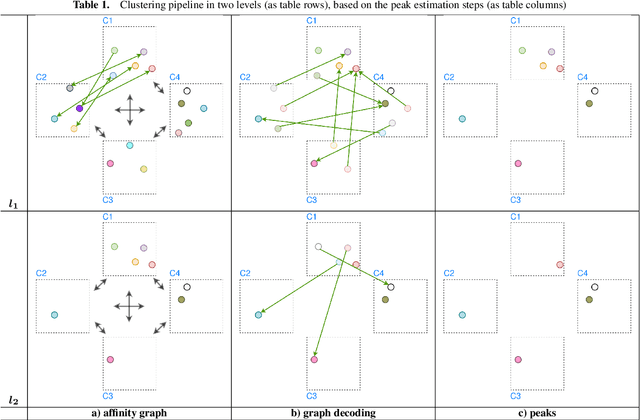
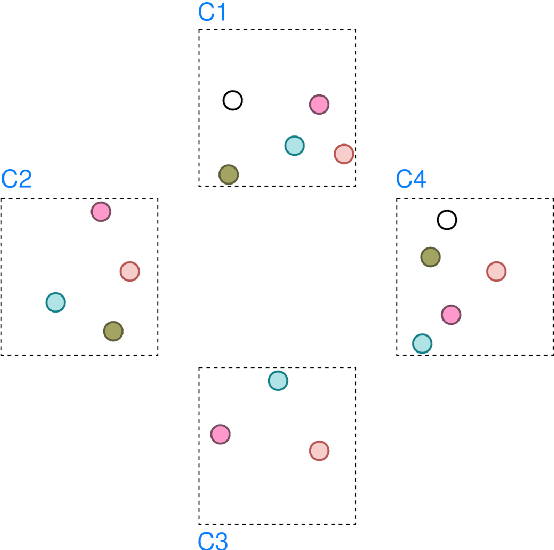
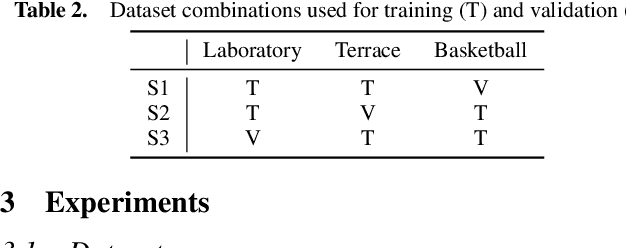
Cross-camera data association is one of the cornerstones of the multi-camera computer vision field. Although often integrated into detection and tracking tasks through architecture design and loss definition, it is also recognized as an independent challenge. The ultimate goal is to connect appearances of one item from all cameras, wherever it is visible. Therefore, one possible perspective on this task involves supervised clustering of the affinity graph, where nodes are instances captured by all cameras. They are represented by appropriate visual features and positional attributes. We leverage the advantages of GNN (Graph Neural Network) architecture to examine nodes' relations and generate representative edge embeddings. These embeddings are then classified to determine the existence or non-existence of connections in node pairs. Therefore, the core of this approach is graph connectivity prediction. Experimental validation was conducted on multicamera pedestrian datasets across diverse environments such as the laboratory, basketball court, and terrace. Our proposed method, named SGC-CCA, outperformed the state-of-the-art method named GNN-CCA across all clustering metrics, offering an end-to-end clustering solution without the need for graph post-processing. The code is available at https://github.com/djordjened92/cca-gnnclust.
YUDO: YOLO for Uniform Directed Object Detection
Aug 08, 2023This paper presents an efficient way of detecting directed objects by predicting their center coordinates and direction angle. Since the objects are of uniform size, the proposed model works without predicting the object's width and height. The dataset used for this problem is presented in Honeybee Segmentation and Tracking Datasets project. One of the contributions of this work is an examination of the ability of the standard real-time object detection architecture like YoloV7 to be customized for position and direction detection. A very efficient, tiny version of the architecture is used in this approach. Moreover, only one of three detection heads without anchors is sufficient for this task. We also introduce the extended Skew Intersection over Union (SkewIoU) calculation for rotated boxes - directed IoU (DirIoU), which includes an absolute angle difference. DirIoU is used both in the matching procedure of target and predicted bounding boxes for mAP calculation, and in the NMS filtering procedure. The code and models are available at https://github.com/djordjened92/yudo.