 Add to Chrome
 Add to Firefox
 Add to Edge
Subgoaling Relaxation-based Heuristics for Numeric Planning with Infinite Actions
Dec 26, 2025
Numeric planning with control parameters extends the standard numeric planning model by introducing action parameters as free numeric variables that must be instantiated during planning. This results in a potentially infinite number of applicable actions in a state. In this setting, off-the-shelf numeric heuristics that leverage the action structure are not feasible. In this paper, we identify a tractable subset of these problems--namely, controllable, simple numeric problems--and propose an optimistic compilation approach that transforms them into simple numeric tasks. To do so, we abstract control-dependent expressions into bounded constant effects and relaxed preconditions. The proposed compilation makes it possible to effectively use subgoaling heuristics to estimate goal distance in numeric planning problems involving control parameters. Our results demonstrate that this approach is an effective and computationally feasible way of applying traditional numeric heuristics to settings with an infinite number of possible actions, pushing the boundaries of the current state of the art.

Handling Infinite Domain Parameters in Planning Through Best-First Search with Delayed Partial Expansions
Sep 04, 2025In automated planning, control parameters extend standard action representations through the introduction of continuous numeric decision variables. Existing state-of-the-art approaches have primarily handled control parameters as embedded constraints alongside other temporal and numeric restrictions, and thus have implicitly treated them as additional constraints rather than as decision points in the search space. In this paper, we propose an efficient alternative that explicitly handles control parameters as true decision points within a systematic search scheme. We develop a best-first, heuristic search algorithm that operates over infinite decision spaces defined by control parameters and prove a notion of completeness in the limit under certain conditions. Our algorithm leverages the concept of delayed partial expansion, where a state is not fully expanded but instead incrementally expands a subset of its successors. Our results demonstrate that this novel search algorithm is a competitive alternative to existing approaches for solving planning problems involving control parameters.
An Efficient Approach for Cooperative Multi-Agent Learning Problems
Apr 07, 2025In this article, we propose a centralized Multi-Agent Learning framework for learning a policy that models the simultaneous behavior of multiple agents that need to coordinate to solve a certain task. Centralized approaches often suffer from the explosion of an action space that is defined by all possible combinations of individual actions, known as joint actions. Our approach addresses the coordination problem via a sequential abstraction, which overcomes the scalability problems typical to centralized methods. It introduces a meta-agent, called \textit{supervisor}, which abstracts joint actions as sequential assignments of actions to each agent. This sequential abstraction not only simplifies the centralized joint action space but also enhances the framework's scalability and efficiency. Our experimental results demonstrate that the proposed approach successfully coordinates agents across a variety of Multi-Agent Learning environments of diverse sizes.
* Accepted at ICTAI 2024
Meta-operators for Enabling Parallel Planning Using Deep Reinforcement Learning
Mar 13, 2024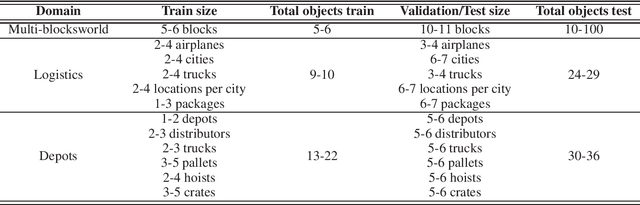
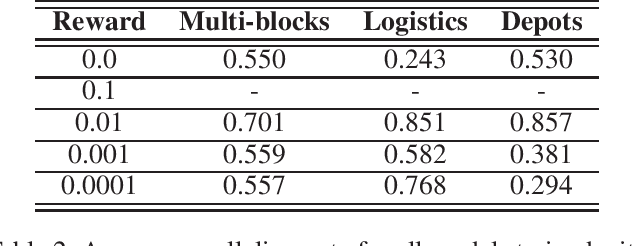
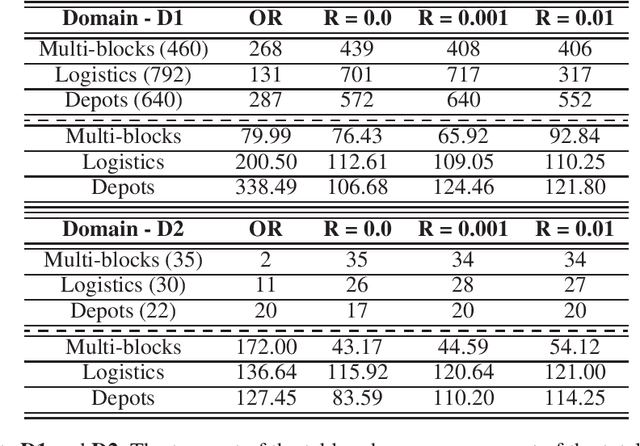
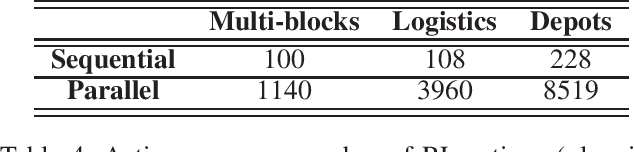
There is a growing interest in the application of Reinforcement Learning (RL) techniques to AI planning with the aim to come up with general policies. Typically, the mapping of the transition model of AI planning to the state transition system of a Markov Decision Process is established by assuming a one-to-one correspondence of the respective action spaces. In this paper, we introduce the concept of meta-operator as the result of simultaneously applying multiple planning operators, and we show that including meta-operators in the RL action space enables new planning perspectives to be addressed using RL, such as parallel planning. Our research aims to analyze the performance and complexity of including meta-operators in the RL process, concretely in domains where satisfactory outcomes have not been previously achieved using usual generalized planning models. The main objective of this article is thus to pave the way towards a redefinition of the RL action space in a manner that is more closely aligned with the planning perspective.