 Add to Chrome
 Add to Firefox
 Add to Edge
DocSeeker: Structured Visual Reasoning with Evidence Grounding for Long Document Understanding
Apr 14, 2026
Existing Multimodal Large Language Models (MLLMs) suffer from significant performance degradation on the long document understanding task as document length increases. This stems from two fundamental challenges: 1) a low Signal-to-Noise Ratio (SNR), with crucial evidence buried in irrelevant pages; and 2) supervision scarcity, as datasets offering only final short answers provide a weak learning signal. In this paper, we address these challenges by proposing a paradigm that requires the model to execute a structured ``\textbf{Analysis}, \textbf{Localization} and \textbf{Reasoning}'' workflow. To instill this capability, we design a two-stage training framework: we first perform Supervised Fine-Tuning on high-quality data generated via an efficient knowledge distillation strategy. Subsequently, we employ an Evidence-aware Group Relative Policy Optimization which jointly optimizes for both evidence localization and answer accuracy. Additionally, we introduce a Evidence-Guided Resolution Allocation strategy to mitigate memory constraints of training on multi-pages documents. Extensive experiments demonstrate that DocSeeker achieves superior performance on both in-domain and out-of-domain tasks. We show it robustly generalizes from short-page training to ultra-long documents and is naturally synergistic with visual Retrieval-Augmented Generation systems, serving as a solid foundation for their implementation.

MDPBench: A Benchmark for Multilingual Document Parsing in Real-World Scenarios
Mar 30, 2026We introduce Multilingual Document Parsing Benchmark, the first benchmark for multilingual digital and photographed document parsing. Document parsing has made remarkable strides, yet almost exclusively on clean, digital, well-formatted pages in a handful of dominant languages. No systematic benchmark exists to evaluate how models perform on digital and photographed documents across diverse scripts and low-resource languages. MDPBench comprises 3,400 document images spanning 17 languages, diverse scripts, and varied photographic conditions, with high-quality annotations produced through a rigorous pipeline of expert model labeling, manual correction, and human verification. To ensure fair comparison and prevent data leakage, we maintain separate public and private evaluation splits. Our comprehensive evaluation of both open-source and closed-source models uncovers a striking finding: while closed-source models (notably Gemini3-Pro) prove relatively robust, open-source alternatives suffer dramatic performance collapse, particularly on non-Latin scripts and real-world photographed documents, with an average drop of 17.8% on photographed documents and 14.0% on non-Latin scripts. These results reveal significant performance imbalances across languages and conditions, and point to concrete directions for building more inclusive, deployment-ready parsing systems. Source available at https://github.com/Yuliang-Liu/MultimodalOCR.
Heddle: A Distributed Orchestration System for Agentic RL Rollout
Mar 30, 2026Agentic Reinforcement Learning (RL) enables LLMs to solve complex tasks by alternating between a data-collection rollout phase and a policy training phase. During rollout, the agent generates trajectories, i.e., multi-step interactions between LLMs and external tools. Yet, frequent tool calls induce long-tailed trajectory generation that bottlenecks rollouts. This stems from step-centric designs that ignore trajectory context, triggering three system problems for long-tail trajectory generation: queueing delays, interference overhead, and inflated per-token time. We propose Heddle, a trajectory-centric system to optimize the when, where, and how of agentic rollout execution. Heddle integrates three core mechanisms: trajectory-level scheduling using runtime prediction and progressive priority to minimize cumulative queueing; trajectory-aware placement via presorted dynamic programming and opportunistic migration during idle tool call intervals to minimize interference; and trajectory-adaptive resource manager that dynamically tunes model parallelism to accelerate the per-token time of long-tail trajectories while maintaining high throughput for short trajectories. Evaluations across diverse agentic RL workloads demonstrate that Heddle effectively neutralizes the long-tail bottleneck, achieving up to 2.5$\times$ higher end-to-end rollout throughput compared to state-of-the-art baselines.
Multimodal OCR: Parse Anything from Documents
Mar 13, 2026We present Multimodal OCR (MOCR), a document parsing paradigm that jointly parses text and graphics into unified textual representations. Unlike conventional OCR systems that focus on text recognition and leave graphical regions as cropped pixels, our method, termed dots.mocr, treats visual elements such as charts, diagrams, tables, and icons as first-class parsing targets, enabling systems to parse documents while preserving semantic relationships across elements. It offers several advantages: (1) it reconstructs both text and graphics as structured outputs, enabling more faithful document reconstruction; (2) it supports end-to-end training over heterogeneous document elements, allowing models to exploit semantic relations between textual and visual components; and (3) it converts previously discarded graphics into reusable code-level supervision, unlocking multimodal supervision embedded in existing documents. To make this paradigm practical at scale, we build a comprehensive data engine from PDFs, rendered webpages, and native SVG assets, and train a compact 3B-parameter model through staged pretraining and supervised fine-tuning. We evaluate dots.mocr from two perspectives: document parsing and structured graphics parsing. On document parsing benchmarks, it ranks second only to Gemini 3 Pro on our OCR Arena Elo leaderboard, surpasses existing open-source document parsing systems, and sets a new state of the art of 83.9 on olmOCR Bench. On structured graphics parsing, dots.mocr achieves higher reconstruction quality than Gemini 3 Pro across image-to-SVG benchmarks, demonstrating strong performance on charts, UI layouts, scientific figures, and chemical diagrams. These results show a scalable path toward building large-scale image-to-code corpora for multimodal pretraining. Code and models are publicly available at https://github.com/rednote-hilab/dots.mocr.
Video Streaming Thinking: VideoLLMs Can Watch and Think Simultaneously
Mar 12, 2026Online Video Large Language Models (VideoLLMs) play a critical role in supporting responsive, real-time interaction. Existing methods focus on streaming perception, lacking a synchronized logical reasoning stream. However, directly applying test-time scaling methods incurs unacceptable response latency. To address this trade-off, we propose Video Streaming Thinking (VST), a novel paradigm for streaming video understanding. It supports a thinking while watching mechanism, which activates reasoning over incoming video clips during streaming. This design improves timely comprehension and coherent cognition while preserving real-time responsiveness by amortizing LLM reasoning latency over video playback. Furthermore, we introduce a comprehensive post-training pipeline that integrates VST-SFT, which structurally adapts the offline VideoLLM to causal streaming reasoning, and VST-RL, which provides end-to-end improvement through self-exploration in a multi-turn video interaction environment. Additionally, we devise an automated training-data synthesis pipeline that uses video knowledge graphs to generate high-quality streaming QA pairs, with an entity-relation grounded streaming Chain-of-Thought to enforce multi-evidence reasoning and sustained attention to the video stream. Extensive evaluations show that VST-7B performs strongly on online benchmarks, e.g. 79.5% on StreamingBench and 59.3% on OVO-Bench. Meanwhile, VST remains competitive on offline long-form or reasoning benchmarks. Compared with Video-R1, VST responds 15.7 times faster and achieves +5.4% improvement on VideoHolmes, demonstrating higher efficiency and strong generalization across diverse video understanding tasks. Code, data, and models will be released at https://github.com/1ranGuan/VST.
TextPecker: Rewarding Structural Anomaly Quantification for Enhancing Visual Text Rendering
Feb 26, 2026Visual Text Rendering (VTR) remains a critical challenge in text-to-image generation, where even advanced models frequently produce text with structural anomalies such as distortion, blurriness, and misalignment. However, we find that leading MLLMs and specialist OCR models largely fail to perceive these structural anomalies, creating a critical bottleneck for both VTR evaluation and RL-based optimization. As a result, even state-of-the-art generators (e.g., Seedream4.0, Qwen-Image) still struggle to render structurally faithful text. To address this, we propose TextPecker, a plug-and-play structural anomaly perceptive RL strategy that mitigates noisy reward signals and works with any textto-image generator. To enable this capability, we construct a recognition dataset with character-level structural-anomaly annotations and develop a stroke-editing synthesis engine to expand structural-error coverage. Experiments show that TextPecker consistently improves diverse text-to-image models; even on the well-optimized Qwen-Image, it significantly yields average gains of 4% in structural fidelity and 8.7% in semantic alignment for Chinese text rendering, establishing a new state-of-the-art in high-fidelity VTR. Our work fills a gap in VTR optimization, providing a foundational step towards reliable and structural faithful visual text generation.
ThinkOmni: Lifting Textual Reasoning to Omni-modal Scenarios via Guidance Decoding
Feb 26, 2026Omni-modal reasoning is essential for intelligent systems to understand and draw inferences from diverse data sources. While existing omni-modal large language models (OLLM) excel at perceiving diverse modalities, they lack the complex reasoning abilities of recent large reasoning models (LRM). However, enhancing the reasoning ability of OLLMs through additional training presents significant challenges, including the need for high-quality data, task-specific adaptation, and substantial computational costs. To address these limitations, we propose ThinkOmni, a training-free and data-free framework that lifts textual reasoning to omni-modal scenarios. ThinkOmni introduces two key components: 1) LRM-as-a-Guide, which leverages off-the-shelf LRMs to guide the OLLM decoding process; 2) Stepwise Contrastive Scaling, which adaptively balances perception and reasoning signals without manual hyperparameter tuning. Experiments on six multi-modal reasoning benchmarks demonstrate that ThinkOmni consistently delivers performance improvements, with main results achieving 70.2 on MathVista and 75.5 on MMAU. Overall, ThinkOmni offers a flexible and generalizable solution for omni-modal reasoning and provides new insights into the generalization and application of reasoning capabilities.
GeoFocus: Blending Efficient Global-to-Local Perception for Multimodal Geometry Problem-Solving
Feb 09, 2026Geometry problem-solving remains a significant challenge for Large Multimodal Models (LMMs), requiring not only global shape recognition but also attention to intricate local relationships related to geometric theory. To address this, we propose GeoFocus, a novel framework comprising two core modules. 1) Critical Local Perceptor, which automatically identifies and emphasizes critical local structure (e.g., angles, parallel lines, comparative distances) through thirteen theory-based perception templates, boosting critical local feature coverage by 61% compared to previous methods. 2) VertexLang, a compact topology formal language, encodes global figures through vertex coordinates and connectivity relations. By replacing bulky code-based encodings, VertexLang reduces global perception training time by 20% while improving topology recognition accuracy. When evaluated in Geo3K, GeoQA, and FormalGeo7K, GeoFocus achieves a 4.7% accuracy improvement over leading specialized models and demonstrates superior robustness in MATHVERSE under diverse visual conditions. Project Page -- https://github.com/dle666/GeoFocus
Next Concept Prediction in Discrete Latent Space Leads to Stronger Language Models
Feb 09, 2026We propose Next Concept Prediction (NCP), a generative pretraining paradigm built on top of Next Token Prediction (NTP). NCP predicts discrete concepts that span multiple tokens, thereby forming a more challenging pretraining objective. Our model, ConceptLM, quantizes hidden states using Vector Quantization and constructs a concept vocabulary. It leverages both NCP and NTP to drive parameter updates and generates a concept to guide the generation of the following tokens. We train ConceptLM from scratch at scales ranging from 70M to 1.5B parameters with up to 300B training data, including Pythia and GPT-2 backbones. Results on 13 benchmarks show that NCP yields consistent performance gains over traditional token-level models. Furthermore, continual pretraining experiments on an 8B-parameter Llama model indicate that NCP can further improve an NTP-trained model. Our analysis suggests that NCP leads to more powerful language models by introducing a harder pretraining task, providing a promising path toward better language modeling.
Kling-Omni Technical Report
Dec 18, 2025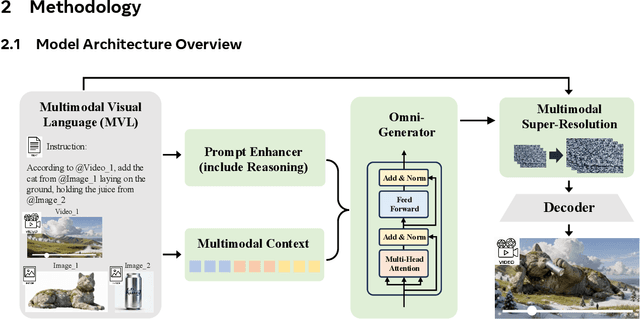
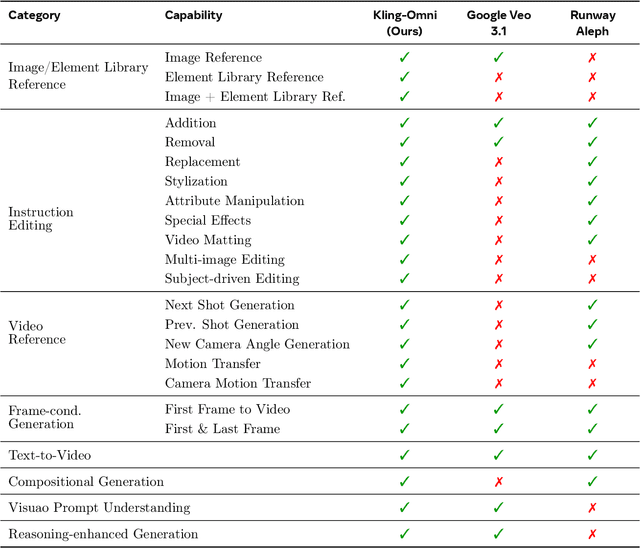
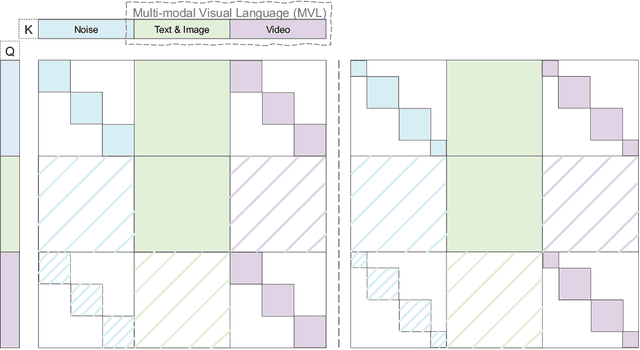
We present Kling-Omni, a generalist generative framework designed to synthesize high-fidelity videos directly from multimodal visual language inputs. Adopting an end-to-end perspective, Kling-Omni bridges the functional separation among diverse video generation, editing, and intelligent reasoning tasks, integrating them into a holistic system. Unlike disjointed pipeline approaches, Kling-Omni supports a diverse range of user inputs, including text instructions, reference images, and video contexts, processing them into a unified multimodal representation to deliver cinematic-quality and highly-intelligent video content creation. To support these capabilities, we constructed a comprehensive data system that serves as the foundation for multimodal video creation. The framework is further empowered by efficient large-scale pre-training strategies and infrastructure optimizations for inference. Comprehensive evaluations reveal that Kling-Omni demonstrates exceptional capabilities in in-context generation, reasoning-based editing, and multimodal instruction following. Moving beyond a content creation tool, we believe Kling-Omni is a pivotal advancement toward multimodal world simulators capable of perceiving, reasoning, generating and interacting with the dynamic and complex worlds.