 Add to Chrome
 Add to Firefox
 Add to Edge
Imgur5k
Papers and Code
AttentionHTR: Handwritten Text Recognition Based on Attention Encoder-Decoder Networks
Jan 23, 2022
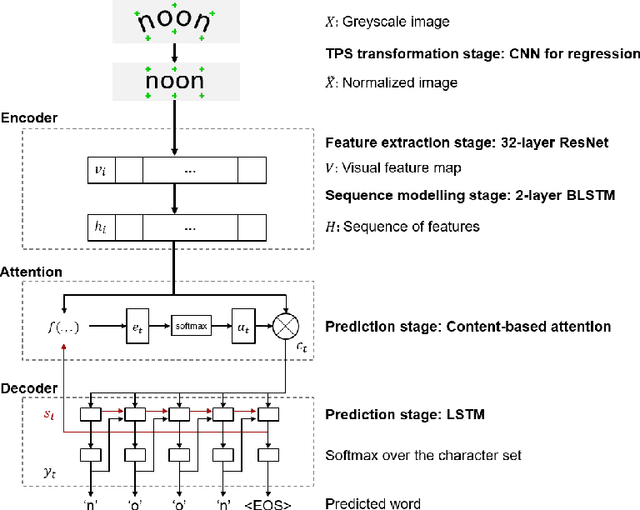
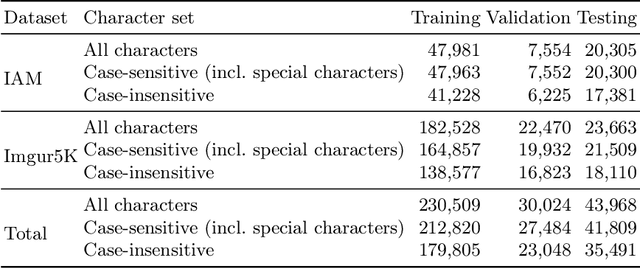
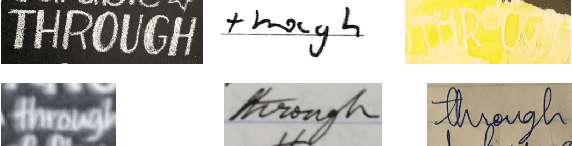
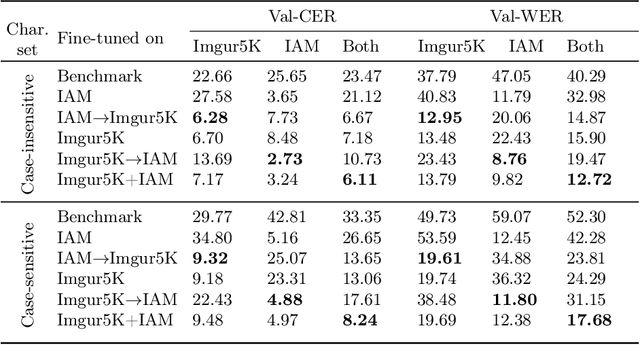
This work proposes an attention-based sequence-to-sequence model for handwritten word recognition and explores transfer learning for data-efficient training of HTR systems. To overcome training data scarcity, this work leverages models pre-trained on scene text images as a starting point towards tailoring the handwriting recognition models. ResNet feature extraction and bidirectional LSTM-based sequence modeling stages together form an encoder. The prediction stage consists of a decoder and a content-based attention mechanism. The effectiveness of the proposed end-to-end HTR system has been empirically evaluated on a novel multi-writer dataset Imgur5K and the IAM dataset. The experimental results evaluate the performance of the HTR framework, further supported by an in-depth analysis of the error cases. Source code and pre-trained models are available at https://github.com/dmitrijsk/AttentionHTR.

TextStyleBrush: Transfer of Text Aesthetics from a Single Example
Jun 15, 2021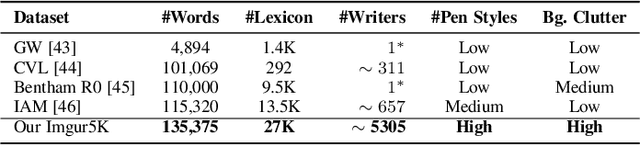
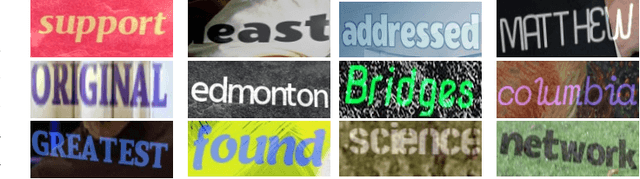
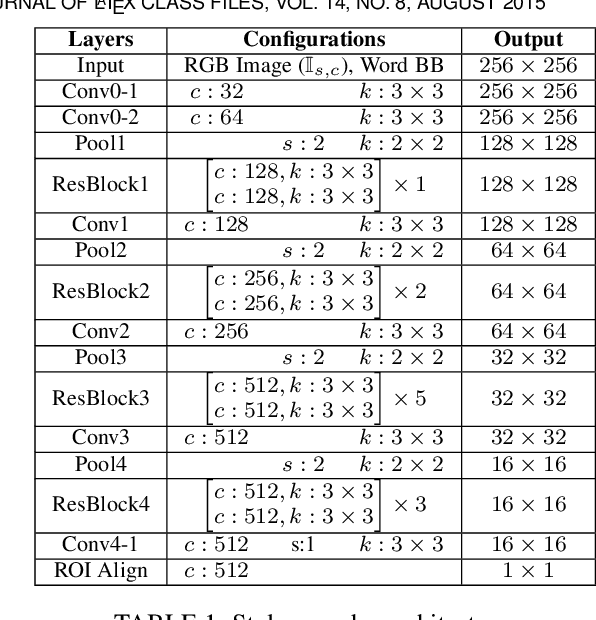
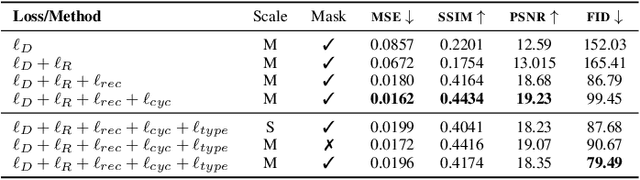
We present a novel approach for disentangling the content of a text image from all aspects of its appearance. The appearance representation we derive can then be applied to new content, for one-shot transfer of the source style to new content. We learn this disentanglement in a self-supervised manner. Our method processes entire word boxes, without requiring segmentation of text from background, per-character processing, or making assumptions on string lengths. We show results in different text domains which were previously handled by specialized methods, e.g., scene text, handwritten text. To these ends, we make a number of technical contributions: (1) We disentangle the style and content of a textual image into a non-parametric, fixed-dimensional vector. (2) We propose a novel approach inspired by StyleGAN but conditioned over the example style at different resolution and content. (3) We present novel self-supervised training criteria which preserve both source style and target content using a pre-trained font classifier and text recognizer. Finally, (4) we also introduce Imgur5K, a new challenging dataset for handwritten word images. We offer numerous qualitative photo-realistic results of our method. We further show that our method surpasses previous work in quantitative tests on scene text and handwriting datasets, as well as in a user study.