 Add to Chrome
 Add to Firefox
 Add to Edge
Towards Robust Multimodal Learning in the Open World
Paper and Code
Nov 13, 2025
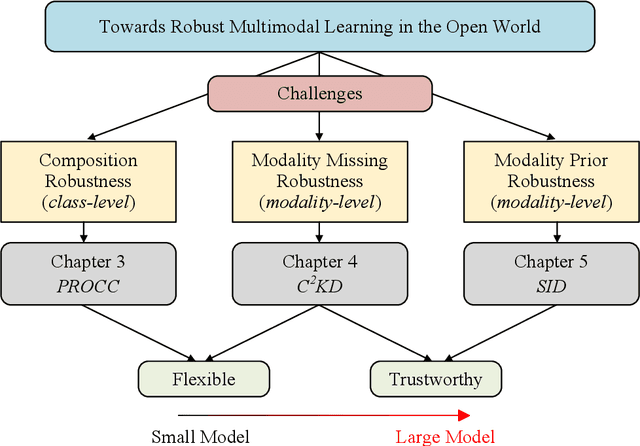
The rapid evolution of machine learning has propelled neural networks to unprecedented success across diverse domains. In particular, multimodal learning has emerged as a transformative paradigm, leveraging complementary information from heterogeneous data streams (e.g., text, vision, audio) to advance contextual reasoning and intelligent decision-making. Despite these advancements, current neural network-based models often fall short in open-world environments characterized by inherent unpredictability, where unpredictable environmental composition dynamics, incomplete modality inputs, and spurious distributions relations critically undermine system reliability. While humans naturally adapt to such dynamic, ambiguous scenarios, artificial intelligence systems exhibit stark limitations in robustness, particularly when processing multimodal signals under real-world complexity. This study investigates the fundamental challenge of multimodal learning robustness in open-world settings, aiming to bridge the gap between controlled experimental performance and practical deployment requirements.
