 Add to Chrome
 Add to Firefox
 Add to Edge
Symmetrization of 3D Generative Models
Paper and Code
Dec 22, 2025
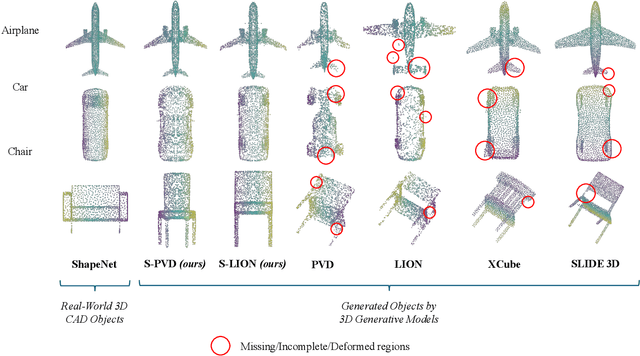
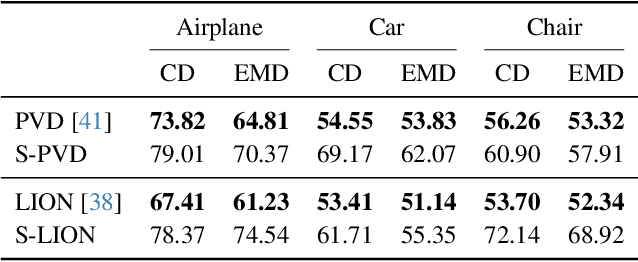
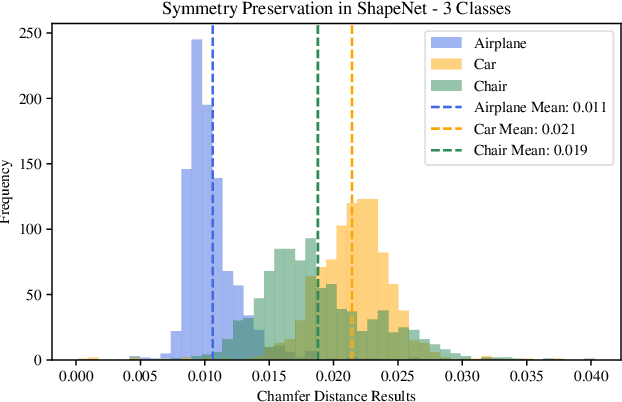
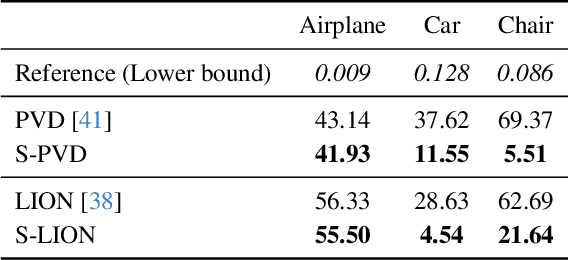
We propose a novel data-centric approach to promote symmetry in 3D generative models by modifying the training data rather than the model architecture. Our method begins with an analysis of reflectional symmetry in both real-world 3D shapes and samples generated by state-of-the-art models. We hypothesize that training a generative model exclusively on half-objects, obtained by reflecting one half of the shapes along the x=0 plane, enables the model to learn a rich distribution of partial geometries which, when reflected during generation, yield complete shapes that are both visually plausible and geometrically symmetric. To test this, we construct a new dataset of half-objects from three ShapeNet classes (Airplane, Car, and Chair) and train two generative models. Experiments demonstrate that the generated shapes are symmetrical and consistent, compared with the generated objects from the original model and the original dataset objects.
