 Add to Chrome
 Add to Firefox
 Add to Edge
SuperRivolution: Fine-Scale Rivers from Coarse Temporal Satellite Imagery
Paper and Code
Nov 12, 2025
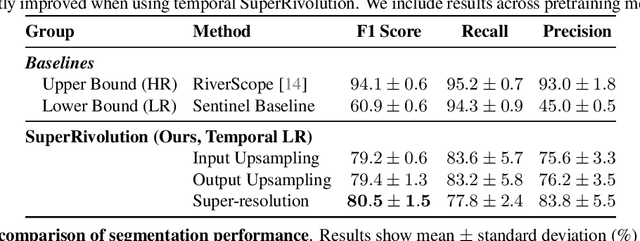
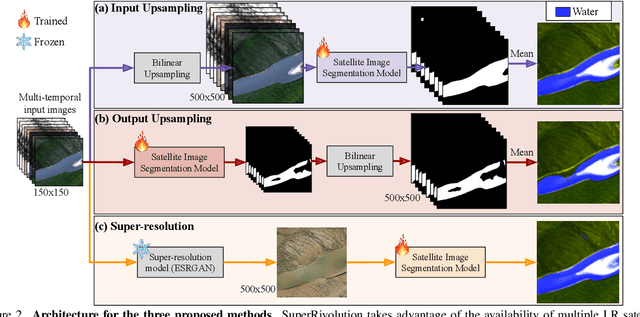
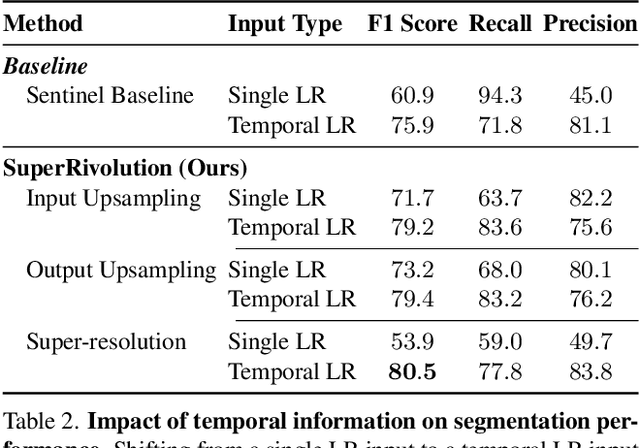
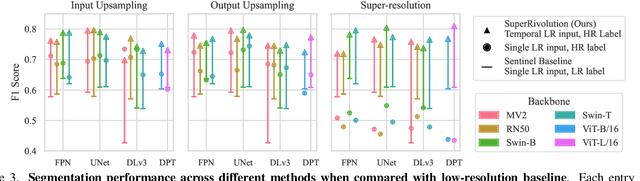
Satellite missions provide valuable optical data for monitoring rivers at diverse spatial and temporal scales. However, accessibility remains a challenge: high-resolution imagery is ideal for fine-grained monitoring but is typically scarce and expensive compared to low-resolution imagery. To address this gap, we introduce SuperRivolution, a framework that improves river segmentation resolution by leveraging information from time series of low-resolution satellite images. We contribute a new benchmark dataset of 9,810 low-resolution temporal images paired with high-resolution labels from an existing river monitoring dataset. Using this benchmark, we investigate multiple strategies for river segmentation, including ensembling single-image models, applying image super-resolution, and developing end-to-end models trained on temporal sequences. SuperRivolution significantly outperforms single-image methods and baseline temporal approaches, narrowing the gap with supervised high-resolution models. For example, the F1 score for river segmentation improves from 60.9% to 80.5%, while the state-of-the-art model operating on high-resolution images achieves 94.1%. Similar improvements are also observed in river width estimation tasks. Our results highlight the potential of publicly available low-resolution satellite archives for fine-scale river monitoring.
