 Add to Chrome
 Add to Firefox
 Add to Edge
Source Localization and Power Estimation through RISs: Performance Analysis and Prototype Validations
Paper and Code
Dec 12, 2025
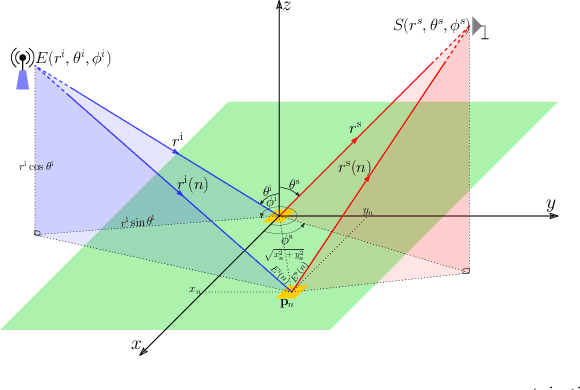


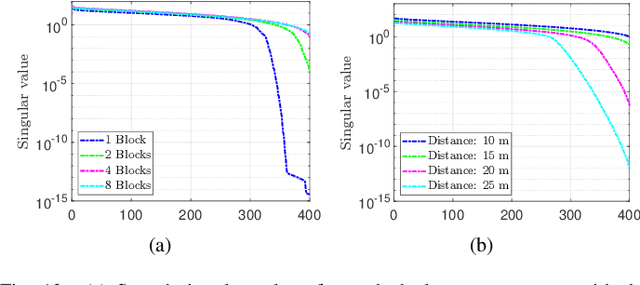
This paper investigates the capabilities and effectiveness of backward localization centered on reconfigurable intelligent surfaces (RISs). In the backward sensing paradigm, the region of interest (RoI) is illuminated using a set of diverse radiation patterns. These patterns encode spatial information into a sequence of measurements, which are subsequently processed to reconstruct the RoI. We show that a single RIS can estimate the direction of arrival of incident waves by leveraging configurational diversity, and that the spatial diversity provided by multiple RISs further improves the accuracy of source localization and power estimation. The underlying structure of the sensing operator in the multi-snapshot measurement process is clarified. For single-RIS localization, the sensing operator is decomposed into a product of structured matrices, each corresponding to a specific physical process: wave propagation to and from the RIS, the relative phase offsets of elements with respect to the reference point, and the applied phase configuration of each element. A unified framework for identifying key performance indicators is established by analyzing the conditioning of the sensing operators. In the multi-RIS setting, we derive--via rank analysis--the governing law among the RoI size, the number of elements, and the number of measurements. Upper bounds on the relative error of the least squares reconstruction algorithm are derived. These bounds clarify how key performance indicators affect estimation error and provide valuable guidance for system-level optimization. Numerical experiments confirm that the trend of the relative error is consistent with the theoretical bounds.
