 Add to Chrome
 Add to Firefox
 Add to Edge
Real-Time Human-Robot Interaction Intent Detection Using RGB-based Pose and Emotion Cues with Cross-Camera Model Generalization
Paper and Code
Dec 18, 2025
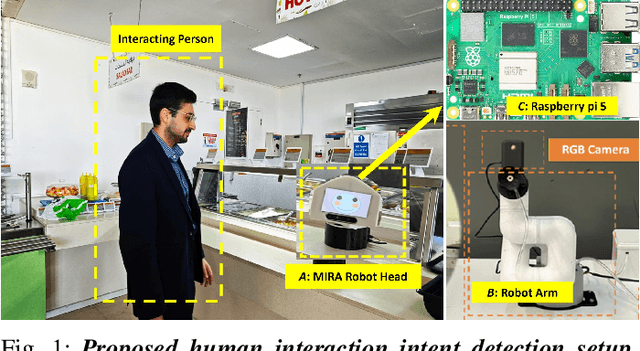
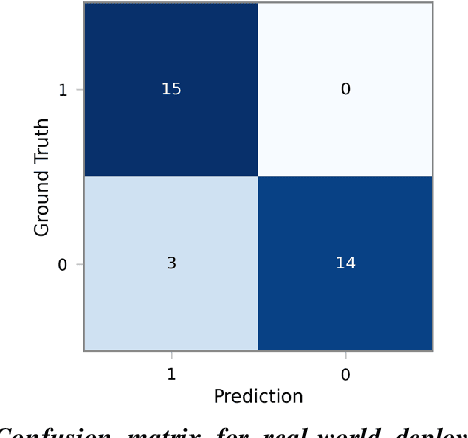

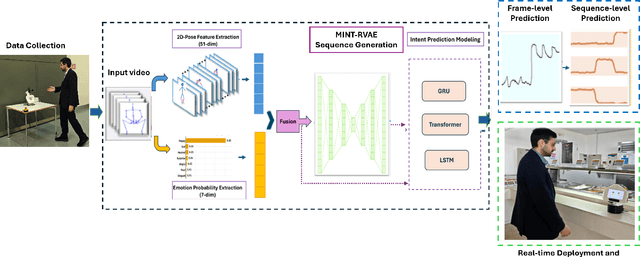
Service robots in public spaces require real-time understanding of human behavioral intentions for natural interaction. We present a practical multimodal framework for frame-accurate human-robot interaction intent detection that fuses camera-invariant 2D skeletal pose and facial emotion features extracted from monocular RGB video. Unlike prior methods requiring RGB-D sensors or GPU acceleration, our approach resource-constrained embedded hardware (Raspberry Pi 5, CPU-only). To address the severe class imbalance in natural human-robot interaction datasets, we introduce a novel approach to synthesize temporally coherent pose-emotion-label sequences for data re-balancing called MINT-RVAE (Multimodal Recurrent Variational Autoencoder for Intent Sequence Generation). Comprehensive offline evaluations under cross-subject and cross-scene protocols demonstrate strong generalization performance, achieving frame- and sequence-level AUROC of 0.95. Crucially, we validate real-world generalization through cross-camera evaluation on the MIRA robot head, which employs a different onboard RGB sensor and operates in uncontrolled environments not represented in the training data. Despite this domain shift, the deployed system achieves 91% accuracy and 100% recall across 32 live interaction trials. The close correspondence between offline and deployed performance confirms the cross-sensor and cross-environment robustness of the proposed multimodal approach, highlighting its suitability for ubiquitous multimedia-enabled social robots.
