 Add to Chrome
 Add to Firefox
 Add to Edge
OASI: Objective-Aware Surrogate Initialization for Multi-Objective Bayesian Optimization in TinyML Keyword Spotting
Paper and Code
Dec 17, 2025
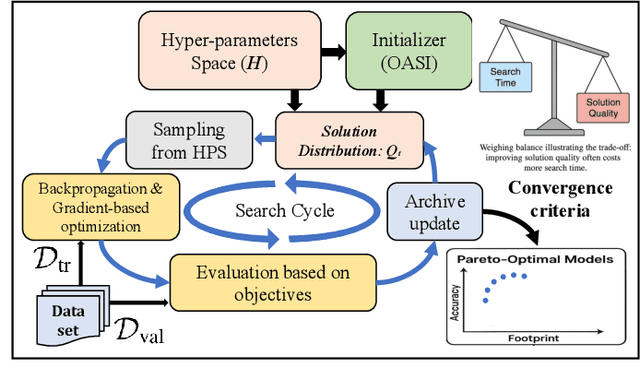
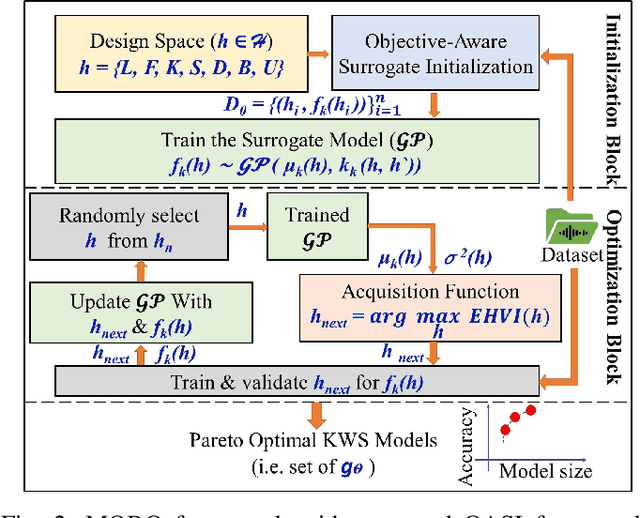
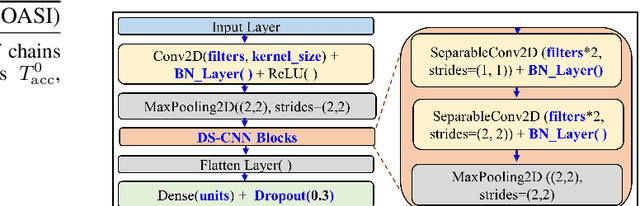
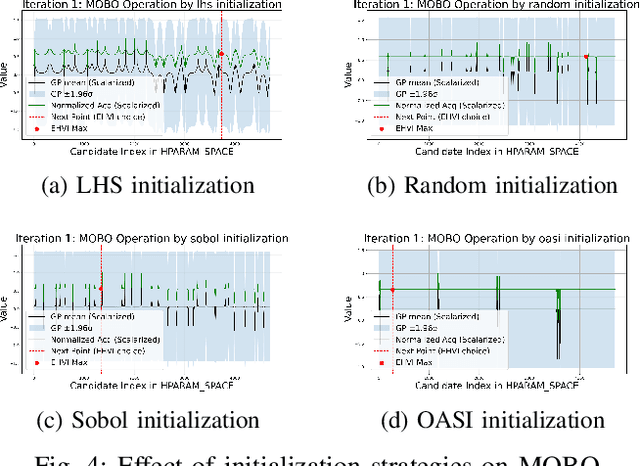
Voice assistants utilize Keyword Spotting (KWS) to enable efficient, privacy-friendly activation. However, realizing accurate KWS models on ultra-low-power TinyML devices (often with less than $<2$ MB of flash memory) necessitates a delicate balance between accuracy with strict resource constraints. Multi-objective Bayesian Optimization (MOBO) is an ideal candidate for managing such a trade-off but is highly initialization-dependent, especially under the budgeted black-box setting. Existing methods typically fall back to naive, ad-hoc sampling routines (e.g., Latin Hypercube Sampling (LHS), Sobol sequences, or Random search) that are adapted to neither the Pareto front nor undergo rigorous statistical comparison. To address this, we propose Objective-Aware Surrogate Initialization (OASI), a novel initialization strategy that leverages Multi-Objective Simulated Annealing (MOSA) to generate a seed Pareto set of high-performing and diverse configurations that explicitly balance accuracy and model size. Evaluated in a TinyML KWS setting, OASI outperforms LHS, Sobol, and Random initialization, achieving the highest hypervolume (0.0627) and the lowest generational distance (0.0) across multiple runs, with only a modest increase in computation time (1934 s vs. $\sim$1500 s). A non-parametric statistical analysis using the Kruskal-Wallis test ($H = 5.40$, $p = 0.144$, $η^2 = 0.0007$) and Dunn's post-hoc test confirms OASI's superior consistency despite the non-significant overall difference with respect to the $α=0.05$ threshold.
