Get our free extension to see links to code for papers anywhere online!Free add-on: code for papers everywhere!Free add-on: See code for papers anywhere!
 Add to Chrome
 Add to Firefox
 Add to Edge
Kernel Ridge Regression for Efficient Learning of High-Capacity Hopfield Networks
Paper and Code
Apr 17, 2025
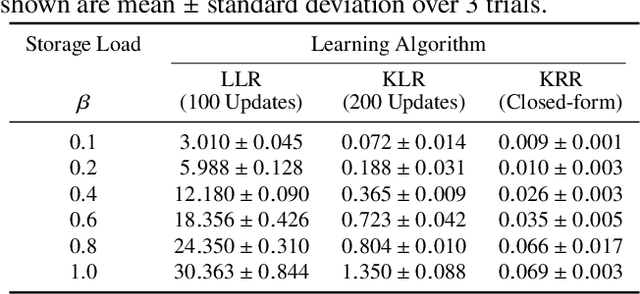
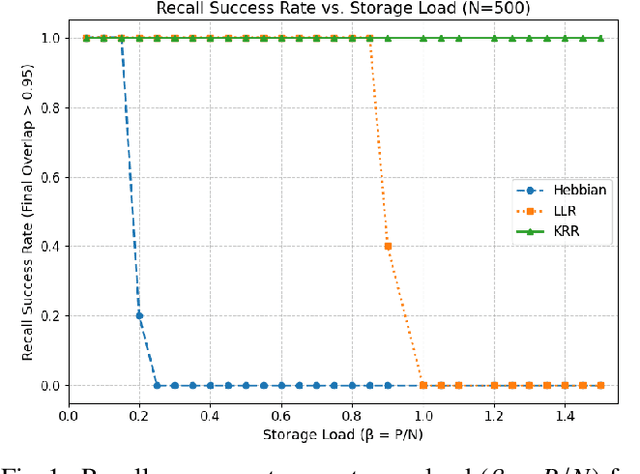
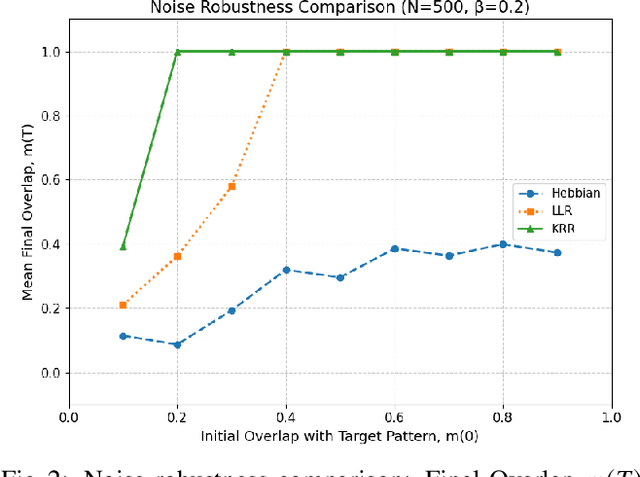
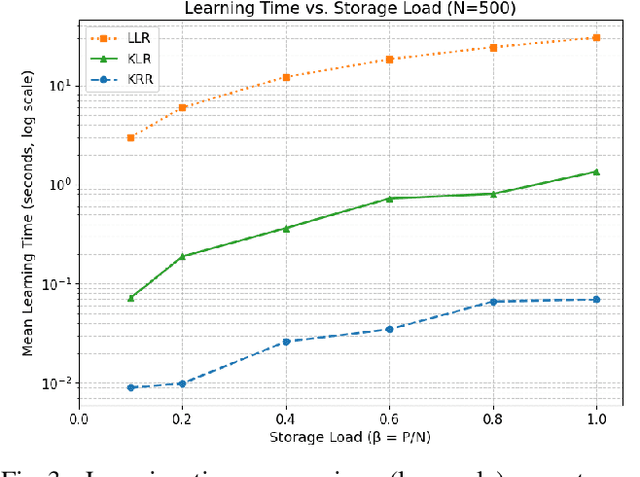
Hebbian learning limits Hopfield network capacity. While kernel methods like Kernel Logistic Regression (KLR) improve performance via iterative learning, we propose Kernel Ridge Regression (KRR) as an alternative. KRR learns dual variables non-iteratively via a closed-form solution, offering significant learning speed advantages. We show KRR achieves comparably high storage capacity (reaching ratio 1.5 shown) and noise robustness (recalling from around 80% corrupted patterns) as KLR, while drastically reducing training time, establishing KRR as an efficient method for building high-performance associative memories.
* 4 pages, 4 figures
View paper on