 Add to Chrome
 Add to Firefox
 Add to Edge
Graph Neural Networks for Source Detection: A Review and Benchmark Study
Paper and Code

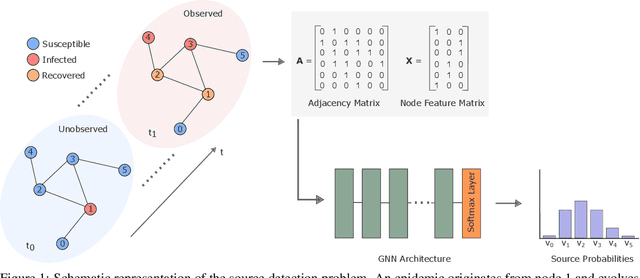
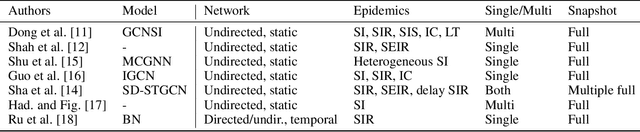
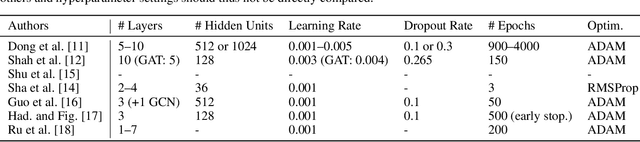
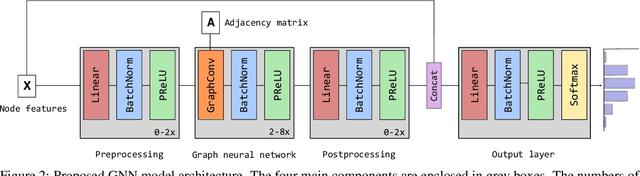
The source detection problem arises when an epidemic process unfolds over a contact network, and the objective is to identify its point of origin, i.e., the source node. Research on this problem began with the seminal work of Shah and Zaman in 2010, who formally defined it and introduced the notion of rumor centrality. With the emergence of Graph Neural Networks (GNNs), several studies have proposed GNN-based approaches to source detection. However, some of these works lack methodological clarity and/or are hard to reproduce. As a result, it remains unclear (to us, at least) whether GNNs truly outperform more traditional source detection methods across comparable settings. In this paper, we first review existing GNN-based methods for source detection, clearly outlining the specific settings each addresses and the models they employ. Building on this research, we propose a principled GNN architecture tailored to the source detection task. We also systematically investigate key questions surrounding this problem. Most importantly, we aim to provide a definitive assessment of how GNNs perform relative to other source detection methods. Our experiments show that GNNs substantially outperform all other methods we test across a variety of network types. Although we initially set out to challenge the notion of GNNs as a solution to source detection, our results instead demonstrate their remarkable effectiveness for this task. We discuss possible reasons for this strong performance. To ensure full reproducibility, we release all code and data on GitHub. Finally, we argue that epidemic source detection should serve as a benchmark task for evaluating GNN architectures.
