 Add to Chrome
 Add to Firefox
 Add to Edge
Dataset and UAV Propagation Channel Modeling for LoRa in the 860 MHz ISM Band
Paper and Code
Dec 17, 2025
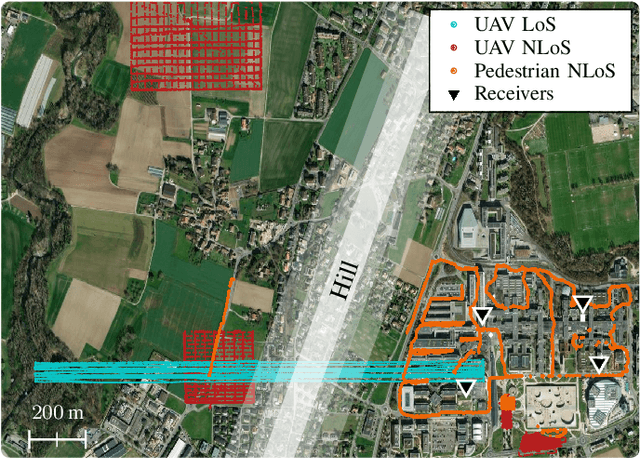
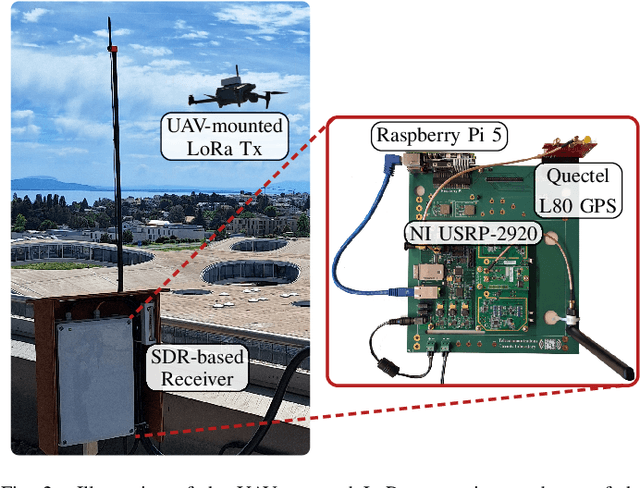
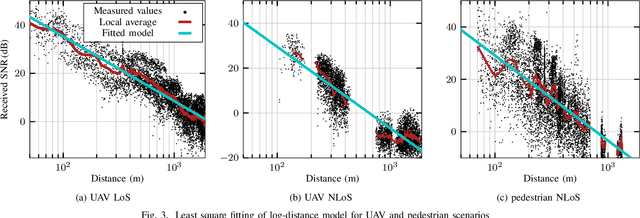
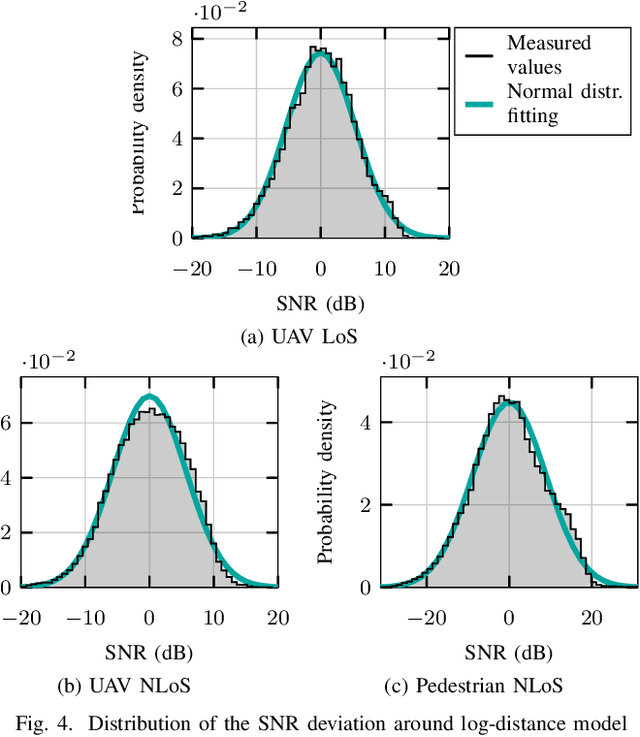
LoRa is one of the most widely used low-power wide-area network technology for the Internet of Things. To achieve long-range communication with low power consumption at a low cost, LoRa uses a chirp spread spectrum modulation and transmits in the sub-GHz unlicensed industrial, scientific, and medical (ISM) frequency bands. Due to the rapid densification of IoT networks, it is crucial to obtain tailored channel models to evaluate the performance of LoRa networks. While channel models for cellular technologies have been investigated extensively, specific characteristics of LoRa transmissions operating at long range with a rather small (~ 250kHz) bandwidth require dedicated measurement campaigns and modeling efforts. In this work, we leverage an SDR-based testbed to gather and publish a dataset of LoRa frames transmitted in a campus environment. The dataset includes IQ samples of the received frames at multiple locations and allows for the evaluation of channel variations with high time resolution. Using the gathered data, we derive empirical propagation channel models for LoRa that include receiver correlation over distance for three scenarios: unmanned aerial vehicle (UAV) line-of-sight (LoS), UAV non-LoS, and pedestrian non-LoS. Furthermore, the dataset is annotated with synchronization information, enabling the evaluation of receiver algorithms using experimental data.
