 Add to Chrome
 Add to Firefox
 Add to Edge
Unsupervised Domain Adaptation Meets Offline Recommender Learning
Paper and Code
Nov 14, 2019
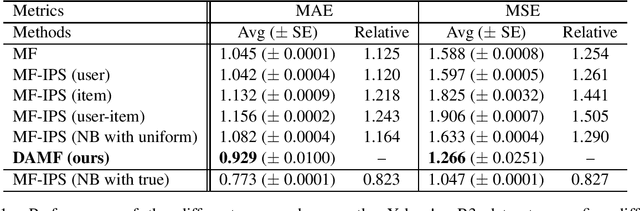
To construct a well-performing recommender offline, eliminating selection biases of the rating feedback is critical. A current promising solution to the challenge is the propensity weighting approach that models the missing mechanism of rating feedback. However, the performance of existing propensity-based algorithms can be significantly affected by the propensity estimation bias. To alleviate the problem, we formulate the missing-not-at-random recommendation as the unsupervised domain adaptation problem and drive the propensity-agnostic generalization error bound. We further propose a corresponding algorithm minimizing the bound via adversarial learning. Our proposed theoretical framework and algorithm do not depend on the propensity score and can obtain a well-performing rating predictor without the true propensity information. Empirical evaluation using benchmark real-world datasets demonstrates the effectiveness and the real-world applicability of the proposed approach.
