Get our free extension to see links to code for papers anywhere online!Free add-on: code for papers everywhere!Free add-on: See code for papers anywhere!
 Add to Chrome
 Add to Firefox
 Add to Edge
An active-set algorithm for spectral unmixing
Paper and Code
Dec 18, 2025
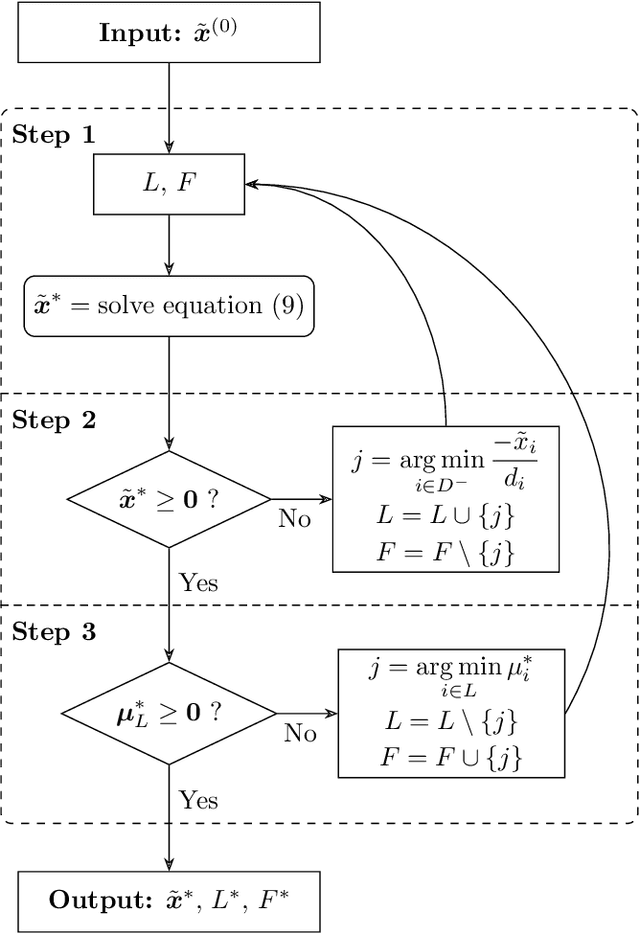
Linear spectral unmixing under nonnegativity and sum-to-one constraints is a convex optimization problem for which many algorithms were proposed. In practice, especially for supervised unmixing (i.e., with a large dictionary), solutions tend to be sparse due to the nonnegativity of the abundances, thereby motivating the use of an active-set solver. Given the problem specific features, it seems advantageous to design a dedicated algorithm in order to gain computational performance compared to generic solvers. In this paper, we propose to derive such a specific algorithm, while extending the nonnegativity constraints to broader minimum abundance constraints.
View paper on