 Add to Chrome
 Add to Firefox
 Add to Edge
A Hybrid Inductive-Transductive Network for Traffic Flow Imputation on Unsampled Locations
Paper and Code
Dec 19, 2025

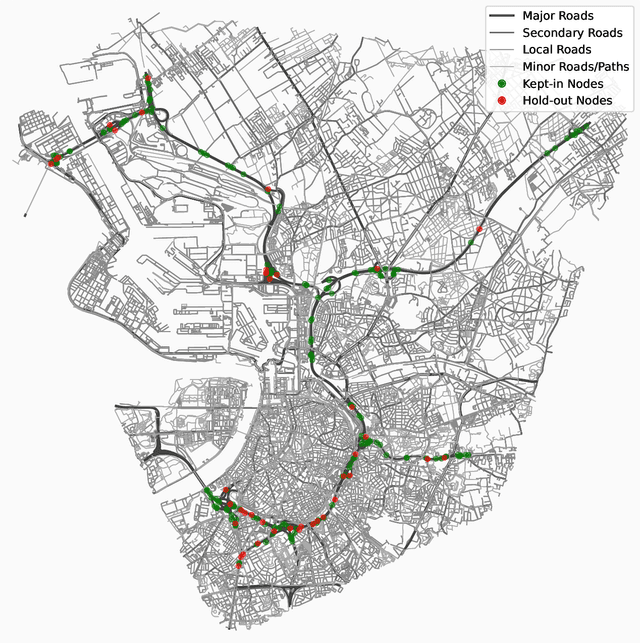
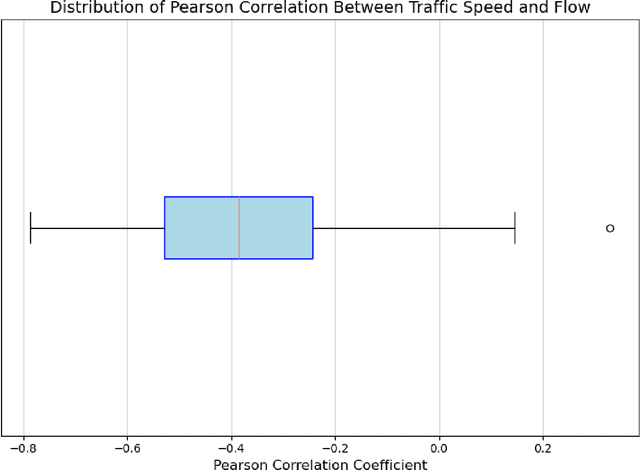
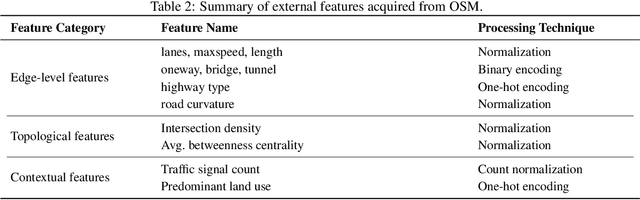
Accurately imputing traffic flow at unsensed locations is difficult: loop detectors provide precise but sparse measurements, speed from probe vehicles is widely available yet only weakly correlated with flow, and nearby links often exhibit strong heterophily in the scale of traffic flow (e.g., ramps vs. mainline), which breaks standard GNN assumptions. We propose HINT, a Hybrid INductive-Transductive Network, and an INDU-TRANSDUCTIVE training strategy that treats speed as a transductive, network-wide signal while learning flow inductively to generalize to unseen locations. HINT couples (i) an inductive spatial transformer that learns similarity-driven, long-range interactions from node features with (ii) a diffusion GCN conditioned by FiLM on rich static context (OSM-derived attributes and traffic simulation), and (iii) a node-wise calibration layer that corrects scale biases per segment. Training uses masked reconstruction with epoch-wise node sampling, hard-node mining to emphasize difficult sensors, and noise injection on visible flows to prevent identity mapping, while graph structure is built from driving distances. Across three real-world datasets, MOW (Antwerp, Belgium), UTD19-Torino, and UTD19-Essen, HINT consistently surpasses state-of-the-art inductive baselines. Relative to KITS, HINT reduces MAE on MOW by $\approx42$% with basic simulation and $\approx50$% with calibrated simulation; on Torino by $\approx22$%, and on Essen by $\approx12$%. Even without simulation, HINT remains superior on MOW and Torino, while simulation is crucial on Essen. These results show that combining inductive flow imputation with transductive speed, traffic simulations and external geospatial improves accuracy for the task described above.
