 Add to Chrome
 Add to Firefox
 Add to Edge
Scaling Laws for Neural Language Models
Jan 23, 2020
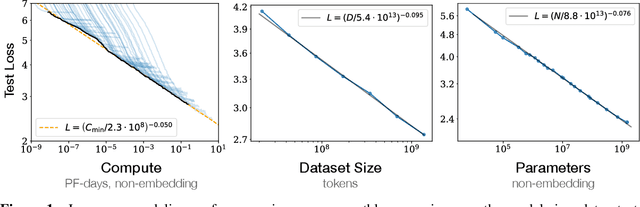
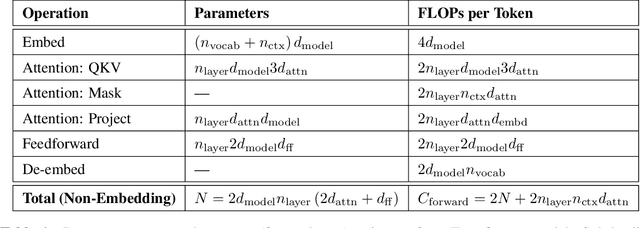
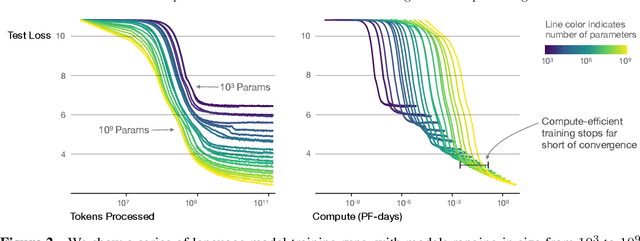
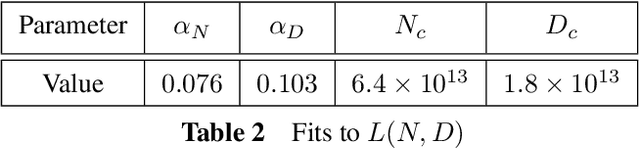
We study empirical scaling laws for language model performance on the cross-entropy loss. The loss scales as a power-law with model size, dataset size, and the amount of compute used for training, with some trends spanning more than seven orders of magnitude. Other architectural details such as network width or depth have minimal effects within a wide range. Simple equations govern the dependence of overfitting on model/dataset size and the dependence of training speed on model size. These relationships allow us to determine the optimal allocation of a fixed compute budget. Larger models are significantly more sample-efficient, such that optimally compute-efficient training involves training very large models on a relatively modest amount of data and stopping significantly before convergence.

An Empirical Model of Large-Batch Training
Dec 14, 2018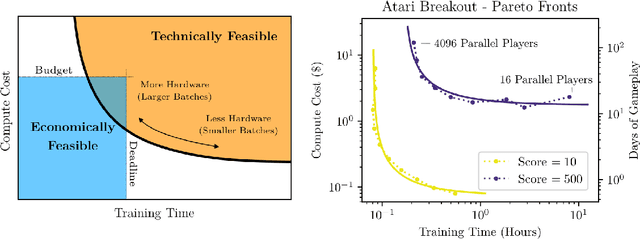
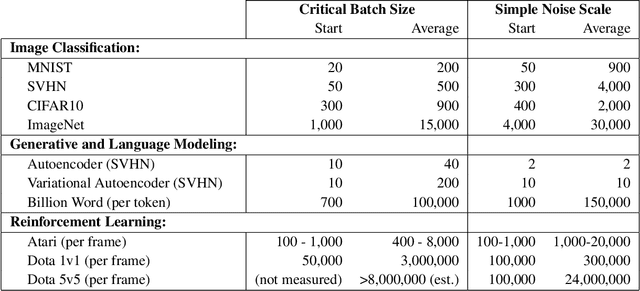
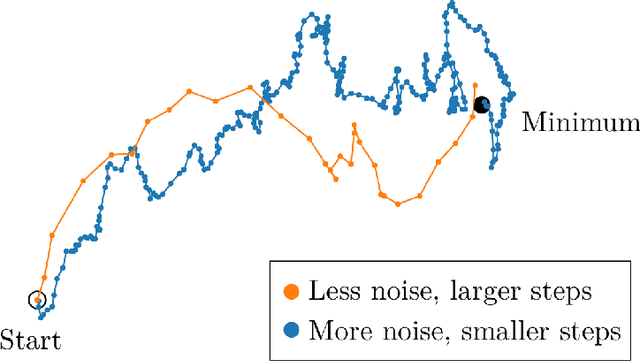
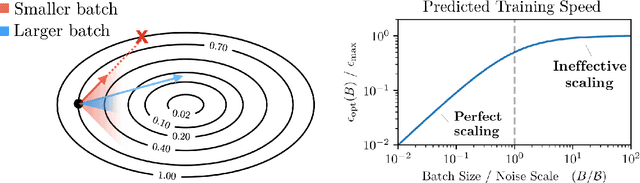
In an increasing number of domains it has been demonstrated that deep learning models can be trained using relatively large batch sizes without sacrificing data efficiency. However the limits of this massive data parallelism seem to differ from domain to domain, ranging from batches of tens of thousands in ImageNet to batches of millions in RL agents that play the game Dota 2. To our knowledge there is limited conceptual understanding of why these limits to batch size differ or how we might choose the correct batch size in a new domain. In this paper, we demonstrate that a simple and easy-to-measure statistic called the gradient noise scale predicts the largest useful batch size across many domains and applications, including a number of supervised learning datasets (MNIST, SVHN, CIFAR-10, ImageNet, Billion Word), reinforcement learning domains (Atari and Dota), and even generative model training (autoencoders on SVHN). We find that the noise scale increases as the loss decreases over a training run and depends on the model size primarily through improved model performance. Our empirically-motivated theory also describes the tradeoff between compute-efficiency and time-efficiency, and provides a rough model of the benefits of adaptive batch-size training.