 Add to Chrome
 Add to Firefox
 Add to Edge
Wall Shear Stress Reconstruction from Concentration: Differentiable Physics and Physics-Informed Neural Networks
Jun 04, 2026
Wall shear stress (WSS) governs near-wall transport dynamics and is a key hemodynamic indicator in cardiovascular flows, yet remains difficult to infer accurately due to the need for precise computation of near-wall velocity gradients. Passive scalar fields, such as concentration or temperature, are advected by the same underlying velocity field and have the potential to uncover hidden flow physics metrics such as WSS. In this work, we demonstrate such reconstruction from spatially limited passive scalar observations using two fundamentally different inverse frameworks: a differentiable physics framework based on discrete adjoint, PDE-constrained optimization, which enforces the governing equations as hard constraints, and physics-informed neural networks (PINNs), which treat them as soft constraints. Benchmark problems include a 2D canonical backward-facing step (2D-BFS) and a 3D patient-specific stenotic coronary artery. For the 2D-BFS case, evaluated under three measurement scenarios (near-wall, far-field, and combined), PINN achieves high accuracy when near-wall data are available but fails when restricted to far-field measurements, whereas the differentiable physics approach recovers accurate WSS across all scenarios. In the 3D patient-specific case, the differentiable physics framework outperforms PINNs, yielding accurate WSS reconstruction. These results establish that measurement location and inverse formulation jointly determine reconstruction fidelity in scalar-based near-wall flow inference. The proposed framework opens a path toward estimation of near-wall hemodynamics from scalar transport data, with broader applicability to fluid flow problems where passive scalars can be observed.

SLE-FNO: Single-Layer Extensions for Task-Agnostic Continual Learning in Fourier Neural Operators
Mar 20, 2026Scientific machine learning is increasingly used to build surrogate models, yet most models are trained under a restrictive assumption in which future data follow the same distribution as the training set. In practice, new experimental conditions or simulation regimes may differ significantly, requiring extrapolation and model updates without re-access to prior data. This creates a need for continual learning (CL) frameworks that can adapt to distribution shifts while preventing catastrophic forgetting. Such challenges are pronounced in fluid dynamics, where changes in geometry, boundary conditions, or flow regimes induce non-trivial changes to the solution. Here, we introduce a new architecture-based approach (SLE-FNO) combining a Single-Layer Extension (SLE) with the Fourier Neural Operator (FNO) to support efficient CL. SLE-FNO was compared with a range of established CL methods, including Elastic Weight Consolidation (EWC), Learning without Forgetting (LwF), replay-based approaches, Orthogonal Gradient Descent (OGD), Gradient Episodic Memory (GEM), PiggyBack, and Low-Rank Approximation (LoRA), within an image-to-image regression setting. The models were trained to map transient concentration fields to time-averaged wall shear stress (TAWSS) in pulsatile aneurysmal blood flow. Tasks were derived from 230 computational fluid dynamics simulations grouped into four sequential and out-of-distribution configurations. Results show that replay-based methods and architecture-based approaches (PiggyBack, LoRA, and SLE-FNO) achieve the best retention, with SLE-FNO providing the strongest overall balance between plasticity and stability, achieving accuracy with zero forgetting and minimal additional parameters. Our findings highlight key differences between CL algorithms and introduce SLE-FNO as a promising strategy for adapting baseline models when extrapolation is required.
An Application of Manifold Learning in Global Shape Descriptors
Jan 08, 2019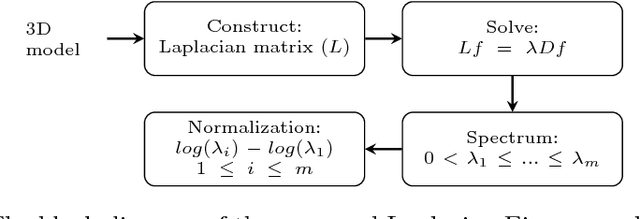
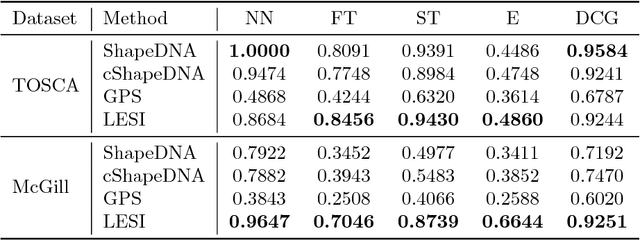
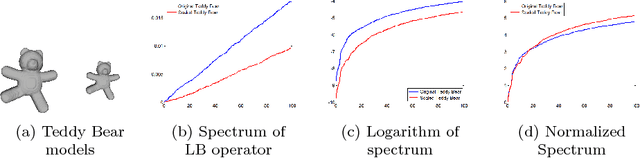
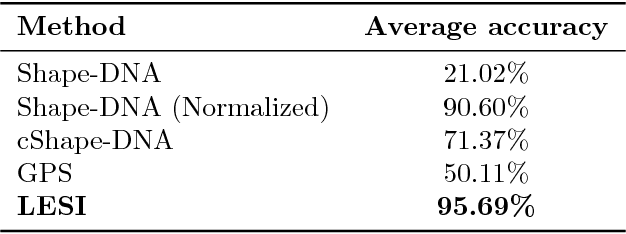
With the rapid expansion of applied 3D computational vision, shape descriptors have become increasingly important for a wide variety of applications and objects from molecules to planets. Appropriate shape descriptors are critical for accurate (and efficient) shape retrieval and 3D model classification. Several spectral-based shape descriptors have been introduced by solving various physical equations over a 3D surface model. In this paper, for the first time, we incorporate a specific group of techniques in statistics and machine learning, known as manifold learning, to develop a global shape descriptor in the computer graphics domain. The proposed descriptor utilizes the Laplacian Eigenmap technique in which the Laplacian eigenvalue problem is discretized using an exponential weighting scheme. As a result, our descriptor eliminates the limitations tied to the existing spectral descriptors, namely dependency on triangular mesh representation and high intra-class quality of 3D models. We also present a straightforward normalization method to obtain a scale-invariant descriptor. The extensive experiments performed in this study show that the present contribution provides a highly discriminative and robust shape descriptor under the presence of a high level of noise, random scale variations, and low sampling rate, in addition to the known isometric-invariance property of the Laplace-Beltrami operator. The proposed method significantly outperforms state-of-the-art algorithms on several non-rigid shape retrieval benchmarks.