 Add to Chrome
 Add to Firefox
 Add to Edge
Vision-Language Models for Ergonomic Assessment of Manual Lifting Tasks: Estimating Horizontal and Vertical Hand Distances from RGB Video
Feb 24, 2026
Manual lifting tasks are a major contributor to work-related musculoskeletal disorders, and effective ergonomic risk assessment is essential for quantifying physical exposure and informing ergonomic interventions. The Revised NIOSH Lifting Equation (RNLE) is a widely used ergonomic risk assessment tool for lifting tasks that relies on six task variables, including horizontal (H) and vertical (V) hand distances; such distances are typically obtained through manual measurement or specialized sensing systems and are difficult to use in real-world environments. We evaluated the feasibility of using innovative vision-language models (VLMs) to non-invasively estimate H and V from RGB video streams. Two multi-stage VLM-based pipelines were developed: a text-guided detection-only pipeline and a detection-plus-segmentation pipeline. Both pipelines used text-guided localization of task-relevant regions of interest, visual feature extraction from those regions, and transformer-based temporal regression to estimate H and V at the start and end of a lift. For a range of lifting tasks, estimation performance was evaluated using leave-one-subject-out validation across the two pipelines and seven camera view conditions. Results varied significantly across pipelines and camera view conditions, with the segmentation-based, multi-view pipeline consistently yielding the smallest errors, achieving mean absolute errors of approximately 6-8 cm when estimating H and 5-8 cm when estimating V. Across pipelines and camera view configurations, pixel-level segmentation reduced estimation error by approximately 20-30% for H and 35-40% for V relative to the detection-only pipeline. These findings support the feasibility of VLM-based pipelines for video-based estimation of RNLE distance parameters.

A Method for Robust Online Classification using Dictionary Learning: Development and Assessment for Monitoring Manual Material Handling Activities Using Wearable Sensors
Oct 22, 2018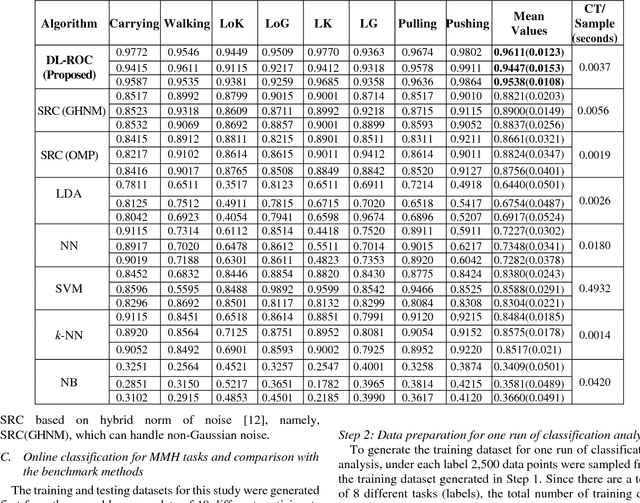
Classification methods based on sparse estimation have drawn much attention recently, due to their effectiveness in processing high-dimensional data such as images. In this paper, a method to improve the performance of a sparse representation classification (SRC) approach is proposed; it is then applied to the problem of online process monitoring of human workers, specifically manual material handling (MMH) operations monitored using wearable sensors (involving 111 sensor channels). Our proposed method optimizes the design matrix (aka dictionary) in the linear model used for SRC, minimizing its ill-posedness to achieve a sparse solution. This procedure is based on the idea of dictionary learning (DL): we optimize the design matrix formed by training datasets to minimize both redundancy and coherency as well as reducing the size of these datasets. Use of such optimized training data can subsequently improve classification accuracy and help decrease the computational time needed for the SRC; it is thus more applicable for online process monitoring. Performance of the proposed methodology is demonstrated using wearable sensor data obtained from manual material handling experiments, and is found to be superior to those of benchmark methods in terms of accuracy, while also requiring computational time appropriate for MMH online monitoring.