 Add to Chrome
 Add to Firefox
 Add to Edge
CROCS: A Two-Stage Clustering Framework for Behaviour-Centric Consumer Segmentation with Smart Meter Data
Jan 15, 2026
With grid operators confronting rising uncertainty from renewable integration and a broader push toward electrification, Demand-Side Management (DSM) -- particularly Demand Response (DR) -- has attracted significant attention as a cost-effective mechanism for balancing modern electricity systems. Unprecedented volumes of consumption data from a continuing global deployment of smart meters enable consumer segmentation based on real usage behaviours, promising to inform the design of more effective DSM and DR programs. However, existing clustering-based segmentation methods insufficiently reflect the behavioural diversity of consumers, often relying on rigid temporal alignment, and faltering in the presence of anomalies, missing data, or large-scale deployments. To address these challenges, we propose a novel two-stage clustering framework -- Clustered Representations Optimising Consumer Segmentation (CROCS). In the first stage, each consumer's daily load profiles are clustered independently to form a Representative Load Set (RLS), providing a compact summary of their typical diurnal consumption behaviours. In the second stage, consumers are clustered using the Weighted Sum of Minimum Distances (WSMD), a novel set-to-set measure that compares RLSs by accounting for both the prevalence and similarity of those behaviours. Finally, community detection on the WSMD-induced graph reveals higher-order prototypes that embody the shared diurnal behaviours defining consumer groups, enhancing the interpretability of the resulting clusters. Extensive experiments on both synthetic and real Australian smart meter datasets demonstrate that CROCS captures intra-consumer variability, uncovers both synchronous and asynchronous behavioural similarities, and remains robust to anomalies and missing data, while scaling efficiently through natural parallelisation. These results...

On the Use of Relative Validity Indices for Comparing Clustering Approaches
Apr 16, 2024


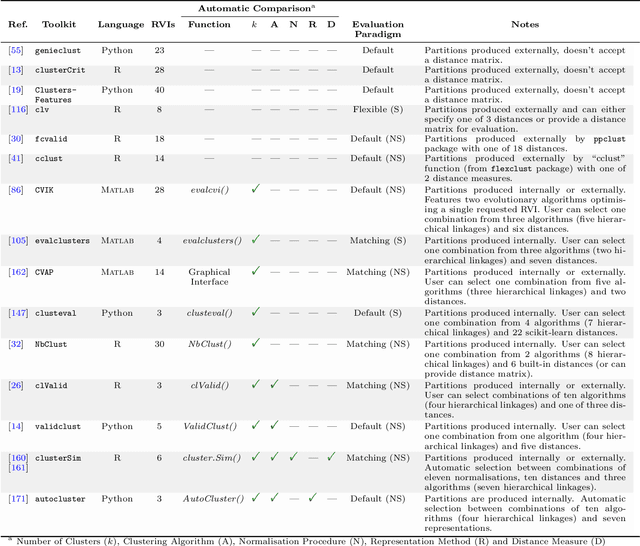
Relative Validity Indices (RVIs) such as the Silhouette Width Criterion, Calinski-Harabasz and Davie's Bouldin indices are the most popular tools for evaluating and optimising applications of clustering. Their ability to rank collections of candidate partitions has been used to guide the selection of the number of clusters, and to compare partitions from different clustering algorithms. Beyond these more conventional tasks, many examples can be found in the literature where RVIs have been used to compare and select other aspects of clustering approaches such as data normalisation procedures, data representation methods, and distance measures. The authors are not aware of any studies that have attempted to establish the suitability of RVIs for such comparisons. Moreover, given the impact of these aspects on pairwise similarities, it is not even immediately obvious how RVIs should be implemented when comparing these aspects. In this study, we conducted experiments with seven common RVIs on over 2.7 million clustering partitions for both synthetic and real-world datasets, encompassing feature-vector and time-series data. Our findings suggest that RVIs are not well-suited to these unconventional tasks, and that conclusions drawn from such applications may be misleading. It is recommended that normalisation procedures, representation methods, and distance measures instead be selected using external validation on high quality labelled datasets or carefully designed outcome-oriented objective criteria, both of which should be informed by relevant domain knowledge and clustering aims.