 Add to Chrome
 Add to Firefox
 Add to Edge
Efficient On-the-fly Category Retrieval using ConvNets and GPUs
Nov 17, 2014

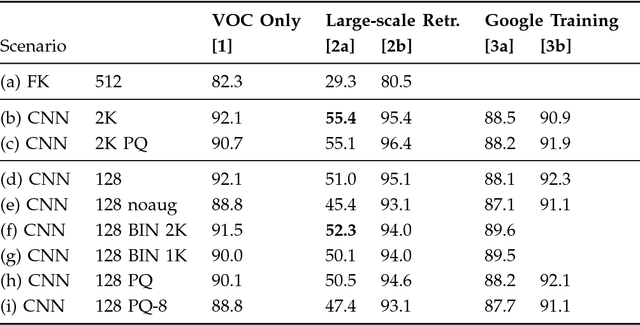
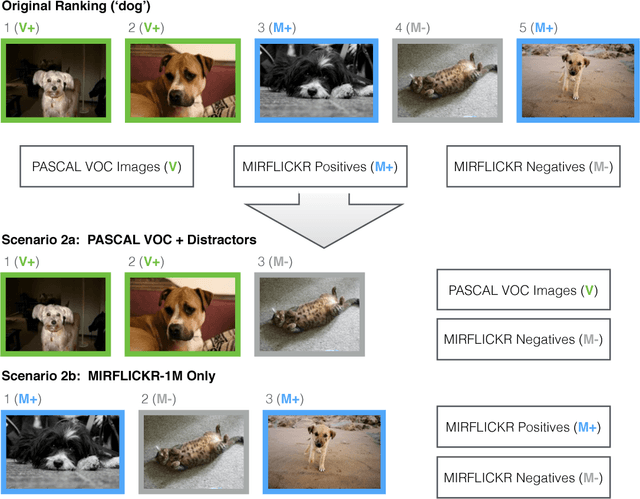
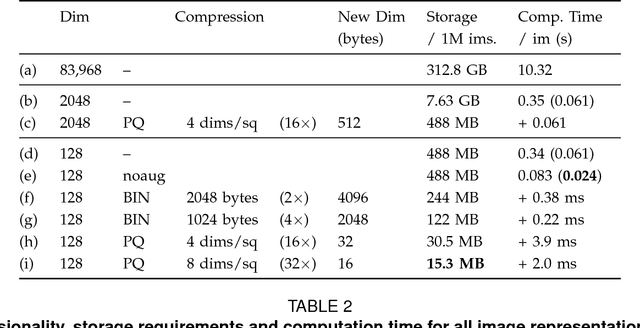
We investigate the gains in precision and speed, that can be obtained by using Convolutional Networks (ConvNets) for on-the-fly retrieval - where classifiers are learnt at run time for a textual query from downloaded images, and used to rank large image or video datasets. We make three contributions: (i) we present an evaluation of state-of-the-art image representations for object category retrieval over standard benchmark datasets containing 1M+ images; (ii) we show that ConvNets can be used to obtain features which are incredibly performant, and yet much lower dimensional than previous state-of-the-art image representations, and that their dimensionality can be reduced further without loss in performance by compression using product quantization or binarization. Consequently, features with the state-of-the-art performance on large-scale datasets of millions of images can fit in the memory of even a commodity GPU card; (iii) we show that an SVM classifier can be learnt within a ConvNet framework on a GPU in parallel with downloading the new training images, allowing for a continuous refinement of the model as more images become available, and simultaneous training and ranking. The outcome is an on-the-fly system that significantly outperforms its predecessors in terms of: precision of retrieval, memory requirements, and speed, facilitating accurate on-the-fly learning and ranking in under a second on a single GPU.

Two-Stream Convolutional Networks for Action Recognition in Videos
Nov 12, 2014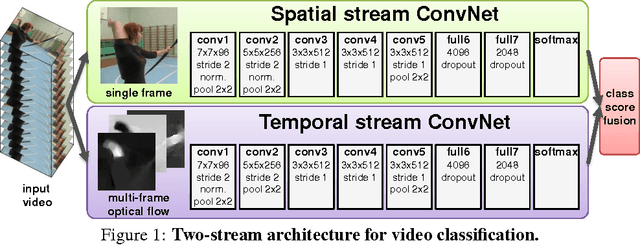
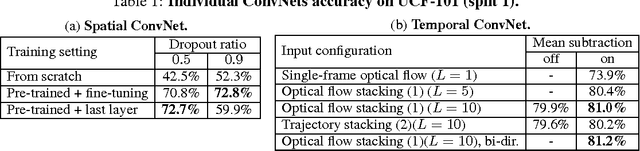
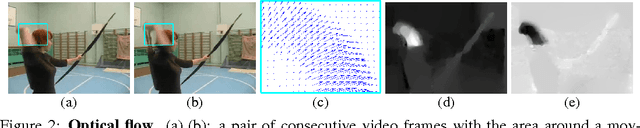

We investigate architectures of discriminatively trained deep Convolutional Networks (ConvNets) for action recognition in video. The challenge is to capture the complementary information on appearance from still frames and motion between frames. We also aim to generalise the best performing hand-crafted features within a data-driven learning framework. Our contribution is three-fold. First, we propose a two-stream ConvNet architecture which incorporates spatial and temporal networks. Second, we demonstrate that a ConvNet trained on multi-frame dense optical flow is able to achieve very good performance in spite of limited training data. Finally, we show that multi-task learning, applied to two different action classification datasets, can be used to increase the amount of training data and improve the performance on both. Our architecture is trained and evaluated on the standard video actions benchmarks of UCF-101 and HMDB-51, where it is competitive with the state of the art. It also exceeds by a large margin previous attempts to use deep nets for video classification.
Return of the Devil in the Details: Delving Deep into Convolutional Nets
Nov 05, 2014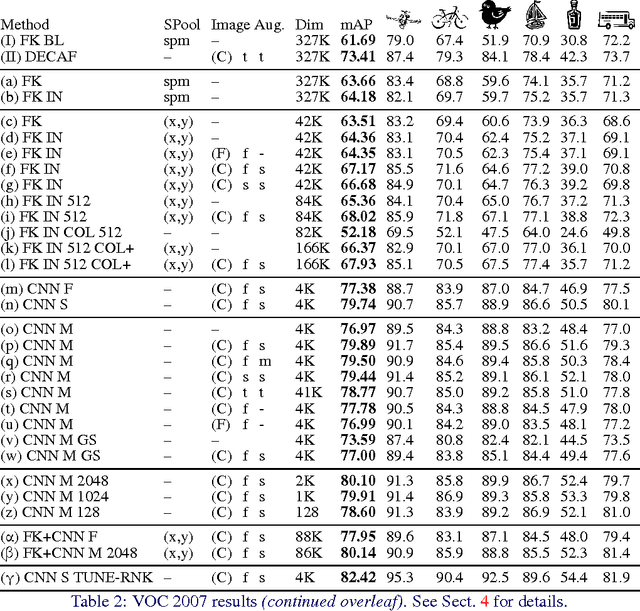
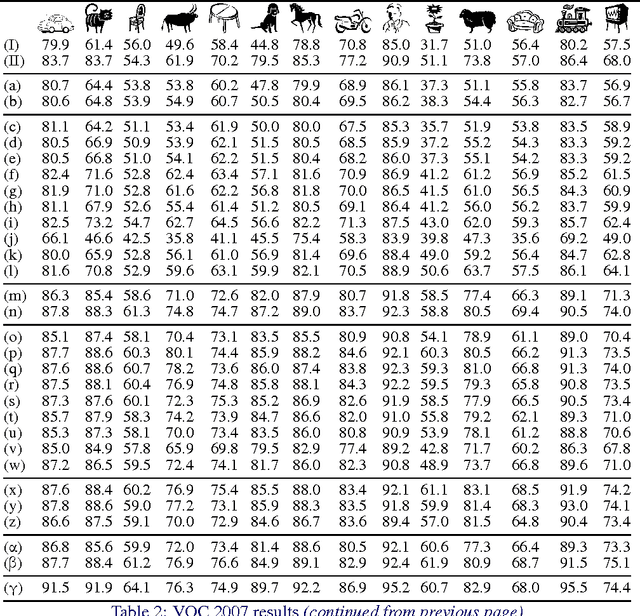
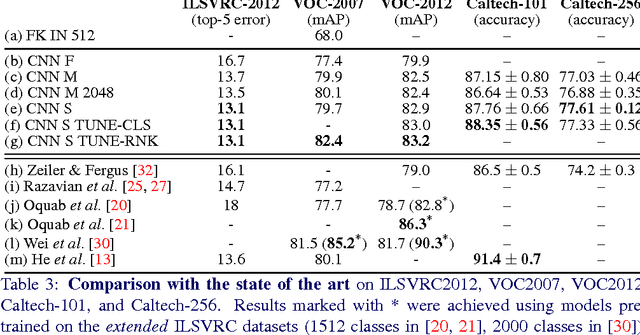
The latest generation of Convolutional Neural Networks (CNN) have achieved impressive results in challenging benchmarks on image recognition and object detection, significantly raising the interest of the community in these methods. Nevertheless, it is still unclear how different CNN methods compare with each other and with previous state-of-the-art shallow representations such as the Bag-of-Visual-Words and the Improved Fisher Vector. This paper conducts a rigorous evaluation of these new techniques, exploring different deep architectures and comparing them on a common ground, identifying and disclosing important implementation details. We identify several useful properties of CNN-based representations, including the fact that the dimensionality of the CNN output layer can be reduced significantly without having an adverse effect on performance. We also identify aspects of deep and shallow methods that can be successfully shared. In particular, we show that the data augmentation techniques commonly applied to CNN-based methods can also be applied to shallow methods, and result in an analogous performance boost. Source code and models to reproduce the experiments in the paper is made publicly available.
Deep Inside Convolutional Networks: Visualising Image Classification Models and Saliency Maps
Apr 19, 2014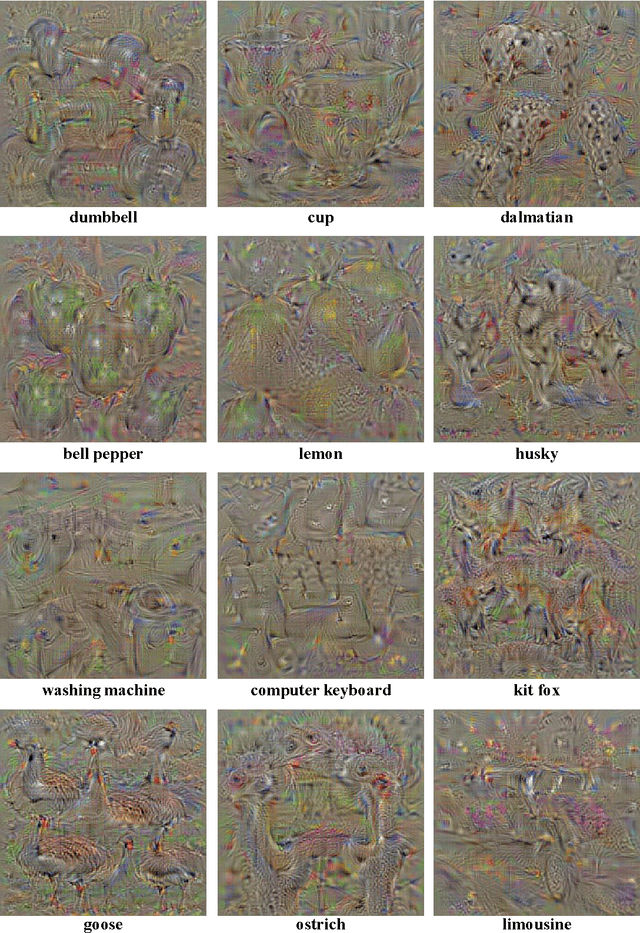
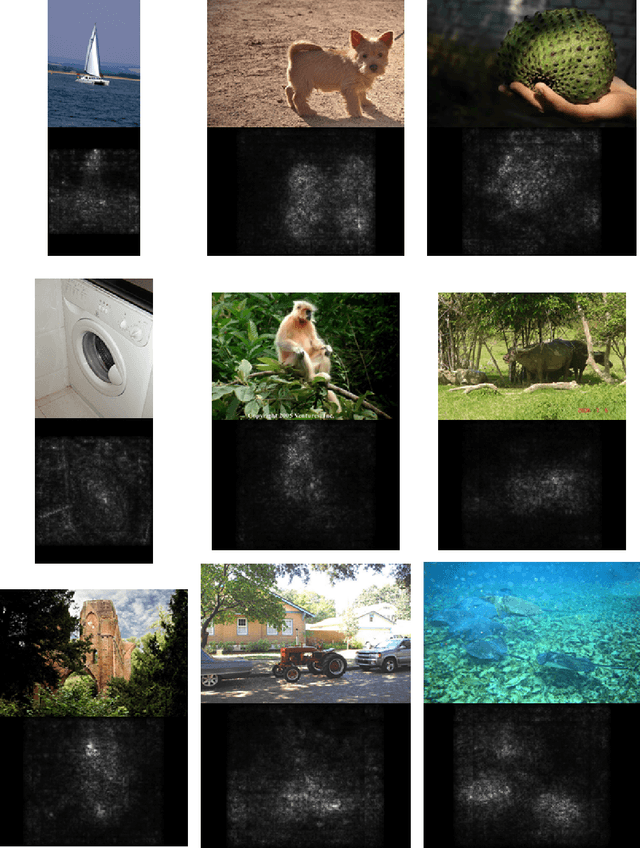
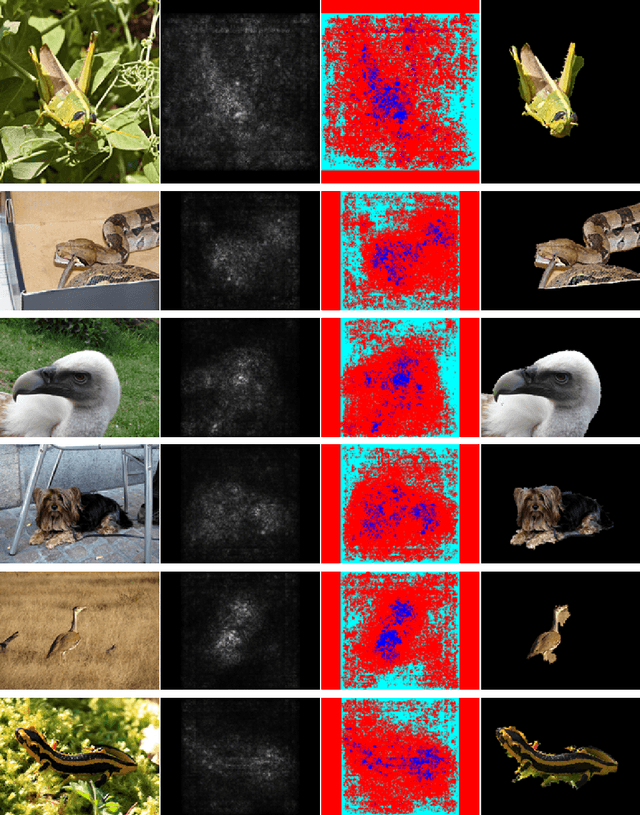
This paper addresses the visualisation of image classification models, learnt using deep Convolutional Networks (ConvNets). We consider two visualisation techniques, based on computing the gradient of the class score with respect to the input image. The first one generates an image, which maximises the class score [Erhan et al., 2009], thus visualising the notion of the class, captured by a ConvNet. The second technique computes a class saliency map, specific to a given image and class. We show that such maps can be employed for weakly supervised object segmentation using classification ConvNets. Finally, we establish the connection between the gradient-based ConvNet visualisation methods and deconvolutional networks [Zeiler et al., 2013].