 Add to Chrome
 Add to Firefox
 Add to Edge
Playing Atari Space Invaders with Sparse Cosine Optimized Policy Evolution
Aug 11, 2025
Evolutionary approaches have previously been shown to be effective learning methods for a diverse set of domains. However, the domain of game-playing poses a particular challenge for evolutionary methods due to the inherently large state space of video games. As the size of the input state expands, the size of the policy must also increase in order to effectively learn the temporal patterns in the game space. Consequently, a larger policy must contain more trainable parameters, exponentially increasing the size of the search space. Any increase in search space is highly problematic for evolutionary methods, as increasing the number of trainable parameters is inversely correlated with convergence speed. To reduce the size of the input space while maintaining a meaningful representation of the original space, we introduce Sparse Cosine Optimized Policy Evolution (SCOPE). SCOPE utilizes the Discrete Cosine Transform (DCT) as a pseudo attention mechanism, transforming an input state into a coefficient matrix. By truncating and applying sparsification to this matrix, we reduce the dimensionality of the input space while retaining the highest energy features of the original input. We demonstrate the effectiveness of SCOPE as the policy for the Atari game Space Invaders. In this task, SCOPE with CMA-ES outperforms evolutionary methods that consider an unmodified input state, such as OpenAI-ES and HyperNEAT. SCOPE also outperforms simple reinforcement learning methods, such as DQN and A3C. SCOPE achieves this result through reducing the input size by 53% from 33,600 to 15,625 then using a bilinear affine mapping of sparse DCT coefficients to policy actions learned by the CMA-ES algorithm.

Evolving Neural Controllers for Xpilot-AI Racing Using Neuroevolution of Augmenting Topologies
Jul 17, 2025This paper investigates the development of high-performance racing controllers for a newly implemented racing mode within the Xpilot-AI platform, utilizing the Neuro Evolution of Augmenting Topologies (NEAT) algorithm. By leveraging NEAT's capability to evolve both the structure and weights of neural networks, we develop adaptive controllers that can navigate complex circuits under the challenging space simulation physics of Xpilot-AI, which includes elements such as inertia, friction, and gravity. The racing mode we introduce supports flexible circuit designs and allows for the evaluation of multiple agents in parallel, enabling efficient controller optimization across generations. Experimental results demonstrate that our evolved controllers achieve up to 32% improvement in lap time compared to the controller's initial performance and develop effective racing strategies, such as optimal cornering and speed modulation, comparable to human-like techniques. This work illustrates NEAT's effectiveness in producing robust control strategies within demanding game environments and highlights Xpilot-AI's potential as a rigorous testbed for competitive AI controller evolution.
SCOPE for Hexapod Gait Generation
Jul 17, 2025Evolutionary methods have previously been shown to be an effective learning method for walking gaits on hexapod robots. However, the ability of these algorithms to evolve an effective policy rapidly degrades as the input space becomes more complex. This degradation is due to the exponential growth of the solution space, resulting from an increasing parameter count to handle a more complex input. In order to address this challenge, we introduce Sparse Cosine Optimized Policy Evolution (SCOPE). SCOPE utilizes the Discrete Cosine Transform (DCT) to learn directly from the feature coefficients of an input matrix. By truncating the coefficient matrix returned by the DCT, we can reduce the dimensionality of an input while retaining the highest energy features of the original input. We demonstrate the effectiveness of this method by using SCOPE to learn the gait of a hexapod robot. The hexapod controller is given a matrix input containing time-series information of previous poses, which are then transformed to gait parameters by an evolved policy. In this task, the addition of SCOPE to a reference algorithm achieves a 20% increase in efficacy. SCOPE achieves this result by reducing the total input size of the time-series pose data from 2700 to 54, a 98% decrease. Additionally, SCOPE is capable of compressing an input to any output shape, provided that each output dimension is no greater than the corresponding input dimension. This paper demonstrates that SCOPE is capable of significantly compressing the size of an input to an evolved controller, resulting in a statistically significant gain in efficacy.
NeuroPAL: Punctuated Anytime Learning with Neuroevolution for Macromanagement in Starcraft: Brood War
Jun 12, 2025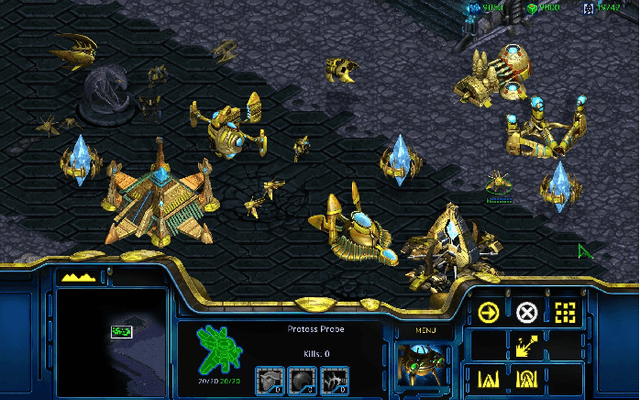
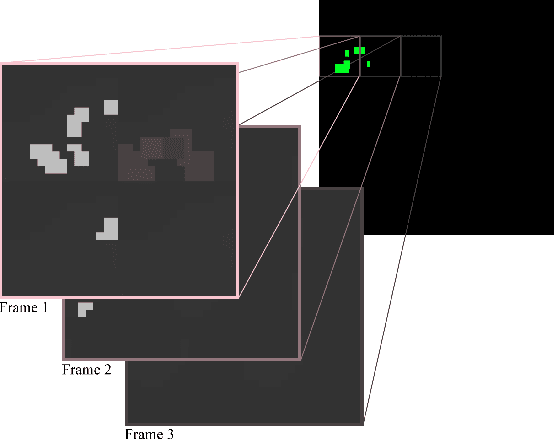
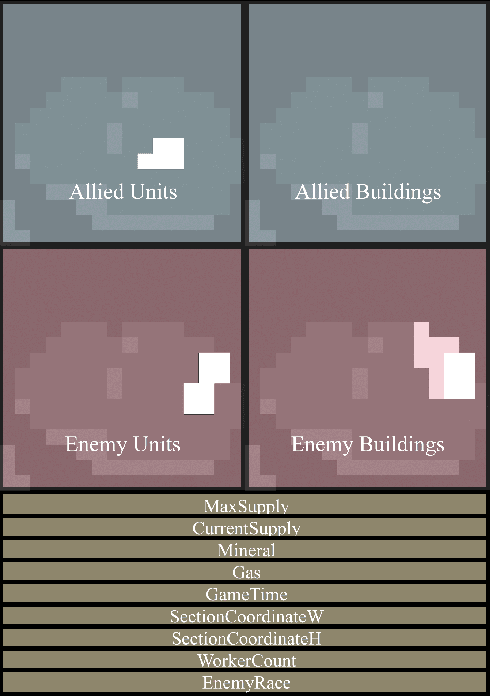
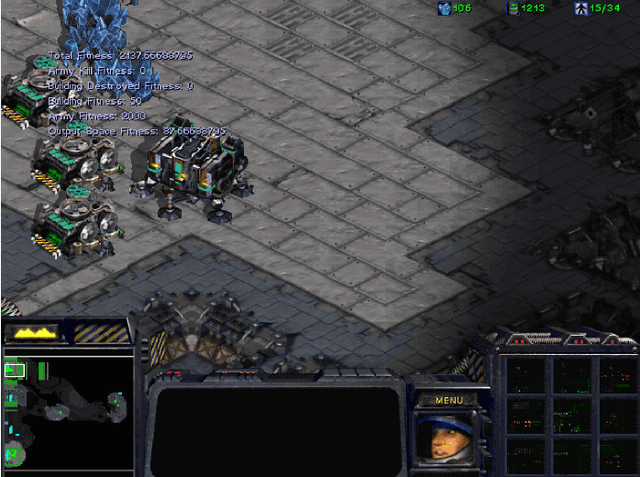
StarCraft: Brood War remains a challenging benchmark for artificial intelligence research, particularly in the domain of macromanagement, where long-term strategic planning is required. Traditional approaches to StarCraft AI rely on rule-based systems or supervised deep learning, both of which face limitations in adaptability and computational efficiency. In this work, we introduce NeuroPAL, a neuroevolutionary framework that integrates Neuroevolution of Augmenting Topologies (NEAT) with Punctuated Anytime Learning (PAL) to improve the efficiency of evolutionary training. By alternating between frequent, low-fidelity training and periodic, high-fidelity evaluations, PAL enhances the sample efficiency of NEAT, enabling agents to discover effective strategies in fewer training iterations. We evaluate NeuroPAL in a fixed-map, single-race scenario in StarCraft: Brood War and compare its performance to standard NEAT-based training. Our results show that PAL significantly accelerates the learning process, allowing the agent to reach competitive levels of play in approximately half the training time required by NEAT alone. Additionally, the evolved agents exhibit emergent behaviors such as proxy barracks placement and defensive building optimization, strategies commonly used by expert human players. These findings suggest that structured evaluation mechanisms like PAL can enhance the scalability and effectiveness of neuroevolution in complex real-time strategy environments.