 Add to Chrome
 Add to Firefox
 Add to Edge
A Correlation Maximization Approach for Cross Domain Co-Embeddings
Sep 10, 2018
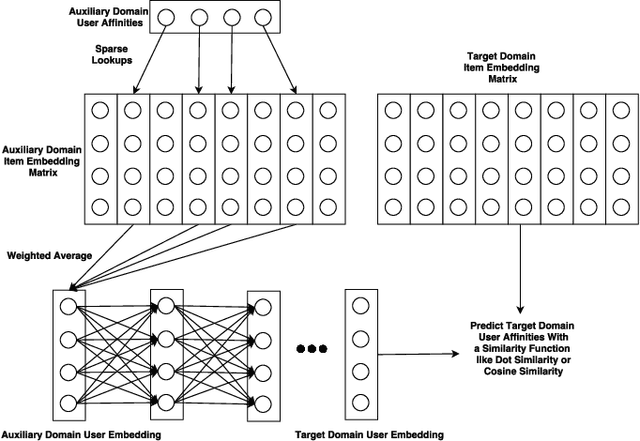
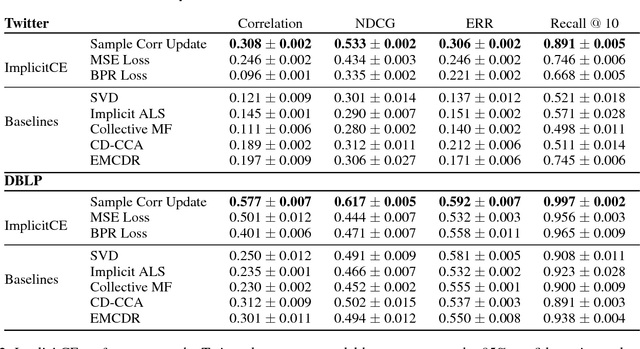
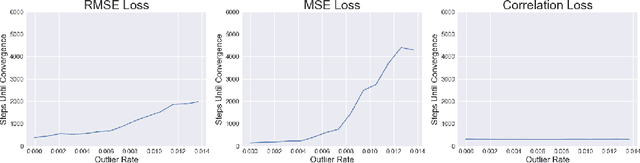
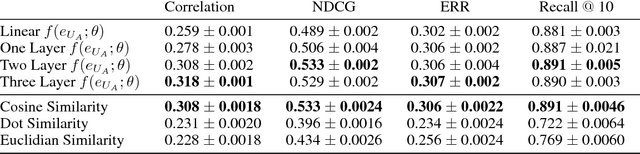
Although modern recommendation systems can exploit the structure in users' item feedback, most are powerless in the face of new users who provide no structure for them to exploit. In this paper we introduce ImplicitCE, an algorithm for recommending items to new users during their sign-up flow. ImplicitCE works by transforming users' implicit feedback towards auxiliary domain items into an embedding in the target domain item embedding space. ImplicitCE learns these embedding spaces and transformation function in an end-to-end fashion and can co-embed users and items with any differentiable similarity function. To train ImplicitCE we explore methods for maximizing the correlations between model predictions and users' affinities and introduce Sample Correlation Update, a novel and extremely simple training strategy. Finally, we show that ImplicitCE trained with Sample Correlation Update outperforms a variety of state of the art algorithms and loss functions on both a large scale Twitter dataset and the DBLP dataset.

Global-and-local attention networks for visual recognition
Sep 06, 2018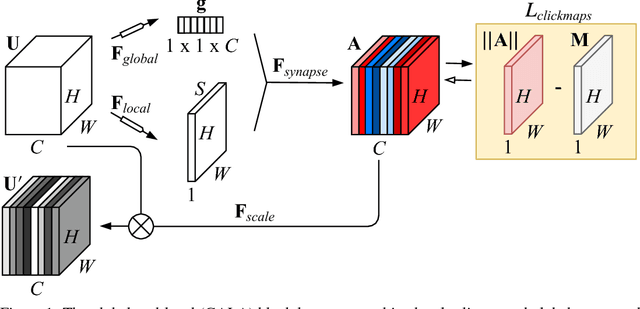
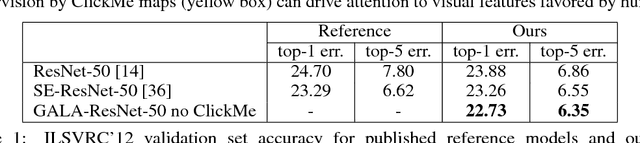
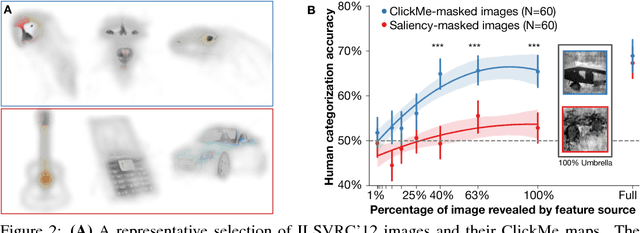

State-of-the-art deep convolutional networks (DCNs) such as squeeze-and- excitation (SE) residual networks implement a form of attention, also known as contextual guidance, which is derived from global image features. Here, we explore a complementary form of attention, known as visual saliency, which is derived from local image features. We extend the SE module with a novel global-and-local attention (GALA) module which combines both forms of attention -- resulting in state-of-the-art accuracy on ILSVRC. We further describe ClickMe.ai, a large-scale online experiment designed for human participants to identify diagnostic image regions to co-train a GALA network. Adding humans-in-the-loop is shown to significantly improve network accuracy, while also yielding visual features that are more interpretable and more similar to those used by human observers.