 Add to Chrome
 Add to Firefox
 Add to Edge
How close are the eigenvectors and eigenvalues of the sample and actual covariance matrices?
Feb 17, 2017
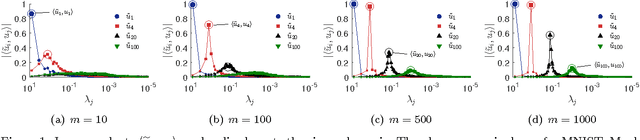
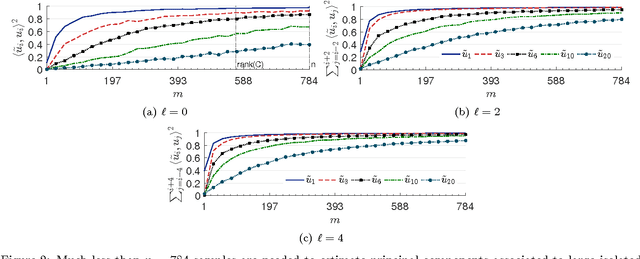
How many samples are sufficient to guarantee that the eigenvectors and eigenvalues of the sample covariance matrix are close to those of the actual covariance matrix? For a wide family of distributions, including distributions with finite second moment and distributions supported in a centered Euclidean ball, we prove that the inner product between eigenvectors of the sample and actual covariance matrices decreases proportionally to the respective eigenvalue distance. Our findings imply non-asymptotic concentration bounds for eigenvectors, eigenspaces, and eigenvalues. They also provide conditions for distinguishing principal components based on a constant number of samples.

Autoregressive Moving Average Graph Filtering
Sep 21, 2016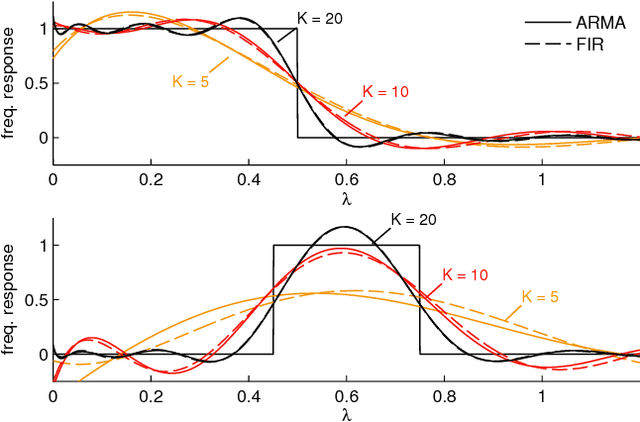
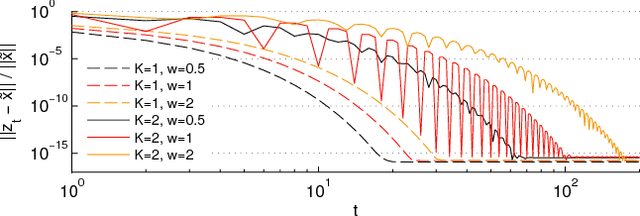
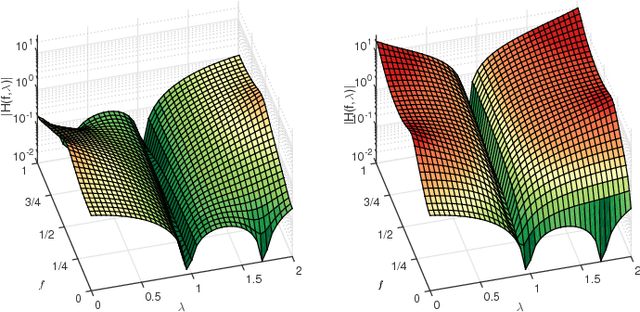
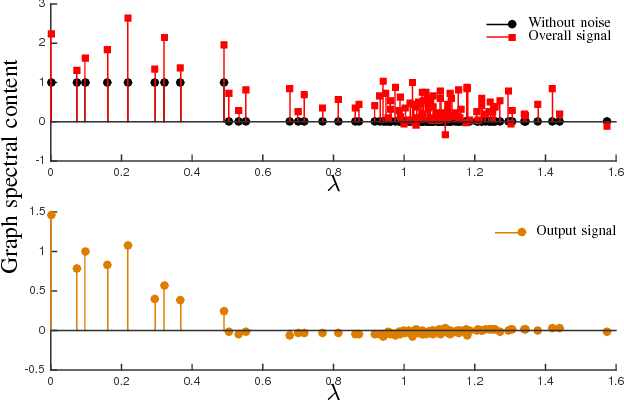
One of the cornerstones of the field of signal processing on graphs are graph filters, direct analogues of classical filters, but intended for signals defined on graphs. This work brings forth new insights on the distributed graph filtering problem. We design a family of autoregressive moving average (ARMA) recursions, which (i) are able to approximate any desired graph frequency response, and (ii) give exact solutions for tasks such as graph signal denoising and interpolation. The design philosophy, which allows us to design the ARMA coefficients independently from the underlying graph, renders the ARMA graph filters suitable in static and, particularly, time-varying settings. The latter occur when the graph signal and/or graph are changing over time. We show that in case of a time-varying graph signal our approach extends naturally to a two-dimensional filter, operating concurrently in the graph and regular time domains. We also derive sufficient conditions for filter stability when the graph and signal are time-varying. The analytical and numerical results presented in this paper illustrate that ARMA graph filters are practically appealing for static and time-varying settings, as predicted by theoretical derivations.
Predicting the evolution of stationary graph signals
Jul 12, 2016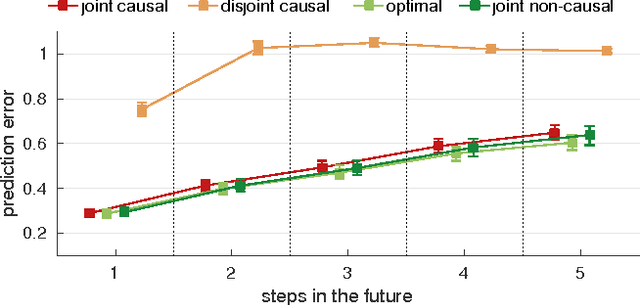
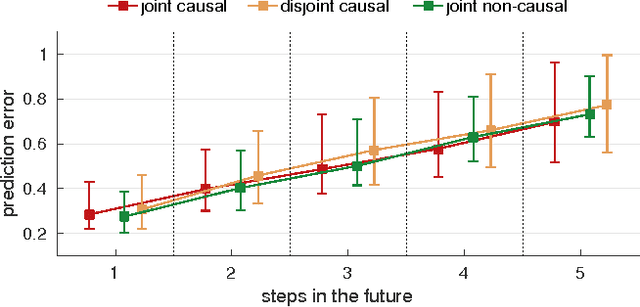
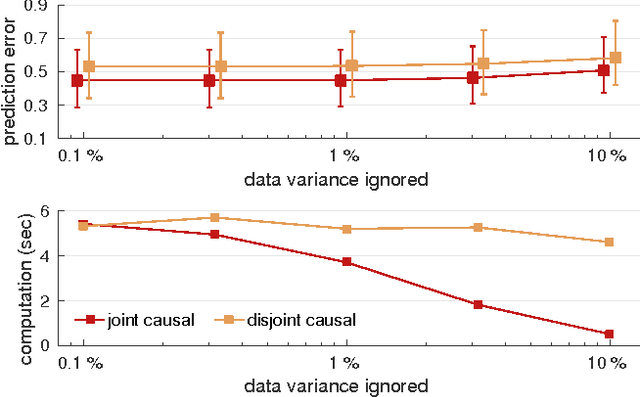
An emerging way of tackling the dimensionality issues arising in the modeling of a multivariate process is to assume that the inherent data structure can be captured by a graph. Nevertheless, though state-of-the-art graph-based methods have been successful for many learning tasks, they do not consider time-evolving signals and thus are not suitable for prediction. Based on the recently introduced joint stationarity framework for time-vertex processes, this letter considers multivariate models that exploit the graph topology so as to facilitate the prediction. The resulting method yields similar accuracy to the joint (time-graph) mean-squared error estimator but at lower complexity, and outperforms purely time-based methods.
Towards stationary time-vertex signal processing
Jun 22, 2016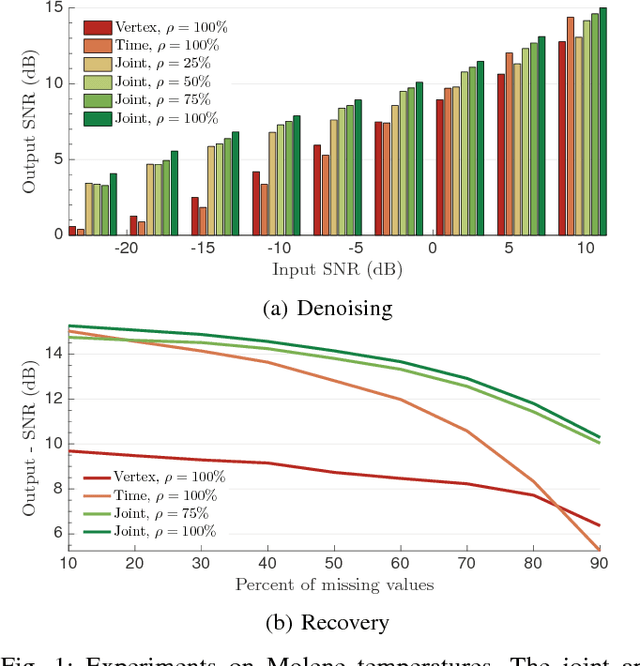
Graph-based methods for signal processing have shown promise for the analysis of data exhibiting irregular structure, such as those found in social, transportation, and sensor networks. Yet, though these systems are often dynamic, state-of-the-art methods for signal processing on graphs ignore the dimension of time, treating successive graph signals independently or taking a global average. To address this shortcoming, this paper considers the statistical analysis of time-varying graph signals. We introduce a novel definition of joint (time-vertex) stationarity, which generalizes the classical definition of time stationarity and the more recent definition appropriate for graphs. Joint stationarity gives rise to a scalable Wiener optimization framework for joint denoising, semi-supervised learning, or more generally inversing a linear operator, that is provably optimal. Experimental results on real weather data demonstrate that taking into account graph and time dimensions jointly can yield significant accuracy improvements in the reconstruction effort.
Frequency Analysis of Temporal Graph Signals
Feb 14, 2016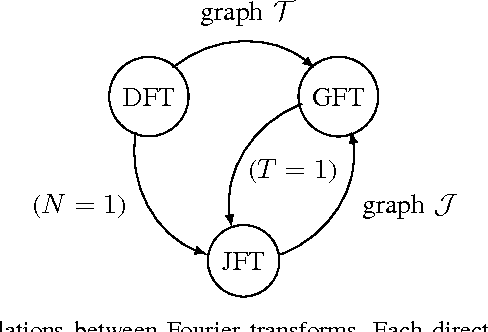


This letter extends the concept of graph-frequency to graph signals that evolve with time. Our goal is to generalize and, in fact, unify the familiar concepts from time- and graph-frequency analysis. To this end, we study a joint temporal and graph Fourier transform (JFT) and demonstrate its attractive properties. We build on our results to create filters which act on the joint (temporal and graph) frequency domain, and show how these can be used to perform interference cancellation. The proposed algorithms are distributed, have linear complexity, and can approximate any desired joint filtering objective.